Introduction
Your best machine operator retires on a Friday. By Monday, the line is down for six hours because nobody else knows the specific sequence he used to reset the extruder after a jam. It's not in the manual. It never was.
This is tribal knowledge in action. Manufacturing runs on thousands of small, unwritten fixes like this one, carried in the heads of a handful of experienced workers rather than stored in any binder or system.
The scale of the risk is real. U.S. manufacturing could need as many as 3.8 million new employees between 2024 and 2033, and roughly 2.8 million of those openings will come from retirements alone, according to The Manufacturing Institute.
This guide breaks down what tribal knowledge actually is, why it's riskier than most plants realize, and how modern capture methods, including AI, can preserve it before it walks out the door.
Key Takeaways
- Tribal knowledge is valuable expertise held by a few workers and rarely documented
- Left uncaptured, it causes inconsistent processes, slower onboarding, and repeat fixes
- Manual methods like interviews and mentorship work, but they're slow and pull workers off the line
- AI-powered wearable tools now capture this knowledge automatically, with zero effort for operators
What Is Tribal Knowledge?
Tribal knowledge is informal information built up by experienced employees over years on the job. It stays undocumented and stuck with the individual (or small group) who holds it, isolated from everyone else in the organization.
Think of it like an oral tradition. The core substance survives as it's passed down, but the retelling shifts slightly each time it moves from one person to the next. One technician's "tap it twice on the left side" becomes another's "give it a firm knock" a few years later. The lesson stays the same, but the details drift with each retelling.
Because it's based on personal experience rather than verified data, tribal knowledge isn't automatically reliable. It can be:
- Accurate - a genuinely effective fix discovered through trial and error
- Flawed - a workaround that happened to work once and got treated as gospel
- Outdated - a solution that worked once but no longer fits how the equipment or process runs today
You'll find the most tribal knowledge in operational, hands-on environments, where expertise is built through repetition rather than classroom training. Machine shops, plant floors, and maintenance departments are prime territory.
Examples of Tribal Knowledge on the Factory Floor
Some of the most common examples show up daily without anyone flagging them as a knowledge risk:
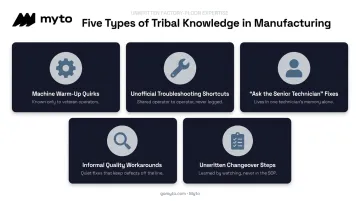
- Undocumented machine quirks, like a press that needs a warm-up cycle before it runs true
- Unofficial troubleshooting shortcuts nobody wrote down because "everyone just knows"
- "Ask the senior technician" fixes for problems the SOP doesn't cover
- Informal quality workarounds used to catch defects before they reach inspection
- Unwritten changeover steps that only the veteran crew remembers in the right order
This isn't unique to manufacturing floors. Sales teams carry unofficial vendor relationship notes. IT departments have that one person who knows the legacy system password nobody documented. Project teams quietly remember why the last rollout failed, even if it's never written into a retrospective.
Tribal Knowledge vs. Explicit and Tacit Knowledge
Understanding where tribal knowledge fits helps explain why it's so hard to manage. Manufacturing knowledge generally falls into three buckets:
| Type | Definition | Example |
|---|---|---|
| Explicit | Documented, verifiable, accessible to anyone | SOPs, safety protocols, official reports |
| Tacit | Experience-based understanding, hard to write down | Knowing how a machine "sounds right" |
| Tribal | Tacit knowledge isolated to specific individuals or shifts | One operator's undocumented fix for a recurring jam |
Chemist and philosopher Michael Polanyi captured the core idea decades ago:
"We can know more than we can tell."
That's tacit knowledge in a sentence, and it explains why so much expertise resists being written down in the first place.
Tribal knowledge is a subset of tacit knowledge, but isolation is what sets it apart, not difficulty of articulation. Tacit knowledge often spreads informally across a whole department, so several people end up carrying the same know-how.
Tribal knowledge stays locked with one person, one shift, or one small crew. Lose that person, and the knowledge disappears with them.
Is Tribal Knowledge Bad? Weighing the Risks and Benefits
Tribal knowledge itself isn't a problem. It's a natural byproduct of experience that builds as workers solve problems in real time. The issue is what happens when nobody captures it.
The risks compound quickly:
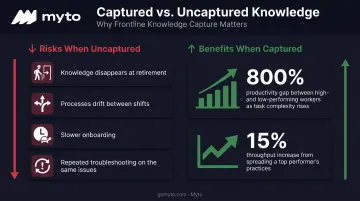
- Knowledge disappears entirely when the employee retires or leaves
- Processes drift between shifts, since each crew runs things slightly differently
- Onboarding slows down, with new hires relying on shadowing instead of clear guidance
- Teams troubleshoot the same recurring issue repeatedly, wasting hours each time
The demographic pressure makes this urgent. Manufacturing's median worker age sits close to 44, and a large share of the current workforce is approaching retirement within the next decade. That timeline aligns with the Manufacturing Institute's projection of millions of retirement-driven openings by 2033.
When captured well, tribal knowledge becomes a real asset. McKinsey found that the productivity gap between high- and low-performing manufacturing workers can grow by up to 800% as task complexity increases. In one aerospace supplier case, identifying a top performer's specific practices and spreading them to other operators produced a 15% throughput increase, according to McKinsey's manufacturing workforce research.
That's the upside: faster decisions and more consistent quality, building a foundation for continuous improvement instead of everyone reinventing the same fix.
How to Capture Tribal Knowledge: Proven Manual Methods
Traditional capture methods still work. They're just slow. Here's the standard sequence most plants follow:
- Identify the gaps. Audit existing documentation and pinpoint the "gatekeepers," meaning the go-to experts for specific machines or problems.
- Interview the experts. Ask targeted questions about shortcuts, exceptions, and recurring issues that never made it into official SOPs.
- Document reality, not the ideal. Capture how work actually gets done, using short formats like checklists, playbooks, and troubleshooting guides rather than dense manuals.
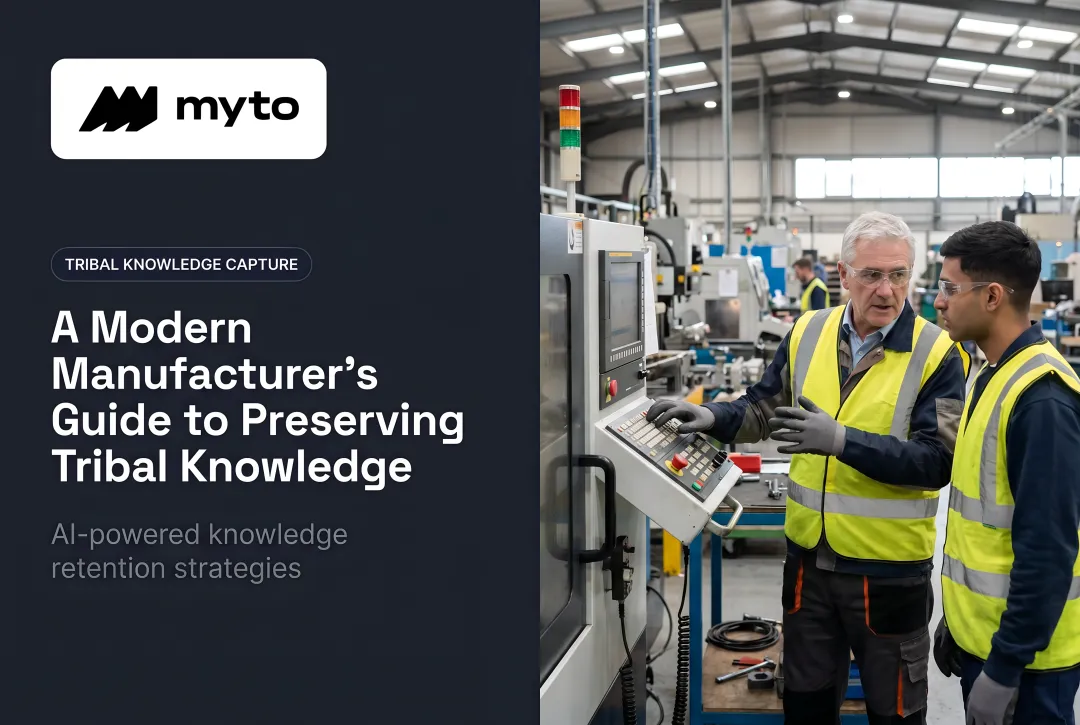
- Build mentorship pairings. Pair veteran workers with new hires for hands-on shadowing, so knowledge transfers through observation, not just documents.
- Assign ownership. Give each document an owner and a review cadence, so it stays accurate as processes change.
This works, but it's rarely fast. IndustryWeek estimates that comprehensive knowledge transfer for complex production expertise can take three to five years, which makes a last-minute exit interview close to useless.
The core limitation is simple:
Every one of these methods requires a worker to stop working in order to document something.
On a busy production floor, that pause rarely happens consistently. Most tribal knowledge stays exactly where it started.
How Myto Captures Tribal Knowledge Automatically on the Production Floor
Manual methods fail for one practical reason: operators are too busy running the line to stop and write things down. Ask a technician to log every troubleshooting step and you'll get compliance for a week, then silence.
This is the exact problem Myto was built to solve.
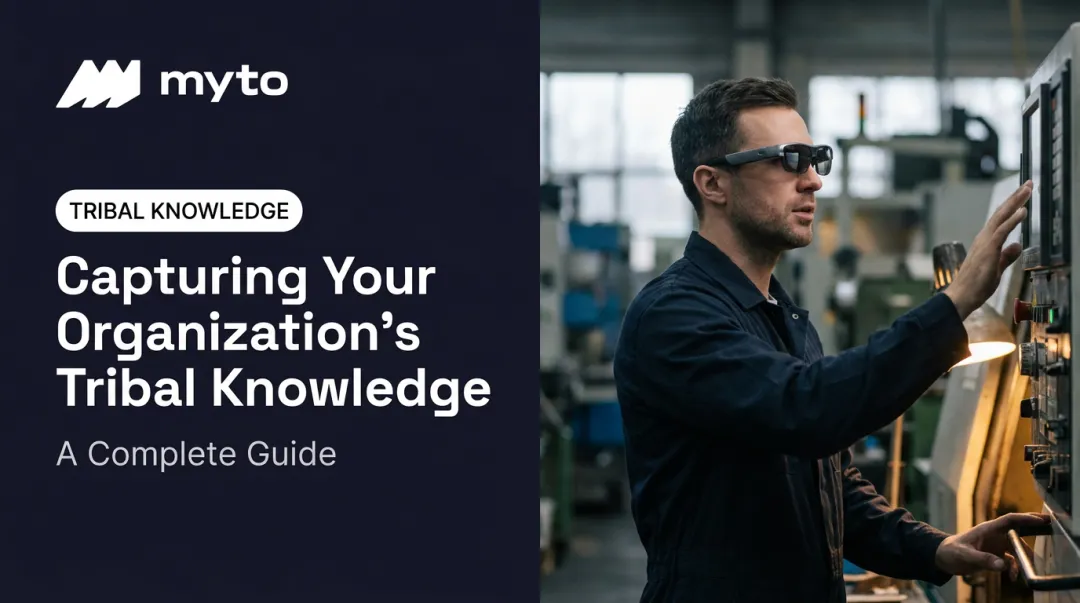
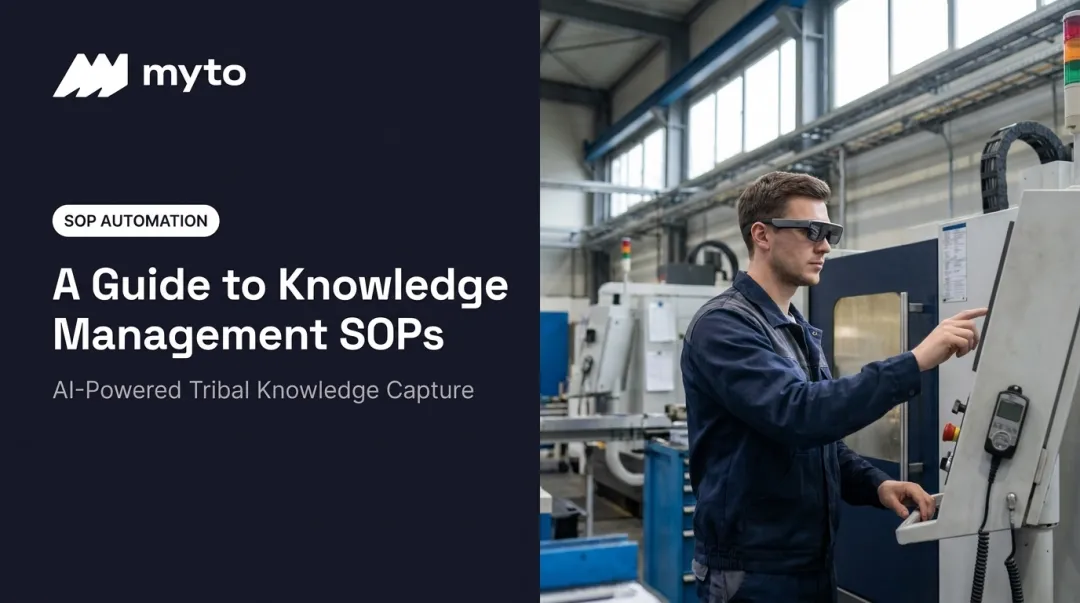
Wearable capture, zero added effort. Myto's AI glasses record physical-world expertise as operators work, hands-free and continuous. There's no button to press, no form to fill out, no clipboard.
An operator diagnosing a spindle vibration or a shift lead managing a downtime event just does the job. The system captures the knowledge as a byproduct of the work itself.
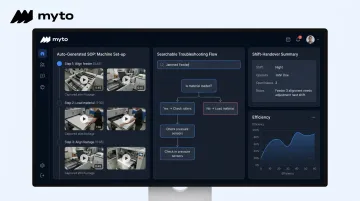
From footage to usable documentation. That captured footage doesn't sit as raw video. Myto structures it, combined with data already pulled from your MES, CMMS, SCADA, and ERP systems, into:
- Audit-ready, version-controlled SOPs (for example, a spindle vibration diagnostics guide with visual aids)
- Searchable troubleshooting flows that surface probable root causes instantly
- Shift-handover documents covering what ran, what broke, and what's still open
- Role-specific training content for new operators
Agentic AI that takes action. Beyond documentation, Myto's agents act on their own:
- Open maintenance tickets automatically when a machine starts acting up
- Surface the right SOP and equipment history the moment a problem appears
- Draft shift-handover notes without anyone typing a word
These agents are trained on your plant's actual operational data, not a generic model, so the guidance reflects your machines and your failure history.
It compounds. Every shift adds more footage, more tickets, more resolved issues. The knowledge layer gets richer and the agents get sharper, without anyone running a special "documentation project."
Setup that doesn't require a new IT department. Myto sits on top of existing systems rather than replacing them, so deployment involves fast setup and minimal IT lift, not a months-long infrastructure overhaul.
Frequently Asked Questions
What is tribe knowledge?
This is typically a variation on "tribal knowledge," referring to undocumented, informal expertise held by a small group of experienced employees rather than being formally recorded anywhere.
Can you still say tribal knowledge?
Yes. It remains the most widely used term in business and manufacturing contexts, though some organizations now prefer "institutional knowledge" for broader inclusivity.
What is another word for tribal knowledge?
Common alternatives include institutional knowledge, tacit knowledge, legacy knowledge, and informal knowledge, each with slightly different nuances depending on context.
Is tribal knowledge the same as tacit knowledge?
They overlap heavily. Tacit knowledge is the broader category of hard-to-articulate, experience-based understanding. Tribal knowledge specifically refers to that expertise being isolated within a small group.
What causes tribal knowledge to form in the first place?
It forms naturally through on-the-job training, mentorship, and repeated experience, especially in plants where formal documentation practices are thin or out of date.
How can manufacturers stop losing tribal knowledge when employees retire?
Combine proactive documentation with modern capture tools, such as Myto's wearable AI glasses, which record expertise passively during normal work so knowledge is preserved before workers walk out the door.