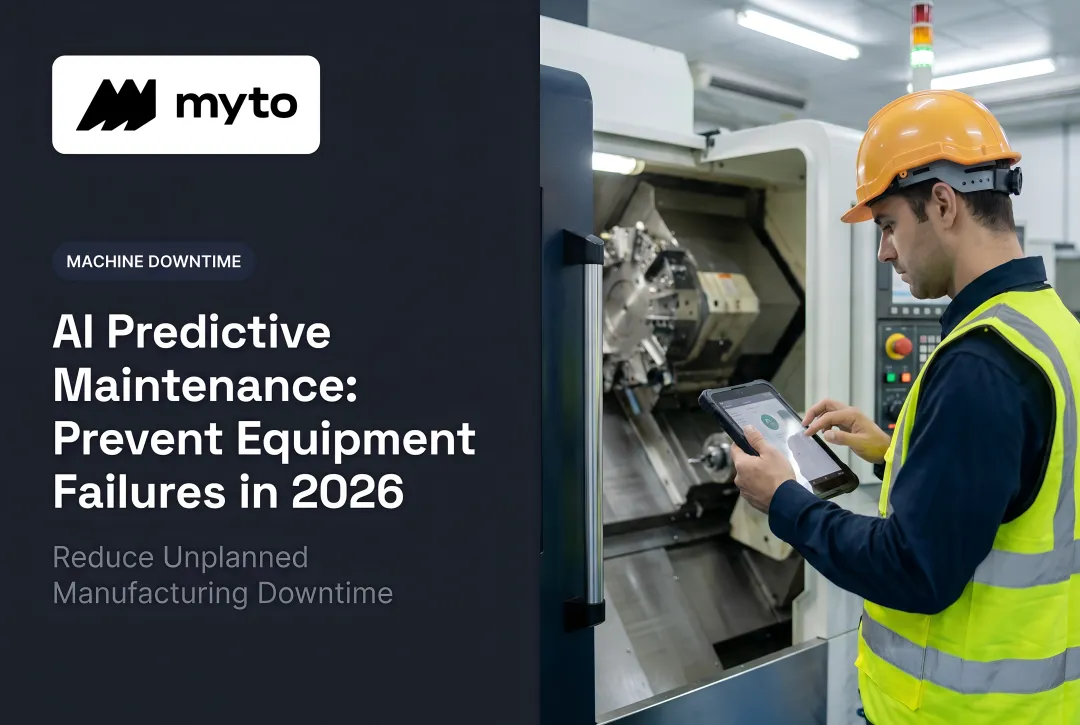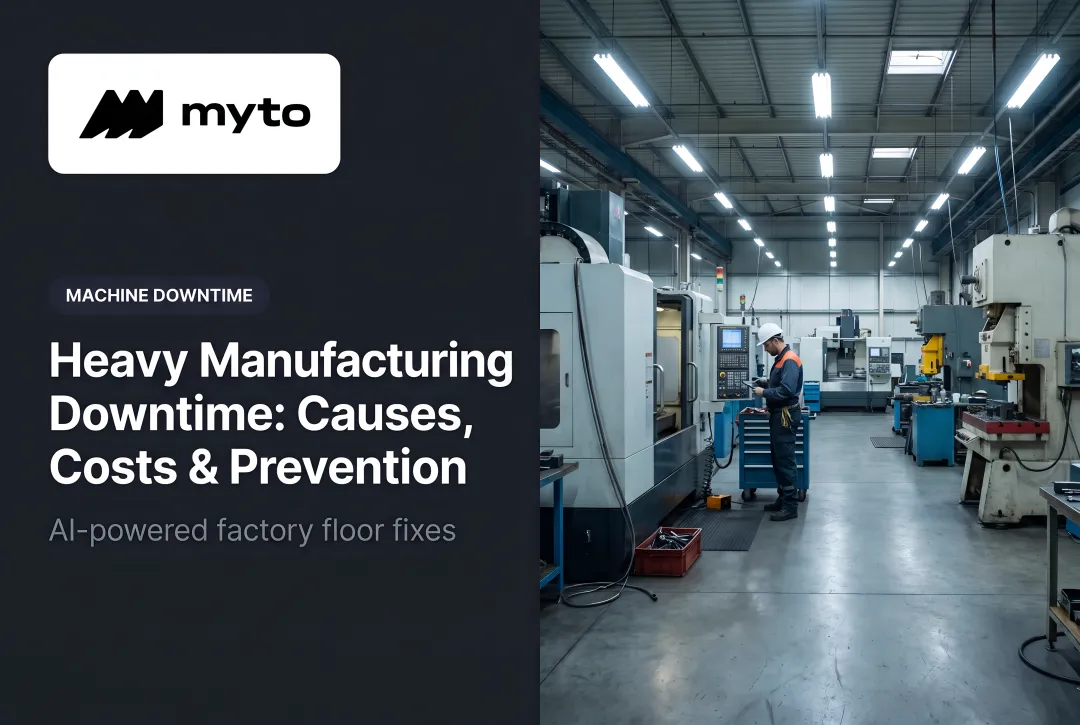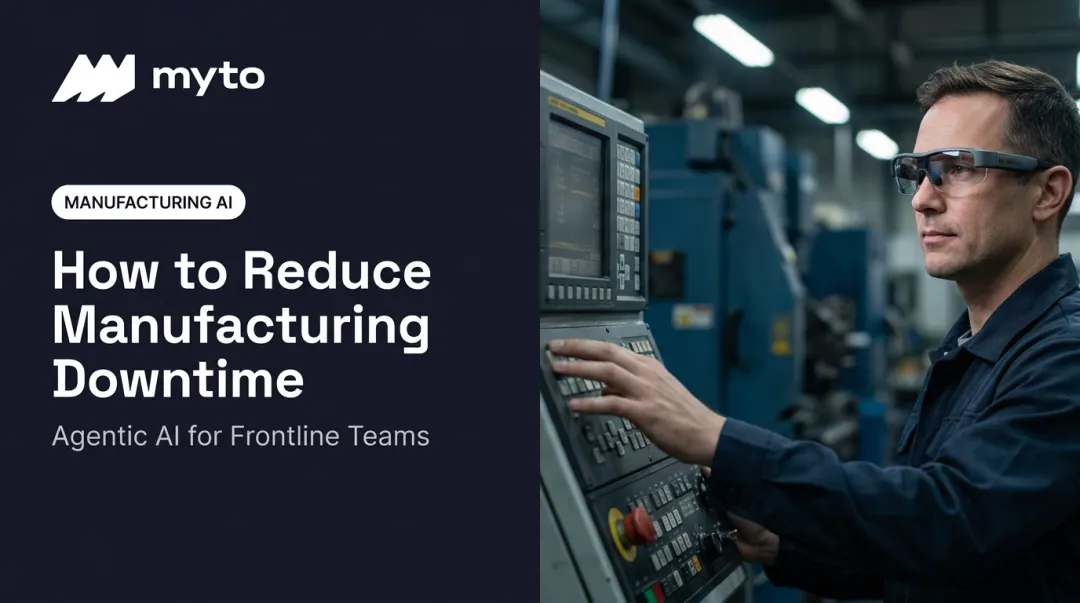
This scene plays out in plants everywhere, and it's expensive. Siemens' 2024 downtime study found that large industrial plants average 25 unplanned downtime incidents and 27 lost production hours every month, with automotive plants losing as much as $2.3 million per hour when the line goes down.
This article breaks down what a breakdown actually is, why they keep happening, the exact steps to handle one, and a root cause most plants never think to address.
Key Takeaways
- Unplanned downtime costs manufacturers anywhere from $36,000 to $2.3 million per hour, depending on the sector.
- Aging equipment and mechanical failure cause most unscheduled downtime industry-wide.
- A structured five-step response (verify, isolate, repair, test, document) cuts recovery time dramatically.
- Undocumented troubleshooting knowledge walking out the door with veteran technicians is the most overlooked cause of slow repairs.
What Is a Machine or Equipment Breakdown?
A machine breakdown is an unplanned stoppage of equipment that was scheduled to be running, and that distinction matters. If a machine sits idle because there's no order to run, that's idle time, not a breakdown. A breakdown happens when the equipment should be producing and can't.
This isn't just semantics: idle time is a scheduling issue, while a breakdown is a reliability failure that triggers an emergency response, pulls technicians off other work, and puts the day's output at risk.
Planned vs. Unplanned Downtime
Not all downtime is created equal.
- Planned downtime covers scheduled maintenance, inspections, and changeovers. It's budgeted and designed to protect long-term uptime.
- Unplanned downtime is the disruptive version. It strikes without warning and forces an emergency response that puts the day's output at risk.
Standards bodies draw this line formally too. ISO 14224 defines downtime purely by whether the triggering event was planned, while the semiconductor industry's SEMI E10 standard treats unscheduled downtime as a distinct "failed" equipment state. The takeaway for plant floors: unplanned downtime deserves its own prevention strategy, not an afterthought.
Common Causes of Machine and Equipment Breakdowns
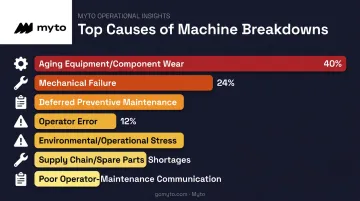
Most breakdowns trace back to a handful of repeat offenders. A 2019 Plant Engineering survey of maintenance professionals found aging equipment responsible for 40% of unscheduled downtime, with mechanical failure at 24% and operator error at 12%.
Here's what tends to drive that breakdown, in order of how often plants actually see it:
- Equipment wear and component failure – Bearings, belts, seals, and motors degrade gradually, then fail suddenly. SKF's failure analysis found poor lubrication accounts for 36% of premature bearing failures.
- Lack of or deferred preventive maintenance – Skipped inspections let small issues, such as a loose fitting or a worn seal, compound into full failures nobody saw coming.
- Operator error and inconsistent training – Incorrect loading, missed steps, unfamiliar SOPs. This gets worse with high frontline turnover and rushed onboarding.
- Environmental and operational stress – Contamination, overheating, vibration, and running equipment past its rated capacity all shorten component life.
- Supply chain and spare parts shortages – A missing gasket or bearing on the shelf turns a two-hour fix into a three-day wait.
- Poor communication between operators and maintenance – The strange noise or odd smell an operator notices often never makes it to the maintenance team before the part fails completely.
That last point deserves attention. Warning signs already exist on the plant floor far more often than teams act on them. The real challenge is getting that information to maintenance before the part fails completely.
The Real Cost of an Equipment Breakdown
Breakdowns cost more than the obvious repair bill. There's a direct hit and a slower-burning one underneath it.
Direct costs show up fast:
- Lost production revenue for every minute the line sits idle
- Idle labor costs from paying operators with nothing to run
- Overtime to claw back the missed schedule
- Expedited shipping charges for parts that should've been on the shelf
ABB's 2023 survey of over 3,000 plant maintenance leaders put the median cost of unplanned downtime at $124,669 per hour. 69% of plants experience at least one unplanned outage a month, and among plants still running run-to-fail maintenance, that jumps to 80%.
Reactive repairs also cost more structurally than planned ones. The Department of Energy's federal operations guide estimates preventive maintenance delivers 12% to 18% in cost savings compared to a purely reactive maintenance program.
Hidden costs are easier to ignore, and more damaging over time:
- Secondary damage cascading to connected equipment
- Shortened asset lifespan from repeated stress and rushed fixes
- Lower crew morale after months of firefighting instead of building
- Increased safety risk when repairs get rushed under production pressure
How to Handle a Machine Breakdown: A Step-by-Step Response
When the line stops, the first ten minutes shape how long the next ten hours look. A structured response beats improvisation every time.
- Verify and diagnose the problem. Talk to the operator first. Ask what they saw, heard, or felt right before the stoppage, then pull equipment logs and status indicators before anyone touches a wrench. Half the diagnostic work happens before a tool comes out.
- Isolate the root cause. Use diagnostic tools, service manuals, and technician experience to narrow down the failure point. Safe shutdown procedures always come first, before any inspection or disassembly begins.
- Execute the repair. Make the fix, or swap in backup or rental equipment to keep production moving. Address the actual root cause here, not a patch that fails again next week under the same conditions.
- Test and verify the fix. Confirm normal operation under real running conditions, not just a quick cycle test. A machine that looks fine idling can still fail under full load.
- Document and follow up. Log the failure, the cause, and exactly what fixed it. This is where most teams drop the ball entirely, leaving the next technician facing the same failure to start from zero.
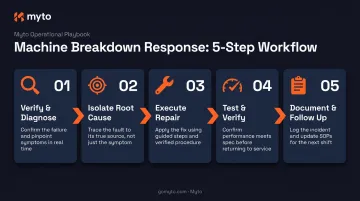
Steps one and five cost the most time, and that's exactly where AI helps most. Tools that surface machine history compress diagnosis, while platforms like Myto turn technician notes into ready-made SOPs automatically.
The Hidden Root Cause Most Teams Miss: Undocumented Knowledge
Here's an uncomfortable truth: many "mysterious" or recurring breakdowns aren't equipment problems at all. They're knowledge problems.
The veteran technician who hears a bearing starting to fail three shifts before it actually seizes has expertise that took years to build. That instinct rarely makes it into a manual, and it definitely doesn't transfer through a five-minute handoff conversation.
When that technician retires or moves on, the knowledge leaves with them, and every new hire relearns the same lessons the hard way.
Traditional documentation methods, including binders, verbally passed tribal knowledge, and disconnected systems, were never built to capture split-second judgment calls. It captures the what of a repair, rarely the how someone knew.
Myto was built to close exactly this gap. Wearable AI glasses record how experienced operators and technicians actually diagnose and fix issues, in the natural flow of work, with zero extra steps added to their day. No stopping to log anything. No pausing to type notes.
That captured footage and audio feeds into an agentic AI layer that structures it into searchable troubleshooting guidance, tied to specific machines and failure modes. The system also pulls in existing SOPs, machine logs, maintenance tickets, and CMMS records, reading them through a manufacturing lens rather than treating them as raw data to migrate.
The practical effect: a spindle starts vibrating at 2 a.m., and the one technician who'd instantly recognize the cause is off shift. The system still surfaces the likely root cause, the relevant SOP, and the equipment history in seconds.
Myto's internal benchmarking points to two costly gaps:
- 60% of unplanned downtime stems from failures the right operator could have caught or diagnosed faster
- 15+ hours of production per week lost per plant waiting on that same expertise gap
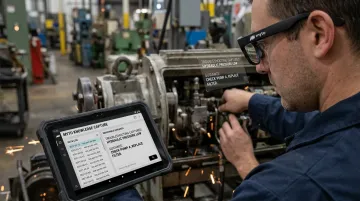
Myto's agents can also coordinate the shift handoff itself, drafting notes, opening tickets, and scheduling follow-up work automatically.
Building a Proactive Strategy to Reduce Future Breakdowns
Fixing breakdowns fast matters. Preventing them matters more. A proactive strategy combines a few concrete pieces:
- Layer preventive and predictive maintenance – Scheduled servicing catches known wear patterns; condition monitoring and sensors catch developing issues before they become stoppages.
- Stock spare parts strategically – Keep high-failure components on the shelf. A missing $40 part shouldn't cause a three-day delay.
- Track history in a CMMS – Equipment history and failure trends reveal which machines need attention before they fail again.
- Train continuously, not once – Onboarding shouldn't be the only training frontline workers get.
- Capture knowledge as it's created – Pairing training with Myto means every troubleshooting win compounds into the knowledge base instead of disappearing when someone clocks out for the last time.
Plants that close the loop between prevention and fast response treat every breakdown as a lesson, making the next fix faster and less costly.
Frequently Asked Questions
What is a machine breakdown?
A machine breakdown is an unplanned stoppage of equipment that was scheduled to be running. It's distinct from idle time (no work available) and planned downtime (scheduled maintenance).
How do you handle a machine breakdown?
Verify the problem with the operator and logs, isolate the root cause safely, execute the repair, test under real load, then document everything. Documentation is the step most teams skip.
What is the difference between planned and unplanned downtime?
Planned downtime is scheduled and controlled, covering maintenance, inspections, and changeovers. Unplanned downtime is sudden and disruptive, triggering emergency response and lost output.
What are the most common causes of equipment breakdowns?
Aging equipment and component wear top the list, followed by mechanical failure, deferred maintenance, and operator error. Poor communication about early warning signs makes all of these worse.
How much does unplanned downtime really cost a manufacturer?
Costs range widely by sector, from roughly $36,000 per hour in FMCG to over $2 million per hour in automotive. The broader industrial median sits around $124,669 per hour, according to ABB's 2023 survey.
How can manufacturers prevent recurring machine breakdowns?
Combine preventive and predictive maintenance with smart spare parts planning. Pair operator training with a knowledge-capture platform so frontline troubleshooting expertise doesn't disappear when people leave.