
Most plants respond by adding sensors and tightening PM schedules. Fewer address a quieter problem: the veteran operator who instinctively knows a machine is about to fail, and what to do about it, isn't always around when the line goes down.
This article covers five strategies that address both sides of the problem, from predictive maintenance to capturing the frontline expertise that too often walks out the door.
Key Takeaways
- Unplanned downtime costs far more than planned downtime, and the gap keeps widening.
- Predictive maintenance alone can cut downtime by 30-50%, based on multiple industry studies.
- MTTR, MTBF, and OEE remain the clearest early-warning signals for reliability teams.
- Captured operator knowledge shortens repair time, even without your best technician on shift.
- Spare-parts readiness and standardized SOPs close gaps predictive tools can't catch alone.
What Is Machine Downtime and Why It Matters
Machine downtime is any period a machine sits idle when it should be producing. That's it. No hidden complexity.
It splits into two categories:
- Planned downtime — scheduled maintenance, changeovers, tooling swaps. You know it's coming.
- Unplanned downtime — breakdowns, missing parts, human error. You don't see it coming, and it's typically far more expensive to resolve.
Why the cost gap? Planned downtime gets scheduled around production needs, with parts and labor lined up in advance. Unplanned downtime hits mid-shift, mid-run, with no prep at all.
Internal data from Myto's manufacturing customers points to a striking pattern: roughly 60% of unplanned downtime stems from equipment failures that the right operator could have caught or diagnosed faster. That knowledge just wasn't accessible in the moment. In other words, a large share of "equipment failure" downtime is really a knowledge-access problem wearing an equipment-failure costume.
That distinction matters. It's the reason the five strategies below don't stop at sensors and schedules.
Strategy 1: Shift From Reactive to Predictive and Proactive Maintenance
Reactive maintenance, running equipment until it breaks, produces the longest and most expensive downtime events. There's no warning, no prep time, and often no spare part on hand. Plants that rely on this model are always playing catch-up.
The alternative is a layered approach that gets progressively smarter:
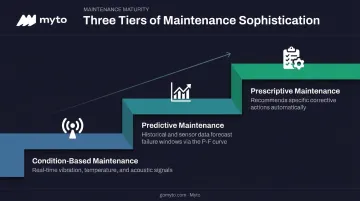
- Condition-based maintenance uses real-time signals, vibration, temperature, acoustic patterns, to flag developing issues before failure. No fixed calendar involved.
- Predictive maintenance goes further, applying historical and sensor data through analytics or machine learning to forecast a failure window. This reflects the P-F curve: the gap between when a problem becomes detectable (P) and when the machine actually fails (F), giving you time to act.
- Prescriptive maintenance takes it one step past prediction, recommending the specific corrective action instead of just flagging risk.
The measured impact
Independent research backs this up with real numbers. McKinsey's analysis of manufacturing analytics found predictive maintenance typically reduces machine downtime by 30-50% and extends machine life by 20-40%. Similar large-scale industrial deployments report comparable reductions in unplanned downtime alongside major maintenance-cost savings.
The catch: predictive tools only catch what sensors are built to catch. A vibration sensor won't tell you the coolant line was rerouted incorrectly last shift, or that a part was reinstalled slightly off-spec. That gap is where the next strategies come in.
Strategy 2: Track the Metrics That Actually Predict Downtime
Sensors flag individual failures. The right metrics reveal patterns before those failures repeat.
Three numbers matter most:
- MTTR (Mean Time to Repair): total repair time divided by number of repairs. A rising MTTR signals slower diagnostics or increasingly complex failures.
- MTBF (Mean Time Between Failures): average operating time between failures. A shrinking MTBF means a machine, or a whole line, is degrading faster than expected.
- OEE (Overall Equipment Effectiveness): Availability × Performance × Quality. Widely cited "world class" OEE sits around 85% (90% availability, 95% performance, 99.9% quality), per OEE.com's benchmarking guidance.
That 85% figure is a reference point, not a universal average — treat it as a target to work toward, not a grade you're failing.
A declining OEE trend often signals downtime risk well before a breakdown actually happens. The problem is that most teams still track these numbers in spreadsheets, updated inconsistently, by whoever remembers to do it.
That approach misses recurring stoppage patterns until they've already cost weeks of production. Automated dashboards that pull directly from machine and maintenance data remove that guesswork, surfacing the same failure signature across shifts or machines before it becomes a habit.
Strategy 3: Capture and Standardize the Tribal Knowledge Walking Out the Door
Here's the piece most downtime strategies skip entirely: a large share of unplanned downtime traces back to missing troubleshooting knowledge, not mechanical failure. The operator who knows the fix is on another shift, retired, or gone, and the right answer simply isn't available at the moment it's needed.
This isn't a small risk. Deloitte and The Manufacturing Institute project that U.S. manufacturing may need up to 3.8 million new employees between 2024 and 2033, with as many as 1.9 million of those jobs going unfilled if workforce challenges aren't addressed.
Every retirement or departure in that window takes years of undocumented know-how with it.
The waiting-for-the-expert problem
Myto's platform data illustrates the pattern directly: plants routinely lose 15+ hours of production waiting for the one senior technician who knows a specific machine. Multiply that across a year, and a single experienced operator leaving can translate into roughly 800 hours of added annual unplanned downtime.
Binders and disconnected wiki pages don't fix this because they document what someone remembered to write down, not what the best operators actually do on the floor.
How Myto closes the gap
Myto's wearable AI glasses capture how the best operators actually work, hands-free, with zero extra steps:
- The glasses record video and audio continuously as a technician diagnoses a problem, no button-pressing or note-taking required.
- Footage syncs automatically to the plant's Myto tenant and gets structured into SOPs, troubleshooting flows, and training content.
- That structured knowledge feeds Myto's agentic AI, which surfaces the relevant SOP, equipment history, and likely root causes the moment a machine acts up again.
The agentic layer doesn't stop at surfacing information. It drafts shift-handover notes and opens maintenance tickets on its own, then logs the troubleshooting path a technician took along the way. That means the next person, even a newer hire at 2 a.m. on a Saturday, has that same diagnostic sequence available.
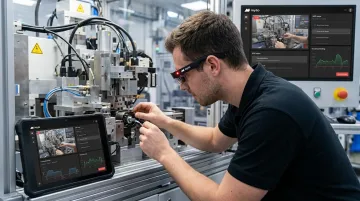
The compounding effect is the real payoff. Every shift captured adds to the knowledge base, so a less experienced operator can work through a problem almost as fast as the veteran who used to be the only person who could fix it. That directly shortens MTTR, shift after shift.
Strategy 4: Optimize Spare Parts and Inventory Readiness
A repair that should take 20 minutes can turn into a two-day shutdown the moment someone can't locate the right part, or grabs the wrong one. Maintenance research consistently identifies "waiting for parts" as classic non-wrench time, meaning the technician is idle instead of fixing anything, per Reliabilityweb's maintenance execution analysis.
Fixing this starts at the part level, not the asset level.
Criticality scoring by individual spare part helps avoid two expensive mistakes:
- Stocking out on a part that's genuinely essential to keep a critical line running
- Overstocking low-impact parts that tie up capital without reducing real risk
The other lever is data alignment. Linking each asset's bill of materials (BOM) to its work order history lets teams forecast part demand by plant location, based on actual failure patterns rather than guesswork.
When BOM data connects cleanly to maintenance records, the right part is identified and located before the technician even reaches the machine. Myto's Operational Data Integration layer pulls this same work order and machine history data alongside floor-level context, keeping the connection current.
Strategy 5: Standardize Procedures, Training, and Root Cause Analysis
Inconsistent SOPs, or ones that exist only in a supervisor's head, create variability between shifts and technicians. That variability shows up as downtime. ARC Advisory Group's process-industry research found that much unplanned downtime clusters around transitional states like startups and grade changes, which are exactly the moments where procedure clarity matters most.
A simple "ready to work" check before repair work begins prevents mid-job delays:
- Materials confirmed on hand
- Manpower assigned and briefed
- Method (the SOP or procedure) verified as current
- Machine access cleared and locked out safely
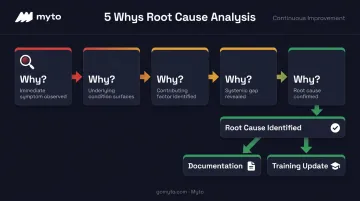
Once the repair is done, the work isn't over. Structured root cause analysis, using established methods like the 5 Whys or a fishbone diagram, prevents the same failure from resurfacing next quarter. RCA only pays off if the findings get tied back into training and documentation. Otherwise you've diagnosed the problem and changed nothing.
This is also where capturing frontline expertise pays a second dividend. Wearable AI capture tools, like Myto's AI glasses, record these root-cause walks hands-free and turn them into reusable documentation for reliability engineering and continuous-improvement programs. Now the RCA isn't just a one-time fix for one machine on one bad Tuesday.
Frequently Asked Questions
What does downtime mean?
Downtime is any period a machine or production line isn't running, whether that's scheduled maintenance or an unexpected breakdown. Both planned and unplanned downtime count, but they carry very different costs.
How to reduce downtime in maintenance?
A combination of predictive maintenance, tracking MTTR/MTBF/OEE, spare-parts readiness, and capturing frontline troubleshooting knowledge reduces both how often downtime happens and how long each event lasts. No single tactic covers every failure mode on its own.
What is the difference between planned and unplanned downtime?
Planned downtime is scheduled in advance, think maintenance windows or changeovers. Unplanned downtime hits without warning and is typically far more expensive because there's no time to prepare parts, labor, or a production workaround.
How is the cost of machine downtime calculated?
It's based on lost production output, labor costs during the stoppage, and repair or replacement expenses. The exact formula varies by industry and how critical the affected asset is to overall output.
Which metrics best predict upcoming machine downtime?
MTTR, MTBF, and OEE are the primary early-warning indicators. A rising MTTR, shrinking MTBF, or declining OEE trend usually signals reliability risk before an actual breakdown occurs.
How does capturing tribal knowledge help reduce machine downtime?
When troubleshooting expertise is captured and searchable, like with Myto's wearable AI capture and agentic AI, any operator can resolve an issue without waiting for one specific expert. That directly shortens repair time and MTTR.