The stakes are real. A large automotive plant now loses $2.3 million per hour of downtime, according to Siemens' 2024 True Cost of Downtime analysis, roughly double the 2019 figure.
This guide breaks down what machine condition monitoring actually is, the five elements every program needs, the main techniques in use today, how to implement one, and why sensor data alone rarely fixes the maintenance problem.
Key Takeaways
- Early detection lets teams plan repairs instead of reacting to failures
- Predictive maintenance costs about half of reactive maintenance per horsepower
- A program needs five elements: acquisition, transmission, storage, analysis, and response
- Vibration, thermography, oil analysis, and ultrasound each catch different failure modes
- Sensor alerts create value only when paired with human expertise to act on them
What Is Machine Condition Monitoring?
Machine condition monitoring is the systematic measurement and analysis of physical parameters on operating equipment, including vibration, temperature, oil condition, and electrical signals, to detect developing faults before they cause failure. Instead of guessing when a bearing might fail, you measure the signs it's already failing.
The Detection-to-Failure Window
Reliability engineers call this the P-F interval: the gap between when a fault first becomes detectable and when it causes functional failure. The wider that window, the more time your team has to diagnose the problem, order parts, and schedule the fix on your terms rather than the machine's.
Detect a fault early and you might have weeks. Miss it, and you're staring at an unplanned shutdown.
Condition Monitoring vs. Basic Machine Monitoring
These terms get used interchangeably, but they're not the same thing. Machine monitoring tracks simple status: running, stopped, producing, idle. Condition monitoring diagnoses underlying health: is this pump degrading, and why.
One tells you a machine is off. The other tells you it's about to be.
Where It Sits on the Maintenance Maturity Spectrum
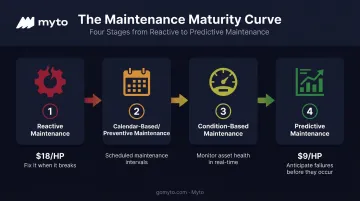
Most facilities move through four stages:
- Reactive maintenance: fix it when it breaks
- Calendar-based/preventive maintenance: service on a fixed schedule
- Condition-based maintenance: act when data shows a problem
- Predictive maintenance: forecast failure timing using trended data
The economics back up the progression. A U.S. Department of Energy operations and maintenance benchmark estimates annual maintenance costs of roughly $18 per horsepower for reactive maintenance, compared to $9 per horsepower for predictive maintenance, about half the cost with far fewer surprises.
Why Machine Condition Monitoring Matters
Condition monitoring pays off in ways that show up on both the maintenance budget and the production line:
- Fewer unplanned shutdowns: faults get caught while there's still time to plan
- Longer equipment life: components get replaced based on actual wear, not a guess
- Lower maintenance spend: no more servicing healthy machines on a fixed schedule
- Better product quality: degrading equipment often produces defects before it fails outright
- Higher OEE: less downtime and fewer quality losses directly lift overall equipment effectiveness
The real value is eliminating waste at both extremes. Calendar-based maintenance often replaces parts too early, wasting labor and inventory. Reactive maintenance replaces them too late, after they've already taken down the line. Condition monitoring replaces parts exactly when they need it.
Real-world proof: Condition monitoring's payoff shows up in hard numbers across industries:
| Facility | Monitoring Approach | Result |
|---|---|---|
| Houston gas-processing plant | Six accelerometers and a phase probe on oxygen compressors | Averted an estimated $2 million in production losses, per an Emerson case study |
| Steel rolling mill | Online vibration and temperature monitoring after tracing a recurring gearbox-bearing fault | Mean time between failures grew from three months to over a year, per the plant's reliability team |
These aren't outliers. They're what happens when maintenance decisions run on data instead of guesswork.
The 5 Key Elements of Condition Monitoring
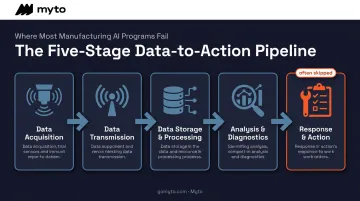
Most condition monitoring programs rest on five foundational elements. Skip one, and the whole system underperforms.
- Data acquisition: sensors capturing vibration, temperature, oil condition, or electrical signals from the machine
- Data transmission: getting that data from the sensor to a central platform or dashboard, wired or wireless
- Data storage and processing: housing the readings somewhere accessible and organized for trending
- Analysis and diagnostics: comparing readings against baselines and thresholds to flag deviations
- Response and action: turning flagged deviations into actual maintenance work orders
Here's the part most programs get wrong: element five gets skipped or delayed. Companies invest heavily in sensors and dashboards, generate mountains of data, and then the alerts sit in an inbox. No action, no reliability improvement. Just a more expensive way to watch equipment fail.
This is the gap agentic AI is built to close. Platforms like Myto push flagged deviations straight into a work order or a technician's queue instead of letting them sit unread.
A North American power utility documented all five stages in one workflow. Wireless vibration monitors covered motors and pumps, a self-organizing mesh network handled transmission, and centralized software managed storage. Spectrum analysis drove diagnostics, and site personnel received fault findings and recommended corrective actions.
That last step mattered most. Replacing an earlier, unreliable transmission system freed up roughly 20 labor hours per week that had been spent just keeping sensors online. Those hours went back into actual analysis and repair work.
Types of Machine Condition Monitoring Techniques
Not every machine needs the same monitoring approach. The right technique depends on the failure mode you're trying to catch and how much continuous visibility you actually need.
The Three Core Monitoring Methods
These three approaches trade cost against blind-spot risk:
- Manual/offline monitoring: technicians walk the floor with handheld data collectors, taking readings at scheduled intervals. Lower cost, but gaps exist between checks.
- Sensor-based/online monitoring: permanently installed sensors or PLC-connected devices stream continuous, real-time data. Higher upfront cost, no blind spots.
- IoT-enabled/remote monitoring: cloud platforms aggregate sensor data across multiple sites, giving remote teams visibility and automated alerts without a technician on-site.
Most facilities combine methods, using manual checks on lower-priority equipment and continuous sensors on critical assets.
Common Parameters and Diagnostic Techniques
Four techniques cover most rotating and electrical equipment:
- Vibration analysis picks up imbalance, misalignment, looseness, and bearing wear through characteristic frequency signatures
- Temperature monitoring and thermography flag lubrication failure, overloading, and electrical faults, often before they escalate to outages
- Oil analysis detects wear particles, contamination, and lubricant breakdown, particularly valuable in enclosed gearboxes and hydraulics
- Ultrasonic testing and motor current signature analysis (MCSA) catch early bearing defects, leaks, arcing, and motor winding faults, often non-invasively
The table below summarizes what each technique catches and where it fits best:
| Technique | Detects | Detection Stage | Best-Fit Equipment |
|---|---|---|---|
| Vibration | Imbalance, misalignment, bearing defects | Early (with acceleration enveloping) to late | Motors, pumps, fans, turbines, compressors |
| Thermography | Loose electrical connections, hot bearings, overloading | Early symptom before outage | Energized panels, motors, gearboxes |
| Oil analysis | Wear metals, contamination, lubricant degradation | Early warning | Engines, gearboxes, hydraulics |
| Ultrasound/MCSA | Leaks, bearing friction, arcing, rotor bar and winding faults | Early | Compressed air systems, energized AC motors |
No single technique catches everything. Most mature programs layer two or three, matched to the failure modes that matter most on each asset.
How to Implement a Machine Condition Monitoring Program
Rolling out condition monitoring works best as a staged process, not a one-time sensor installation.
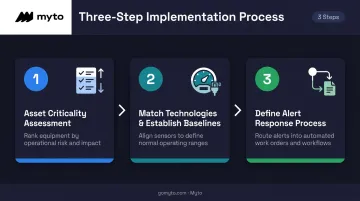
- Run an asset criticality assessment. Rank machines by production impact, safety consequence, and repair cost. Not every asset deserves a $10,000 sensor package. Focus first on the equipment that would hurt most if it failed.
- Match technologies to failure modes, then establish baselines. Deploy sensors, record healthy baseline readings, and set alert thresholds around those baselines.
- Define a clear alert response process. Connect monitoring data directly to work orders in your CMMS. This is the step most programs skip, and it determines whether monitoring reduces downtime or just generates dashboards nobody acts on. Myto's AI troubleshooting and knowledge capture can speed this step, turning technician expertise into team-wide guidance.
Common failure modes map to specific monitoring technologies:
| Failure Mode | Best-Suited Monitoring |
|---|---|
| Bearing wear, misalignment | Vibration analysis |
| Overheating, loose connections | Thermography |
| Lubricant degradation, contamination | Oil analysis |
| Motor winding faults | Electrical monitoring |
ISO 17359 offers general guidance for structuring these programs, and ISO 55001 ties the decisions back to cost, risk, and performance. Both are worth reviewing before you scale past a pilot group of critical assets.
Closing the Loop: Why Sensor Data Alone Isn't Enough
Here's the uncomfortable truth about condition monitoring: even the best sensor system in the world only generates an alert. It doesn't diagnose root cause, and it doesn't fix the machine. That still takes a human who knows what the alert means and how to respond to it.
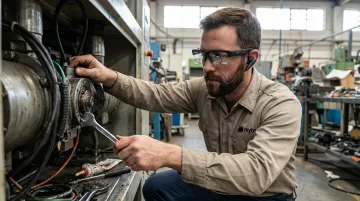
This is where most programs stall. Vibration analysis flags a bearing fault, and now what? On day shift, your senior technician glances at the trend and knows exactly what's wrong because they've fixed this exact pump a dozen times.
At 2 a.m. on a Saturday, that same alert lands in front of a less-experienced tech who has no idea where to start.
That gap is the tribal knowledge problem. The know-how for interpreting a specific alert signature and fixing a specific machine often lives in one or two veterans' heads. When they retire or move on, that knowledge walks out the door with them, and the sensor data that flagged the fault becomes a lot less useful.
This is the exact gap Myto was built to close. Instead of asking technicians to stop and write down what they did, Myto's wearable AI glasses capture the troubleshooting process hands-free, in the natural flow of work:
- Captures video and audio of the actual diagnostic steps as they happen
- Records the physical maneuvers a senior tech uses to isolate a fault
- Preserves sensory cues that rarely make it into a manual, like how an experienced operator hears a bearing about to fail
Myto's agentic AI then structures that captured footage into searchable SOPs, troubleshooting flows, and training content, tied to the specific machine and failure mode. It also ingests existing machine history, maintenance tickets, and logs. So when a vibration alert flags a spindle issue, the system can surface the relevant SOP, prior repair history, and likely root causes in one place.
The result is a loop that compounds. Structured machine data tells you something is wrong, and captured human expertise tells the next technician exactly how to fix it, without needing to track down whoever handled it last time.
Frequently Asked Questions
What is machine condition monitoring?
It's the systematic measurement and analysis of physical parameters, such as vibration, temperature, oil condition, and electrical signals, on operating equipment. The goal is catching developing faults before they cause functional failure.
What are the 5 elements of condition monitoring?
Data acquisition, data transmission, data storage and processing, analysis and diagnostics, and response and action. Most programs handle the first four well but fall short on the fifth.
What are the three types of equipment monitoring?
Manual/offline monitoring relies on handheld tools at scheduled intervals. Sensor-based/online monitoring instead uses permanently installed devices for continuous data collection. IoT-enabled/remote monitoring takes it further, aggregating multi-site sensor data through the cloud.
What's the difference between condition monitoring and condition-based maintenance?
Condition monitoring is the practice of collecting and observing data to measure machine state. Condition-based maintenance is the strategy that acts on that data, deciding when and how to intervene.
How often should machine condition monitoring be performed?
It depends on asset criticality and how fast faults typically progress. Continuous online monitoring suits critical, fast-failing equipment, while periodic manual checks work fine for lower-risk assets.
What industries benefit most from condition monitoring?
Manufacturing, automotive, oil and gas, and any operation with rotating equipment and high downtime costs. Facilities running 24/7 with expensive unplanned outages see the fastest payback.