Introduction
Walk into any large company and ask where the "real" knowledge lives. You'll get pointed to a wiki, a shared drive, maybe a CRM.
But the answer that actually matters is usually a person — the maintenance tech who's been there 22 years, the account manager who remembers why a client left in 2019.
That knowledge is invisible until someone needs it urgently.
As organizations scale, this sprawl creates real damage: repeated mistakes, slow onboarding, and a quiet drain of expertise every time a veteran employee walks out the door.
Employees already spend nearly 20% of their workweek just searching for internal information or the right colleague to ask, according to McKinsey research on the social economy.
This guide defines enterprise knowledge management, breaks down its core pieces, and explains why capturing tacit, frontline expertise (not just documents) is the next frontier.
Key Takeaways
- Enterprise knowledge management (EKM) captures, organizes, and activates knowledge across every department
- A complete EKM system blends repositories, search, AI, governance, and expertise discovery — never just one tool
- Tacit, undocumented knowledge is hardest to capture, yet employees rely on it most
- Workers lose nearly 20% of their workweek searching for information without a connected system
What Is Enterprise Knowledge Management?
Enterprise knowledge management is the systematic process of capturing, organizing, sharing, and applying an organization's collective knowledge to improve decision-making and performance. That's the textbook definition. In practice, it means building a nervous system for an organization's know-how.
Scale Is What Separates EKM From Everyday Knowledge Sharing
Small teams share knowledge naturally: someone asks a question in a group chat, and it gets answered. Enterprises can't rely on that. They're coordinating knowledge across:
- Multiple departments with their own tools and terminology
- Different physical locations and time zones
- Disconnected systems that were never designed to talk to each other
At that scale, informal knowledge sharing breaks down. You need structure, ownership, and a system that doesn't depend on everyone knowing everyone.
Explicit Knowledge vs. Tacit Knowledge
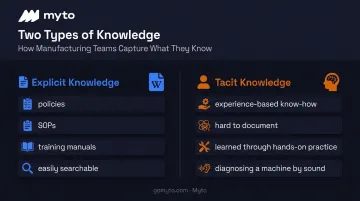
EKM has to account for two very different kinds of knowledge. Explicit knowledge covers documented policies, SOPs, wikis, and training manuals: information that's already written down and easy to search. Tacit knowledge is know-how gained through experience, like knowing a machine is about to fail from the sound it makes.
Management researcher Ikujiro Nonaka drew this distinction in his 1991 Harvard Business Review article on knowledge creation, noting that tacit knowledge is personal and context-specific, making it genuinely difficult to formalize into words.
Most EKM tools are built almost entirely for the explicit side. That's a problem, because the tacit side is where a lot of the real expertise lives. Platforms like Myto are built specifically to close that gap, capturing know-how directly from the floor instead of waiting for someone to write it down.
The core goal of EKM, stated simply, is getting the right knowledge to the right person (or increasingly, the right AI system) at the right time. Everything else is implementation detail.
Why Enterprise Knowledge Management Matters
Poor knowledge management isn't a minor inconvenience. It shows up directly in the numbers.
APQC found that knowledge workers spend an average of 8.2 hours per week looking for, recreating, or duplicating information that already exists somewhere in the organization, according to APQC's research on knowledge worker productivity. That's more than a full workday, every single week, spent reinventing wheels.
Where the Damage Actually Shows Up
- Knowledge silos and redundant work: When departments can't see what other teams already learned, they solve the same problems repeatedly, wasting time and morale.
- Knowledge loss when people leave: Every retirement, resignation, or transfer takes tacit expertise with it, especially in roles built on hands-on skill rather than documented procedure.
- Slow onboarding: Without a knowledge layer, new hires learn through word-of-mouth and shadowing, a method that doesn't scale past a handful of people.
- Weaker AI performance: AI assistants and copilots are only as good as the knowledge they're grounded in. Feed them scattered, outdated, or ungoverned information, and they'll confidently generate wrong answers.
The financial toll of this is hard to pin to one universal number — it depends heavily on industry and headcount. But the pattern is consistent everywhere: unmanaged knowledge steadily drains productivity, morale, and decision quality until someone finally measures it.
What Are the Core Components of an Enterprise Knowledge Management System?
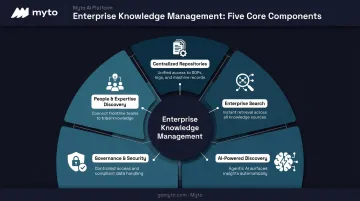
A complete EKM system isn't one tool sitting on a shelf. It's an ecosystem of connected capabilities, and skipping any one of them leaves a gap.
Centralized Knowledge Repositories
Wikis, knowledge bases, and document systems act as the single source of truth for policies, guides, and reference material. Everyone knows where to look for the official version of a procedure.
Their limitation is real, though: repositories only hold what someone bothered to write down. They can't capture real-time context, and they go stale the moment nobody updates them.
Enterprise Search and AI-Powered Discovery
Search unifies scattered information across chat, CRM, ticketing systems, and file storage into one interface, eliminating the need to check five different tools for one answer.
AI layers push this further. Rather than returning a list of documents that might contain an answer, AI-powered discovery synthesizes an actual answer, summarizes long documents, and surfaces relevant context automatically. That's the difference between search and discovery.
Knowledge Governance and Security
Not everything should be visible to everyone. Permission-aware access keeps sensitive information protected while still making it discoverable to the people who genuinely need it.
Governance (audit logs, role-based access, retention policies) is also what keeps AI-generated answers trustworthy. Without it, you can't verify why an AI gave a certain answer or whether it pulled from an outdated or restricted source.
People and Expertise Discovery
Not all valuable knowledge is written down. Some of it lives only in the experience of a handful of employees or operators.
Connecting people to knowledge, helping teams quickly find the right subject matter expert, reduces bottlenecks and preserves institutional memory that would otherwise disappear with one resignation letter. Myto's wearable AI glasses capture this tribal knowledge directly from the floor, turning it into searchable, shareable answers before it walks out the door.
Enterprise Knowledge Management in Manufacturing: The Tacit Knowledge Blind Spot
Here's the uncomfortable truth about most EKM software: it was designed for office work. Wikis, ticketing systems, and document repositories handle knowledge that lives in text. They don't handle the hands-on, physical expertise that keeps a production line running.
That gap matters given the scale of what's at stake. Manufacturing value added hit roughly $3.0 trillion at an annual rate in Q1 2026, equal to about 9.4% of total U.S. value-added output, according to NAM's manufacturing facts data. That's a massive share of the economy running on knowledge that mostly never gets written down.
Why Frontline Expertise Falls Through the Cracks
Traditional KM tools require manual documentation. Frontline workers don't have time for that, and honestly, most weren't hired to be documentation specialists. So the knowledge defaults to:
- Outdated binders that describe how machines worked years ago
- Tribal knowledge passed operator-to-operator, unevenly and incompletely
- Disconnected systems (MES, CMMS, SCADA, ERP) that never talk to each other
Manufacturers are also facing a wave of retirements over the next several years, according to Deloitte and The Manufacturing Institute's workforce research. As a result, decades of undocumented troubleshooting knowledge are walking out the door with each departure.
A Different Approach: Capturing Knowledge Without Adding Work
This is the specific gap Myto was built to close. Instead of asking operators to document what they know, Myto's AI-enabled wearable glasses passively capture how operators actually troubleshoot and work — the diagnostic steps, the shift-handoff conversations, the muscle-memory fixes that never make it into a manual.
That captured expertise feeds into agentic AI that can:
- Auto-generate audit-ready SOPs based on how work actually happens today
- Draft structured shift-handover notes instead of illegible handwritten ones
- Surface relevant SOPs, machine history, and diagnostic guidance the moment a technician needs it
- Open tickets and schedule maintenance follow-ups without manual input
The result is knowledge capture built into the natural flow of work, with no new screens for operators to manage, feeding a system that gets smarter every shift.
Best Practices for Implementing Enterprise Knowledge Management
Getting EKM right isn't about buying the most feature-rich platform. A few principles separate programs that stick from ones that quietly die after six months.
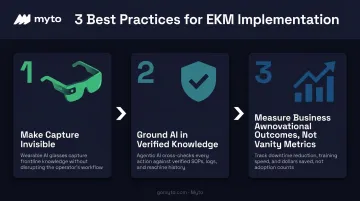
Make capture invisible. Passive capture from natural workflows outperforms initiatives that ask employees to manually log or tag information. Wearable AI glasses, like the ones from Myto, let operators capture procedures hands-free while they work. If it requires extra steps, adoption drops fast — especially on the factory floor.
Ground AI in verified knowledge. AI tools are only as trustworthy as the knowledge behind them. Feed automated answers with governed, current information, or you'll erode trust the first time an AI confidently gets something wrong.
Measure business outcomes, not vanity metrics. Skip the document-count dashboards and track time saved searching, reduced downtime, faster onboarding, and repeat-error rates instead. Those numbers connect directly to the bottom line.
Frequently Asked Questions
What is the difference between enterprise knowledge management and a knowledge base?
A knowledge base is a repository for storing content. EKM is the broader strategy that connects that content, plus the tacit knowledge that isn't written down, to the workflows, people, and systems that actually need it.
What are the main components of an enterprise knowledge management system?
Five components: centralized repositories, enterprise search, AI-powered discovery, governance and security, and people/expertise discovery. Skipping any one leaves a real gap.
How does AI improve enterprise knowledge management?
AI moves EKM from keyword search to answer-based discovery, synthesizing information and surfacing context automatically. But it only performs well when grounded in structured, governed knowledge.
What is tacit knowledge and why is it hard to capture?
Tacit knowledge is experience-based know-how that's rarely documented, like a technician diagnosing a problem by sound. It's hard to capture because traditional systems require manual effort that frontline and technical workers rarely have time for.
How do you measure the ROI of enterprise knowledge management?
Look at reduced search time, faster onboarding, lower repeat-error rates, and reduced downtime or ticket volume. These practical indicators matter far more than counting documents in a repository.
Who owns enterprise knowledge management within an organization?
EKM is typically a shared responsibility across IT, operations, and business unit leaders. Executive sponsorship matters most, since driving adoption and governance across departments rarely happens without it.