Introduction
Walk onto most manufacturing floors and ask ten people to define "SOP" versus "work instruction." You'll likely get ten different answers.
That confusion isn't harmless. It shows up as slower training, inconsistent quality checks, and operators hunting for the right document mid-shift while a machine sits idle.
Getting this distinction right affects training speed, error rates, and how smoothly you pass a compliance audit. Manufacturing isn't a niche concern, either.
The sector contributed $3.0 trillion at an annual rate to the U.S. economy in Q1 2026, with real value added equal to 9.4% of GDP (NAM).
Yet many plants still run on binders and institutional memory. That's a growing risk.
Deloitte and the Manufacturing Institute project 2.8 million manufacturing job openings tied to retirements between 2024 and 2033 (The Manufacturing Institute).
When experienced workers leave without documented knowledge, the gap between SOPs and work instructions turns into a real operational risk.
This article breaks down what separates the two, when to use each, and how to keep both current without piling paperwork onto your team.
Key Takeaways
- SOPs are high-level, process-wide documents; work instructions are detailed, task-specific guides
- Work instructions answer "how"; SOPs answer "what and why"
- Both support compliance frameworks like ISO 9001 and OSHA while reinforcing day-to-day consistency
- The right document depends on task complexity, audience, and how often the process changes
- Leading manufacturers now auto-generate both directly from real frontline work
SOP vs Work Instruction: Quick Comparison
Before going deeper, here's how the two stack up side by side:
| Category | SOP | Work Instruction |
|---|---|---|
| Purpose | Defines the overall process, policy, and compliance framework | Details the exact steps for one specific task |
| Level of detail | Broad, high-level overview | Granular, step-by-step, often visual |
| Audience | Managers, supervisors, cross-functional teams | Frontline operators performing the task |
| Update frequency | More rigid, tied to compliance cycles | Updated often as tools or tasks change |
| Format | Text-based policy documents, flowcharts | Checklists, photos, videos, digital guides |
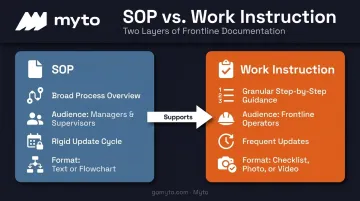
Think of the SOP as the rulebook and the work instruction as the play-by-play for one specific move inside that rulebook.
What Is an SOP?
A standard operating procedure is a formal, written document outlining how to complete a routine, repeatable process from start to finish. It's the document quality managers and compliance teams point to when someone asks, "What's our official process for this?"
In a manufacturing plant, a solid SOP:
- Reduces variability between shifts by giving every team the same baseline process
- Speeds up onboarding since new hires reference one authoritative document, not tribal memory
- Keeps you audit-ready for standards like ISO 9001 or OSHA's Process Safety Management rule
Common SOP Formats
SOP formats aren't one-size-fits-all. Most take one of three shapes, and hybrid versions are common too:
- Checklist-style: a straightforward sequence of boxes to tick off, best for simple, linear tasks
- Hierarchical — steps broken into sub-steps, suited to more complex procedures with several stages
- Flowchart-based (visual decision trees), useful when a process branches depending on conditions
Use Cases of SOPs
SOPs govern process-level decisions across a plant, including:
- Quality control checkpoints and non-conformance handling
- Equipment calibration schedules
- Shift-change protocols and handover requirements
They dominate in regulated industries where the process itself is the compliance target: automotive assembly frameworks, pharmaceutical batch-record procedures required under FDA drug manufacturing rules, and food safety protocols built around HACCP principles.
Here's a real example of what happens when SOPs are missing. A foam manufacturer faced recurring quality and productivity problems tied to labor shortages and language barriers on its production line.
Working with a Manufacturing Extension Partnership advisor, the plant built formal SOPs and translated work instructions to retrain its machine operators, resolving quality issues that had persisted for months. Documentation didn't just check a compliance box. It fixed a production problem.
What Is a Work Instruction?
A work instruction is a highly detailed, task-specific guide covering the exact steps, tools, and conditions for one operation. Where an SOP tells you what the process is and why it exists, a work instruction tells an operator exactly how to do the task in front of them right now.
Frontline workers depend on work instructions more than SOPs for a simple reason: they're in the middle of a task, not reviewing policy. A good work instruction delivers:
- Faster cross-training by removing guesswork for new or rotating operators
- Fewer assembly errors through precise, step-level guidance
- Less machine downtime caused by operator mistakes during setup or changeover
These benefits play out differently depending on format. Work instructions typically come in four types: text-based, visual or diagram-based, video, and digital interactive guides that walk operators through each step in sequence.
Use Cases of Work Instructions
Work instructions handle the granular parts of daily production, such as:
- Machine setup and changeover sequences
- Torque specifications for fasteners
- Assembly sequences for multi-part builds
They're the dominant document type in CNC machining, electronics assembly, and aerospace component builds, where a single missed step can scrap an entire part.
The evidence backs this up. A NIST-hosted Army report on interactive digital work instructions for CNC setup at Watervliet Arsenal tracked real production results. Components built using the method hit a 100% inspection pass rate, with no added cost or schedule impact.
That's what happens when operators get exact, task-level guidance instead of a generic procedure document.
SOP vs Work Instruction: Which Should You Use?
The decision usually comes down to four factors:
- Task complexity — simple, single-step tasks rarely need a full SOP
- Regulatory requirement — if a standard mandates a written procedure, start with an SOP
- Audience — managers need policy context; operators need step-level detail
- Frequency of change — processes that shift often work better with lighter, faster-updated work instructions
Choose an SOP when you're standardizing a company-wide policy or satisfying a compliance requirement. Choose a work instruction when training someone on one detailed technical task. Use both together for complex, regulated processes where the "why" and the "how" both need to be documented.
A Common Shop-Floor Scenario
Picture a plant where night-shift defect rates run consistently higher than day shift. The cause usually isn't a skills gap. It's that process knowledge lives in the head of a few senior day-shift operators and never made it into a document anyone else can use.
Once that plant documents standardized work covering every shift, not just the informal practice of its most experienced team, variability between shifts tends to drop. This mirrors what the Lean Enterprise Institute reports about standardized work: documenting the current process for all shifts reduces variability and simplifies training.
The catch is capturing what those senior operators know in the first place. That's traditionally the bottleneck: someone has to shadow the expert, take notes, and write it up, and by the time it's published, the process has already changed again.
Where Automated Capture Changes the Equation
This is the exact problem Myto's platform was built to solve. Instead of pulling an experienced operator off the line to document their process, Myto's AI glasses record real workflows hands-free, while the operator does their normal job. There's no clipboard to carry and no notes to type up afterward.
Myto combines that captured footage with existing plant data, including machine logs, maintenance tickets, MES and CMMS records, and quality data. The platform then automatically structures everything into audit-ready SOPs and work instructions that reflect how work actually happens today.
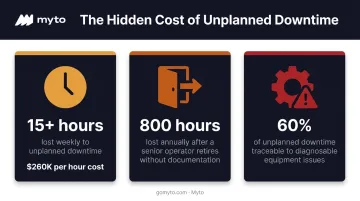
Getting this right carries real financial weight. Internal industry analysis points to costs like:
- More than 15 hours of production lost per week to unplanned downtime, at a cost of roughly $260,000 per hour
- Close to 800 hours of lost production per year after a senior operator retires without documenting their knowledge
- About 60% of unplanned downtime traceable to equipment issues the right operator could have diagnosed faster, had that knowledge been captured
If your team is struggling to keep both SOPs and work instructions current while your best operators near retirement, it's worth exploring how AI-assisted capture works before that knowledge walks out the door.
Conclusion
There's no single winner between SOPs and work instructions. They operate at different altitudes of the same goal: consistent, safe, compliant production. An SOP standardizes the process. A work instruction guides the specific task inside it.
The manufacturers that get this right see fewer errors, faster onboarding, a stronger compliance posture, and less unplanned downtime. That only happens when both document types stay clear, current, and within reach on the floor, not buried in a binder or a folder nobody opens. Myto closes that gap, capturing frontline knowledge as it happens and keeping SOPs and work instructions current automatically.
Frequently Asked Questions
What is the difference between a standard operating procedure (SOP) and a work instruction?
An SOP covers the overall process at a high level, defining policy and compliance requirements. A work instruction details the specific steps for one task within that broader process, right down to tools and settings.
What is the difference between an SOP and a workflow?
A workflow is a visual map showing how work moves between people or systems. An SOP is the written document that governs how a task should be performed, and it may include a workflow diagram as one supporting element.
What are the three types of SOPs?
The three common formats are checklist-style, hierarchical or step-and-sub-step, and flowchart-based. Many processes also use hybrid formats combining these approaches, especially when they include both linear steps and decision points.
Who should be responsible for writing SOPs and work instructions in a manufacturing plant?
Managers, quality teams, or compliance staff who own the broader process typically author SOPs. Subject matter experts and experienced operators who perform the task firsthand should write work instructions.
Can a work instruction exist without an SOP, or vice versa?
Simple, low-complexity tasks may only need a work instruction with no formal SOP behind them. Regulated or cross-departmental processes typically require an SOP with supporting work instructions underneath it.
How often should SOPs and work instructions be reviewed and updated?
SOPs typically follow scheduled reviews, often annually, alongside immediate updates when regulations or major process changes occur. Work instructions need more frequent updates since tools, equipment, and task steps change faster at the floor level.