Traditional automation only reacts once something breaks. Meanwhile, the knowledge that could prevent the breakdown in the first place often lives in a senior technician's head, a binder in the maintenance office, or a handwritten note nobody can read at shift change. That gap costs plants real production time.
This article breaks down what agentic AI actually means for manufacturers, where it's already working, the benefits and hurdles, and how platforms like Myto bring it down to the factory floor.
Key Takeaways
- Agentic AI autonomously plans, decides, and acts across production.
- Manufacturers deploy it for maintenance, scheduling, and supply chain coordination.
- Success depends on data readiness, governance, and workforce upskilling, not algorithms alone.
- Myto's AI glasses capture tribal knowledge for autonomous troubleshooting and documentation.
What Is Agentic AI in Manufacturing?
Agentic AI refers to autonomous, goal-driven systems that sense conditions, reason through options, plan a course of action, and execute it across production environments with minimal human intervention. IBM defines agentic AI as software that autonomously pursues complex goals and makes decisions with limited supervision, a sharp contrast to systems that simply react to a request.
That distinction matters on a factory floor, where the difference between "detecting a fault" and "resolving a fault" can mean hours of lost output.
Agentic AI vs. Traditional Automation vs. Generative AI
These three categories get lumped together constantly, but they solve different problems.
- Traditional automation follows fixed rules and reacts only to predefined triggers, like a sensor threshold tripping an alarm
- Generative AI produces content or insights on request, such as drafting a maintenance report when asked
- Agentic AI autonomously executes multistep workflows, adapting in real time without waiting for someone to press a button
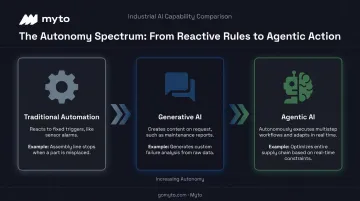
Think of agentic systems as digital teammates that sense, reason, negotiate, and decide within defined safety and quality guardrails, then act, rather than tools that wait to be told what to do. Myto's agentic AI agents apply this same model on the shop floor, automating troubleshooting, generating SOPs, and coordinating shift handovers without waiting for a supervisor's sign-off.
Single-Agent vs. Multi-Agent Systems
A single agent typically handles one function, such as monitoring vibration on a specific machine. Multi-agent systems coordinate across production, maintenance, and supply chain roles simultaneously, balancing conflicting priorities like throughput targets against machine wear.
This shift toward coordination is accelerating fast. Manufacturers aren't just piloting isolated bots anymore; they're building networks of agents that negotiate trade-offs the way a cross-functional team would, just at machine speed.
Key Applications of Agentic AI in Manufacturing
Agentic AI use cases now span the shop floor, quality control, supply chain, and frontline knowledge, pushing manufacturing from reactive firefighting toward proactive, interconnected systems.
Predictive Maintenance & Autonomous Quality Control
Agentic systems detect defects, trigger inspections, adjust machine settings, and trace root causes automatically. In electronics manufacturing, ASMPT's Process Lens inspection system reports up to 70% shorter inspection times and up to 80% fewer false calls.
Paired with its self-learning WORKS Process Expert module, the system can autonomously adjust solder-printing process parameters to correct a recurring soldering defect before it repeats on the next unit. That's the agentic loop in action: detect, decide, act, verify, without a human approving each step.
Dynamic Production Scheduling & Process Optimization
Agents continuously resequence jobs and rebalance workloads in real time when disruptions hit. Rather than halting an automotive assembly line for a single missing component, an agentic system reroutes that unit downstream, reslots another vehicle into the open position, and keeps the line moving.
Mercedes-Benz's MO360 data platform already supports this kind of shortage scenario planning across its production network, giving teams the visibility to make these calls fast.
Supply Chain & Inventory Coordination
Agentic AI synchronizes procurement, supplier risk signals, and demand data to prevent bottlenecks before they cascade downstream. According to Gartner's supply chain forecast, 50% of cross-functional supply chain management solutions will use intelligent agents to execute decisions autonomously by 2030, a sharp jump from where most manufacturers stand today. That shift signals manual procurement decisions are becoming a competitive liability.
Frontline Knowledge Capture & Troubleshooting
Here's the use case most vendors skip: capturing undocumented operator expertise and converting it into standardized, AI-accessible troubleshooting workflows. When a veteran technician knows a spindle vibration means bearing wear before any sensor confirms it, that judgment call has historically never left their head.
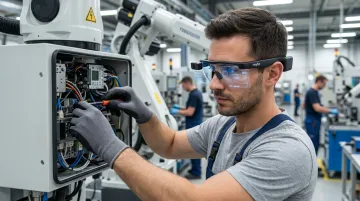
Agentic platforms can now turn that instinct into a documented, repeatable diagnostic path other technicians can act on. Myto's wearable AI glasses capture this kind of expertise hands-free as operators work, then its agentic layer turns it into troubleshooting workflows the rest of the team can follow.
Product Development & Digital Twin Simulation
Agentic AI accelerates R&D by generating design variations and coordinating digital twin simulations, letting engineers validate performance virtually before committing to physical prototypes. NIST's digital twin research and Siemens' comprehensive digital twin environment both support running what-if scenarios that agentic systems can evaluate autonomously before a single part gets machined.
How Myto Turns Frontline Expertise into Autonomous Action
Manufacturing contributes roughly $2.3 trillion, or about 10% of U.S. GDP, yet the people keeping those lines running still depend on binders, disconnected systems, and knowledge trapped in the heads of veteran operators.
When that person retires, the expertise usually leaves with them. That's the exact problem Myto's founding team, with backgrounds spanning Mercedes-Benz, BCG, and Stanford, set out to solve.
Myto's approach starts with hands-free wearable capture. Operators wear AI glasses that passively record video and audio as they work, whether they're troubleshooting a jammed conveyor or walking a new hire through a shift handoff. There's no button to press, no form to fill out, and no change to how the job gets done.
That captured footage feeds directly into Myto's Operational Data Integration layer, alongside existing SOPs, machine logs, maintenance tickets, and MES/CMMS/ERP records. The platform maps logs to machines, connects tickets to relevant SOPs, and links shift-handoff notes to troubleshooting flows, building a structured knowledge base rather than another disconnected data silo.
From there, Myto's agentic AI layer takes over:
- Surfacing the right SOP and equipment history the moment a machine acts up
- Drafting shift-handover notes automatically instead of relying on illegible paper logs
- Opening maintenance tickets and scheduling follow-ups without operator input
- Generating audit-ready documentation from captured footage
What separates this from a static digital SOP library is compounding intelligence. Every new machine event, troubleshooting session, and shift handoff adds to the knowledge graph, meaning the system gets sharper the longer it runs.
That intelligence layer also comes with practical deployment advantages:
- Runs on top of existing MES, CMMS, SCADA, and ERP systems, no rip-and-replace required
- Keeps IT lift low, so rollout moves fast
- Draws on backing from Y Combinator and General Catalyst, giving manufacturers a way to adopt agentic AI without betting on an unproven vendor
Benefits of Agentic AI in Manufacturing
Three benefits stand out when agentic AI moves from pilot to production floor:
- Cost reduction and efficiency: Autonomous optimization lowers waste, energy use, and manual intervention. The World Economic Forum's Global Lighthouse Network reports AI-enabled sites achieving 47% lower material waste and 26% lower emissions.
- Increased agility and uptime: Real-time autonomous decisions maintain production continuity during disruptions. Siemens' 2024 downtime survey found predictive-maintenance adopters seeing 50% less unplanned downtime, a meaningful buffer against the roughly $695 million annual cost of an idle line at a large automotive plant.
- Faster innovation cycles: Agentic AI compresses R&D and documentation time, freeing engineers and operators to focus on judgment calls instead of paperwork.
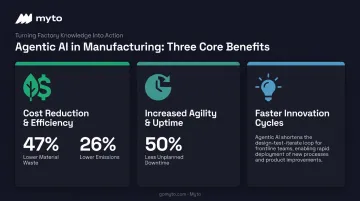
That shift alone can reshape what a technical team accomplishes in a quarter.
Challenges & Best Practices for Scaling Agentic AI Adoption
Agentic AI isn't plug-and-play. Three recurring obstacles show up, along with one best practice for managing them:
- Data and infrastructure readiness. Legacy systems and fragmented data limit what agents can do. Platforms requiring minimal IT lift, like Myto, help teams start without a full data overhaul.
- Governance and human oversight. Autonomous actions need decision boundaries, human-in-the-loop checkpoints, and audit trails, guided by frameworks like NIST's AI Risk Management Framework.
- Workforce skills gap. Employees shift from executing tasks to supervising AI. This calls for real reskilling programs paired with hands-on support from AI specialists.
- Start small and scale deliberately. Pilot a narrow, high-value use case, such as predictive maintenance, before expanding into enterprise-wide orchestration.
Rockwell Automation reports that 95% of manufacturers are already investing in AI. Governance, not speed, determines which manufacturers actually see returns on that investment.
Frequently Asked Questions
Which AI is best for the manufacturing industry?
There's no single "best" AI; the right choice depends on the use case. Agentic AI platforms that combine automation with real-time reasoning are increasingly preferred for autonomous operations.
How can AI be used in the manufacturing industry?
Major applications include predictive maintenance, quality control, production scheduling, supply chain optimization, and capturing frontline expertise into digital workflows. Each solves a different bottleneck on the floor.
What is an example of an agentic AI in manufacturing?
A system that detects a defect, adjusts machine settings, and triggers a quality check, all without human intervention, is a working example. It can even trace the root cause on its own.
What industries are using agentic AI?
Automotive, electronics, aerospace, chemicals, consumer goods, and industrial equipment manufacturing all use agentic AI, though adoption depth varies widely by sector.
What's the difference between agentic AI and traditional AI in manufacturing?
Task-based AI reacts to specific inputs on request. Agentic AI plans multistep actions, coordinates across systems, and adapts autonomously without waiting for a prompt.
Is agentic AI safe for manufacturing operations?
Agentic AI operates within defined safety and quality guardrails. Governance frameworks with human-in-the-loop controls keep autonomous actions accountable and reversible when something goes wrong.