
Most plants underestimate how much downtime is actually costing them because they track the big stoppages and miss the five-minute stops that add up across a shift. This post defines machine downtime, breaks down what causes it, walks through the exact formula for calculating it, and covers what actually reduces it on the floor.
Key Takeaways
- Machine downtime is idle equipment time when work is available, split into planned and unplanned categories.
- The core formula: Downtime % = (Downtime Hours / Planned Operating Hours) x 100.
- Unplanned downtime from equipment failure and knowledge gaps is the most disruptive and expensive category.
- How you track downtime, manually or automatically, determines how trustworthy your OEE numbers are.
What Is Machine Downtime?
Machine downtime is any period a piece of production equipment is unavailable to run while there's scheduled work for it to do. That last part matters. If a machine sits quiet because there's no order to run, that's idle time, not downtime. Downtime specifically refers to lost availability during hours the machine was supposed to be producing.
Every downtime event falls into one of two buckets, and the distinction changes how you should react to it.
Planned vs. Unplanned Downtime
Planned downtime is built into the schedule ahead of time:
- Scheduled preventive maintenance
- Product changeovers
- Quality inspections
- Operator training sessions
It's predictable, so it rarely disrupts throughput targets in a meaningful way.
Unplanned downtime is the opposite: a stoppage nobody scheduled, like a jammed conveyor, a tripped sensor, or a bearing that finally gave out.
It introduces volatility into a schedule that was otherwise locked in, and it costs more per hour than planned stops because there's no buffer built around it.
Machine Uptime vs. Downtime: What's the Difference?
Uptime is the time a machine is actively running and producing. Downtime is everything else within scheduled hours. They're two sides of the same availability equation.
A quick way to think about it: uptime % + downtime % should always equal 100% of planned operating time. If your line is scheduled for 80 hours a week and runs for 68 of them, you're looking at 85% uptime and 15% downtime.
Both metrics get tracked together as part of Overall Equipment Effectiveness (OEE), which we'll get into below.
Common Causes of Unplanned Machine Downtime
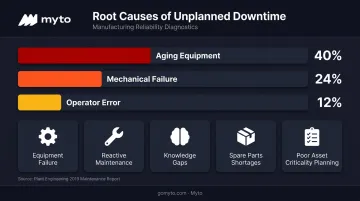
Unplanned stoppages rarely come from a single source. Plant Engineering's 2019 Maintenance Report, a survey of nearly 200 industrial facilities, found that aging equipment accounted for 40% of unplanned downtime causes. Mechanical failure followed at 24%, with operator error close behind at 12%.
The most common root causes we see on production floors:
- Equipment failure — component wear, contamination, overheating, or electrical faults that build up quietly until something finally breaks
- Reactive maintenance — skipping preventive or predictive schedules lets small issues escalate into full breakdowns
- Operator error and knowledge gaps — wrong settings, incorrect loading, and troubleshooting delays that get worse with high turnover and undocumented tribal knowledge
- Spare parts shortages — a missing bearing or seal turns a 20-minute fix into a multi-hour wait
- Poor asset criticality planning — treating every machine the same way instead of prioritizing the ones that actually stop the line
Here's the part most root-cause reports miss: these causes rarely act alone. A bearing failure is a mechanical trigger, but what usually stretches it from a 30-minute fix into a four-hour outage is the process or knowledge gap that delayed the diagnosis.
The machine broke because of wear. The line stayed down because nobody on shift knew where to start.
How to Calculate Machine Downtime
The core formula is straightforward:
Downtime % = (Downtime Hours / Planned Operating Hours) x 100
To use it, you need two numbers: total downtime hours and planned operating hours. Here's how to get both.
- Identify planned operating time. This is scheduled production time, not calendar time. A line running three 8-hour shifts, five days a week, has 120 planned hours for that week.
- Log actual downtime. Every stoppage gets a timestamp, a duration, and a reason code, then add them all up.
- Subtract and calculate using the formula above.
Worked example: A stamping line is scheduled for 120 hours this week. A hydraulic failure takes it down for 6 hours, and a series of short jams add another 2 hours. Total downtime: 8 hours.
Downtime % = (8 / 120) x 100 = 6.7%
That means the line was available 93.3% of its scheduled time. A 6.7% downtime rate might sound manageable until you multiply it by the plant's hourly cost of downtime.
Turning Downtime Into a Financial Metric
Hours don't mean much to a plant manager's boss. Dollars do. To convert downtime hours into a financial figure, account for three components:
- Lost output — units you didn't produce, multiplied by the margin or revenue per unit
- Idle labor cost — wages paid to operators standing around during the stoppage
- Overtime to recover schedule — extra hours needed to hit the original production target
Formula example: That 8-hour stoppage hit a line producing 50 units per hour at a $40 margin per unit. Here's how the costs stack up:
- Lost output: 400 units x $40 margin = $16,000
- Idle labor: 4 operators x $28/hour x 8 hours = $896
- Recovery overtime: 6 hours at time-and-a-half to hit the original target
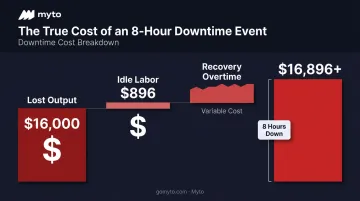
The total cost of that single stoppage climbs well past the sticker price of "8 hours down."
Downtime's Role in OEE (Overall Equipment Effectiveness)
Downtime feeds directly into the Availability component of OEE, defined as Run Time / Planned Production Time, per Vorne's OEE calculation reference. OEE itself is Availability x Performance x Quality.
Accurate downtime data is what makes that OEE score trustworthy. Missed short stops or guessed timestamps produce a wrong Availability number, and that error carries into everything built on top of it: OEE, capacity planning, and maintenance budgets.
How to Measure and Track Machine Downtime
How you capture downtime data determines whether you can trust it.
Manual, paper-based logging is still common, and it's also the weakest link. Operators estimate start and stop times after the fact, round durations to the nearest 15 minutes, and pick whatever reason code is closest at hand.
Short stops under five minutes often get skipped entirely because nobody writes down a jam that clears itself.
Automated tracking through sensors, a CMMS, or an MES closes that gap. These systems log every stop event with exact timestamps the moment it happens, no rounding, no forgetting.
The tradeoff is that most automated systems still need a human to assign the reason for the stop, even if the timing is captured perfectly. Myto's AI agents extend that by suggesting likely reason codes from machine history and operator context, without extra steps for the operator.
To make that reason-code data actually useful, structure it around a consistent taxonomy:
- Mechanical
- Electrical
- Process
- Changeover
Without that structure, you end up with a downtime number that's accurate but not actionable—you know how much time you lost, but not where to focus the fix.
How to Reduce Machine Downtime
Reducing downtime comes down to three levers: catching failures earlier, closing knowledge gaps faster, and making sure parts and schedules don't become the bottleneck.
1. Shift from reactive to preventive and predictive maintenance. Scheduled inspections catch wear before it becomes a breakdown. Condition-based monitoring (vibration sensors, thermal readings, oil analysis) pushes this further by flagging failures before symptoms are visible to the naked eye.
2. Close the training and tribal knowledge gap. This is where unplanned downtime often gets extended rather than caused. A machine trips, and the fix is well known, but only to the one technician who's been running that line for 15 years.
If that person is on vacation or a different shift, everyone else is guessing.
This is the exact gap Myto's platform is built to close. Operators wear lightweight AI glasses that record troubleshooting steps hands-free, no forms, no pausing to type notes mid-task. That footage gets structured automatically into SOPs and troubleshooting flows tied to the specific machine and failure mode.
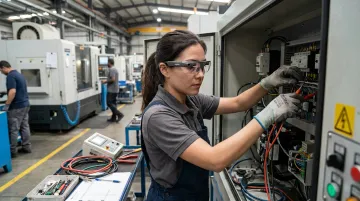
The next time a spindle starts vibrating at 2 a.m. on a Saturday, an operator on a completely different shift can pull up the same diagnostic checklist the senior tech used. No more waiting hours for someone to answer a phone call.
3. Maintain adequate spare parts inventory and lean on the CMMS. Use the existing maintenance system to automate scheduling and flag low parts inventory before a routine fix turns into a multi-day wait for a shipped component.
Frequently Asked Questions
How do you calculate the downtime of a machine?
Divide total downtime hours by planned operating hours, then multiply by 100. For example, 8 hours of downtime out of 120 scheduled hours equals a 6.7% downtime rate.
What is machine downtime?
Machine downtime is any period a machine isn't running when it's scheduled to be producing. It includes both planned stops, like maintenance, and unplanned stops, like breakdowns.
What is the difference between machine uptime and downtime?
Uptime is the time a machine is actively running within scheduled hours; downtime is the non-running time within that same window. Together, they add up to 100% of planned operating time.
What is the difference between planned and unplanned downtime?
Planned downtime is scheduled in advance, such as maintenance or changeovers, and rarely disrupts output targets. Unplanned downtime is unexpected, more disruptive, and typically far more expensive per hour.
How does machine downtime affect OEE?
Downtime directly reduces the Availability component of OEE, calculated as Run Time divided by Planned Production Time. Lower availability pulls down your overall OEE score regardless of performance or quality.
What is considered a good downtime percentage in manufacturing?
There's no universal benchmark since it varies by industry, equipment age, and process type. What matters more is tracking your own trend over time and consistently pushing that percentage down.