Downtime tracking software has moved well past simple stop-detection. The category now includes AI-driven resolution tools that connect directly to overall equipment effectiveness (OEE) goals and cost optimization, not just historical reporting.
This guide ranks the top machine downtime tracking software for 2026, breaks down the selection criteria plant managers actually use, and highlights an emerging shift: tools that help teams resolve downtime faster, not just log it after the fact.
TL;DR
- Downtime tracking software auto-detects and logs stoppages, replacing whiteboards and logbooks
- Core criteria: automated capture, reason codes, alerts, OEE analytics, integrations, deployment speed
- Picks span dedicated trackers, IIoT platforms, hardware appliances, and AI tools like Myto
- 2026 trend: tools must help teams act on downtime, not just report it
Overview of Downtime Tracking Software in the Manufacturing Industry
Downtime tracking software automatically detects when a machine stops, timestamps the event, and applies a reason code, surfacing Overall Equipment Effectiveness (OEE) Availability losses that most manufacturers underestimate on paper.
Manufacturing remains a major driver of the U.S. economy. According to a 2023 NIST report, value added reached $2.3 trillion in real terms, roughly 10% of GDP. Every hour of unplanned downtime chips directly into that output.
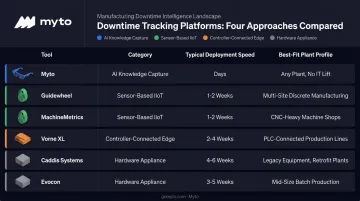
The software serving this sector spans several distinct approaches:
- Sensor-based OEE trackers that clip onto existing equipment
- Controller-connected edge platforms built for CNC-heavy shops
- Hardware appliances with fixed, one-time costs
- AI-powered platforms that convert captured troubleshooting knowledge into faster resolutions
The list below covers all four categories, so you can match the approach to your plant's equipment mix and IT constraints.
Top Machine Downtime Tracking Software for 2026
We evaluated each platform against six factors: automated detection accuracy, reason-code usability, analytics and OEE depth, integrations, deployment speed, and — new for 2026 — AI-assisted resolution capability. Detecting a stop is table stakes now. Helping a technician fix it fast is where the real ROI lives.
Myto
Founded by a team with roots at Mercedes-Benz, BCG, and Stanford, and backed by Y Combinator and General Catalyst, Myto was built to capture frontline expertise that traditional downtime tools never record.
Most downtime trackers can tell you a machine went down and for how long. They can't tell you what the senior technician actually did to fix it. Myto closes that gap with hands-free AI glasses that capture how operators troubleshoot in real time. That data feeds an agentic AI system that can troubleshoot alongside workers, auto-generate documentation, and coordinate shift handoffs, with no extra logging steps required.
| Key Features | Wearable hands-free capture, AI troubleshooting agents, auto-generated SOPs, automated shift-handoff coordination |
| Pricing | SaaS subscription with AI glasses included; contact vendor for current rates |
| Deployment | Fast setup with minimal IT lift; no heavy infrastructure or PLC integration required |
| Best For | Manufacturers already tracking downtime events who need to cut resolution time by capturing and reusing tribal troubleshooting knowledge |
Guidewheel
Guidewheel clips non-invasive current sensors onto a machine's power line and works on any electrically driven equipment, regardless of age. Data transmits over cellular, so there's no need to touch the plant's OT network.
Guidewheel's sensors reportedly take about 2.5 minutes each to install, with data flowing within roughly 40 minutes and full go-live in a day or two. That speed, paired with multi-site dashboards, suits high-throughput, multi-shift operations running mixed equipment fleets.
| Key Features | Real-time downtime detection, SMS/email alerts, one-tap reason coding, OEE and top-loss tracking |
| Pricing | Contact vendor; product-specific pricing isn't publicly posted, so confirm current rates directly |
| Best For | Mid-size to enterprise plants with mixed, aging equipment fleets |
MachineMetrics
MachineMetrics focuses on discrete CNC machining, using a proprietary edge device that connects to a wide range of controllers, including FANUC, Mazak, Okuma, Haas, Siemens, Allen-Bradley, and Mitsubishi.
The platform applies configurable logic to classify downtime events directly from controller and alarm signals, feeding Pareto and OEE analytics. Reviewers consistently note strong analytical depth alongside a real learning curve, so budget time for onboarding.
| Key Features | Automated OEE from machine controls, downtime Pareto reporting, workflow notifications, predictive analytics |
| Pricing | Enterprise/contact-vendor; scales by connected-machine volume |
| Best For | Enterprise manufacturers running 50+ modern CNC machines with dedicated IT support |
Caddis Systems
Caddis positions itself as a fast-deploying, transparently priced platform built to scale from single job shops to multi-plant operations. Most shops report being operational in under two hours.
Its AI-ready data architecture and operator-first reason code capture stand out as differentiators, producing clean, structured data that AI tools can query later, without requiring a data science team to prep it first.
| Key Features | Automated detection and timestamping, AI-ready data architecture, text/email alerts, same-day installation |
| Pricing | Published plans include a 60-day pilot for up to 10 devices and a $100/month per-machine lease; confirm current rates with the vendor |
| Best For | Growing job shops and multi-site manufacturers wanting fast time-to-value without enterprise minimums |
Vorne XL
Vorne XL runs on a hardware-appliance model: buy the device once, connect it directly to your machines, and skip recurring software fees entirely. The XL HD+ lists at $4,690 as a one-time purchase, with free updates, support, and unlimited users included.
Its physical scoreboards and Andon views give plant floors strong floor-level visibility, and its Pareto and Top Losses reports generate automatically. The tradeoff: remote, multi-site access isn't its strength against cloud-native competitors.
| Key Features | Automated downtime detection, Pareto charts, Total Production Timeline, digital Andon views |
| Pricing | One-time hardware purchase (XL HD+ listed at $4,690); verify current models and pricing on Vorne's site |
| Best For | Discrete production lines wanting fixed-cost, on-premise OEE tracking with strong floor visibility |
Evocon
Evocon takes a plug-and-play IIoT approach: clip-on sensors, cloud dashboards, and setup within a few days, no local software installs or heavy IT involvement needed.
Its simplicity is the draw for small and mid-size manufacturers, and Evocon offers a 30-day free trial with no financial commitment. Analytics run lighter than enterprise platforms like MachineMetrics, but for teams that just need clear, reliable OEE numbers, that's often enough.
| Key Features | Automated downtime detection, operator reason coding, real-time OEE dashboards, ERP integration |
| Pricing | Per-machine subscription billed annually, plus device fee; 30-day free trial available; verify current tiers with vendor |
| Best For | SME manufacturers wanting straightforward OEE without heavy hardware or IT lift |
Beyond Detection: Why AI-Powered Knowledge Capture Is the Next Frontier
Traditional downtime trackers excel at one thing: detecting and timestamping stops. What they leave unsolved is harder — helping a technician figure out how to fix the issue quickly, once it happens.
That gap is widening as experienced operators retire. McKinsey reports that the share of U.S. manufacturing employees aged 55 and older grew from roughly 10% in 1995 to about 25% in 2025, with annual retirement rates near 2% a year. Each departure risks taking undocumented troubleshooting knowledge out the door for good.
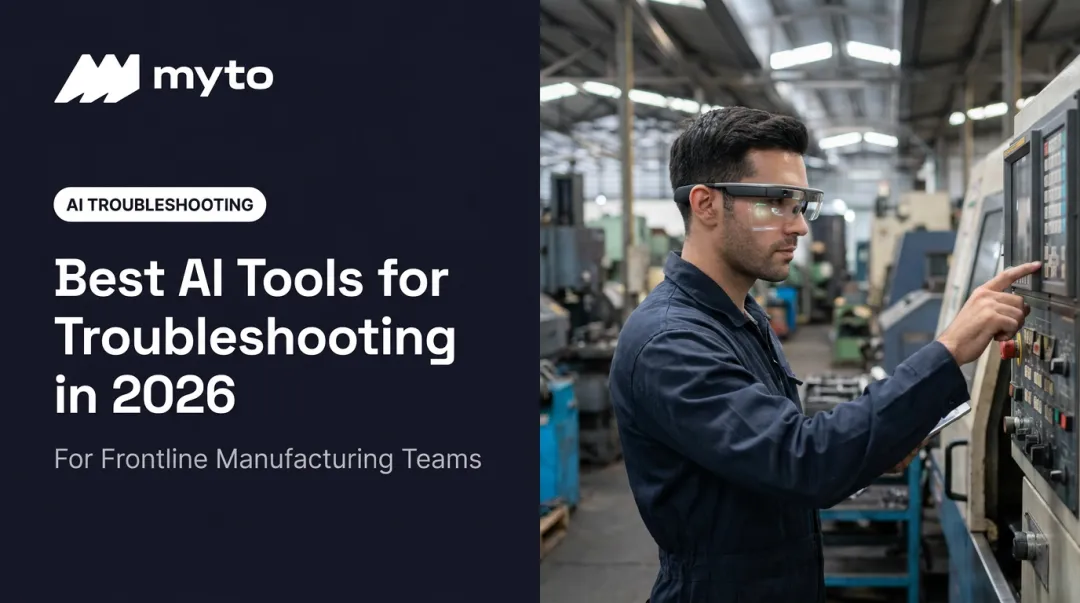
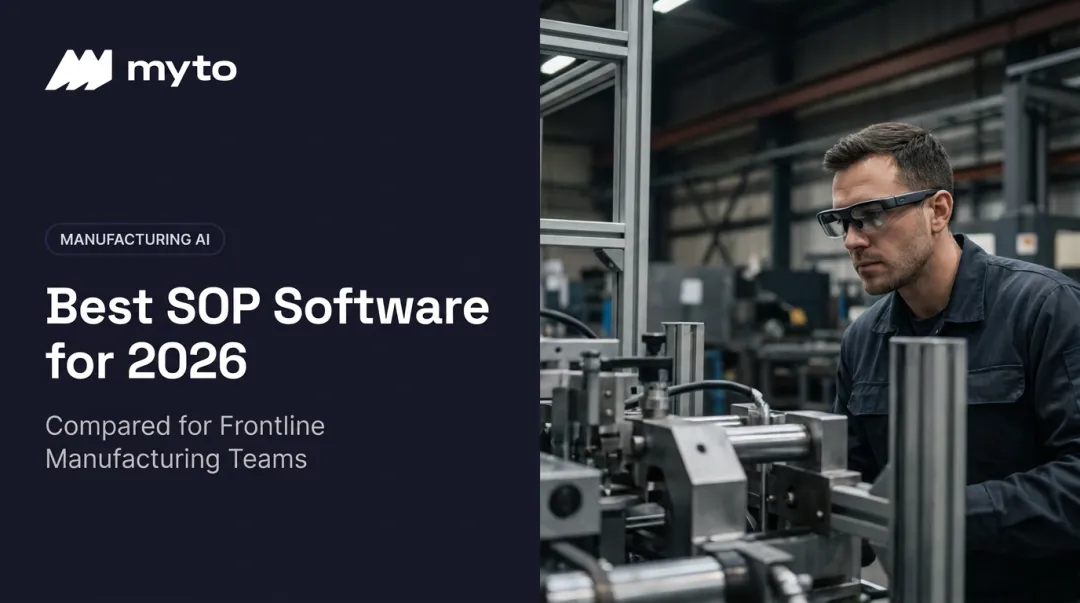
This is where wearable AI capture changes the equation. AI glasses, like the ones Myto provisions, record how top operators actually diagnose and resolve issues in the natural flow of work. No extra logging steps, no forms, no stopping to write anything down.
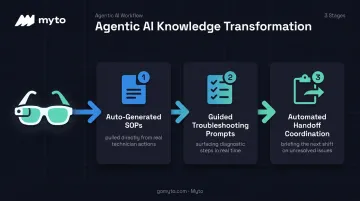
Once that footage and audio sync to the platform, agentic AI turns it into reusable assets:
- Auto-generated SOPs pulled from what the expert actually did, not what a process engineer guessed years ago
- Guided troubleshooting prompts that surface the right diagnostic checklist the moment a worker hits a wall
- Automated handoff coordination that tells the next shift what broke, what got fixed, and what still needs attention
This layer sits alongside existing OEE and downtime tools rather than replacing them. Your tracker tells you a machine went down at 2:14 a.m. and stayed down for 47 minutes. Myto's layer tells the next technician how the senior tech resolved the identical fault six weeks earlier, complete with a visual reference clip.
That's the real shift happening in 2026: closing the gap between "we know it's down" and "we know how to fix it fast."
How We Chose the Best Downtime Tracking Software
Most buyers make the same two mistakes: prioritizing feature checklists over whether operators will actually adopt the tool, and underestimating how much friction legacy equipment adds to deployment timelines.
We weighted six factors, each tied to a business outcome:
- Automated capture accuracy: fewer false positives mean cleaner data and less time reconciling records
- Reason-code usability: if coding a stop takes 30 seconds, operators skip it; usability drives adoption
- Analytics and OEE depth: Pareto charts and top-loss reports should point to the next fix, not just describe history
- Integrations and multi-site visibility: data needs to reach CMMS, MES, or ERP systems without manual exports
- Deployment speed: faster time-to-value means less disruption and quicker ROI proof
- AI/resolution capability: measuring whether a tool helps reduce mean time to repair (MTTR), not just log it
Each factor maps to a metric plant managers already track: MTTR, OEE, and total cost of ownership.
Conclusion
The right downtime tracking partner depends on your plant, not a vendor's brand reputation. A job shop running a dozen aging CNC machines needs something very different from an automotive plant running 200 modern lines across three sites.
Whichever profile fits your plant, the next steps are the same:
- Pilot on one line first.
- Verify vendor pricing and claims directly — most of the figures above are contact-vendor for a reason.
- Ask a harder question than "Does this detect downtime?" Ask whether it helps your team capture not just what went down, but how to fix it faster next time.
If you already have a downtime tracker in place, wearable capture and agentic AI can sit alongside it to cut resolution time. Myto's team can walk you through what that looks like on your floor.
Frequently Asked Questions
What is downtime tracking?
Downtime tracking is the automated or manual process of detecting, timestamping, and categorizing machine stoppages. It lets teams analyze patterns and reduce lost production time over weeks and months, not just react to individual incidents.
What's the difference between planned and unplanned downtime?
Planned downtime covers scheduled stops like changeovers, tooling swaps, and preventive maintenance. Unplanned downtime is unexpected, caused by equipment failures, jams, or material shortages, and carries a far higher cost to production.
How much does machine downtime tracking software cost?
Pricing models range widely: one-time hardware appliances like Vorne XL, per-machine monthly SaaS fees like Evocon or Caddis, and enterprise contracts like Guidewheel or MachineMetrics. Always verify current figures directly with the vendor.
Can downtime tracking software work on legacy machines?
Most platforms support legacy equipment through retrofit sensors, current clamps, or edge gateways. These typically don't require modern PLC integration, so older electrically driven machines can still be monitored.
How is AI changing machine downtime tracking in 2026?
The shift is moving from passive detection toward AI agents and knowledge-capture tools that help troubleshoot, document, and resolve downtime faster. Tools like Myto add this layer on top of existing trackers.
Does downtime tracking software integrate with CMMS or MES systems?
Many platforms offer APIs or built-in integrations that route downtime data into maintenance work orders or broader MES and ERP systems, so information doesn't stay siloed in one dashboard.