
Whatever the industry, the question is the same: how fast can you get back up and running?
That's what Mean Time to Repair (MTTR) measures. It's a single number that captures how well an organization bounces back from failure, and it shows up everywhere, from manufacturing plants to IT ops centers to software teams tracking DevOps performance.
Manufacturers know this number intimately. Unplanned downtime can cost upward of $260,000 per hour, and the average plant loses more than 15 hours of production a week to it.
This guide breaks down what MTTR actually means, how to calculate it, how it relates to MTBF, MTTF, and MTTA, and the specific strategies that lower it.
Key Takeaways
- MTTR measures average repair or recovery time: total downtime divided by number of incidents.
- The acronym also stands for repair, recovery, response, or resolution, so clarify which one you're tracking.
- Pairing high MTBF with low MTTR produces the best system availability.
- Unplanned downtime can exceed $260,000 per hour in manufacturing settings.
- Tribal knowledge, weak monitoring, and manual troubleshooting are the biggest drivers of high MTTR.
What Is MTTR (Mean Time to Repair)?
Mean Time to Repair is the average time it takes to fix a failed system, machine, or component and get it back to full operation. The clock starts when something breaks and stops the moment it's functional again.
The "R" Ambiguity: Repair, Recovery, Respond, or Resolve
Here's where most confusion comes from: MTTR doesn't always stand for the same thing.
- Mean time to repair: only the active fix time, from start of work to test-complete
- Mean time to recovery: the full outage window, including detection and diagnosis delays
- Mean time to respond: the clock from the alert firing until recovery, excluding the lag before anyone noticed
- Mean time to resolve: everything above, plus steps taken to prevent the failure from happening again
None of these are wrong. But if your maintenance team reports "repair" time while your IT team reports "recovery" time, you're comparing apples to engine blocks. Always state which variant you're using and where the clock starts and stops.
The MTTR Formula
The core formula is simple:
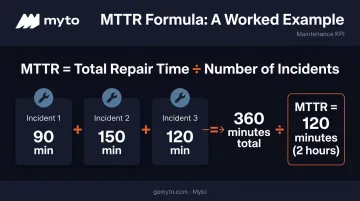
MTTR = Total repair time ÷ Number of incidents
A worked example: Say a CNC machine failed three times last month:
- Incident 1: 90 minutes to repair
- Incident 2: 150 minutes to repair
- Incident 3: 120 minutes to repair
Add them up: 90 + 150 + 120 = 360 minutes total repair time. Divide by 3 incidents, and MTTR comes out to 120 minutes, or 2 hours.
That's it. The math stays this simple whether you're measuring minutes for a server outage or hours for a production line. What matters more is consistency: define what counts as an "incident," track it the same way every time, and convert everything to a common unit before averaging.
Common Misconceptions About MTTR
A few myths tend to stick around:
- Low MTTR doesn't mean fewer incidents. A machine can be repaired quickly and still break down constantly. MTTR measures repair speed, not reliability. That distinction belongs to MTBF.
- It's not just a maintenance or IT metric. Operations, quality, and support teams all influence how fast a fix happens, especially when diagnosis depends on cross-functional input.
- Automation alone won't fix a broken process. A monitoring dashboard doesn't help if nobody knows what to do once the alert fires. Tools speed up execution; they don't replace a documented fix path.
MTTR vs. MTBF vs. MTTF vs. MTTA: Understanding Related Metrics
MTTR is one of several failure metrics that get lumped together in conversation, and mixing them up leads to reports that don't tell you anything useful.
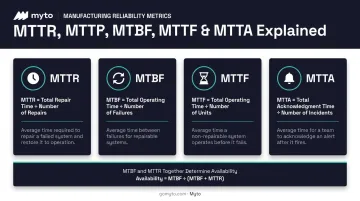
MTBF: Mean Time Between Failures
MTBF measures the average operating time between failures for a repairable system.
MTBF = Total operational time ÷ Number of failures
If a packaging line ran 900 hours over a quarter and failed three times, MTBF is 300 hours. A rising MTBF means equipment is failing less often.
MTTF: Mean Time to Failure
MTTF applies to components that aren't repaired, only replaced, like a sealed bearing or a light bulb. It measures average lifespan before failure.
MTTF = Total operational time ÷ Number of units
The distinction matters: MTBF assumes the system gets fixed and returns to service. MTTF assumes it's thrown away.
MTTA: Mean Time to Acknowledge
MTTA measures the average time between an alert firing and someone starting work on it. It's the gap between "something's wrong" and "someone's on it."
This diagnoses a different problem than MTTR. A high MTTA points to alerting fatigue or staffing gaps. A high MTTR, once someone's engaged, points to diagnostic or repair-process issues.
Connecting MTTR to Availability and Industry Benchmarks
These metrics tie together through system availability:
Availability = MTBF ÷ (MTBF + MTTR)
A machine that rarely fails (high MTBF) and gets fixed fast when it does (low MTTR) delivers the best uptime. Improving either number helps; improving both compounds the effect.
MTTR's influence extends beyond the factory floor, too. In software delivery, MTTR (often called "time to restore service") is one of the four original DORA metrics used to benchmark DevOps performance, alongside deployment frequency, lead time for changes, and change failure rate. According to DORA's 2021 State of DevOps research, elite-performing teams restore service in under one hour, while low performers can take more than six months.
One caveat: DORA has since refined this metric, narrowing "time to restore service" toward recovery from failed deployments specifically. Check which version you're comparing against before benchmarking your own numbers.
Why MTTR Matters for Your Business
Downtime translates directly into lost revenue, tracked as a line item on the P&L.
The financial stakes are steep. Downtime costs vary widely by industry, but the numbers are consistently high:
- Automotive manufacturing: up to $2.3 million per hour at a large plant, per Siemens' 2024 True Cost of Downtime report
- Fast-moving consumer goods: around $36,000 per hour, according to the same report
- The world's 500 largest industrial companies: unplanned downtime eats an estimated 11% of revenue
- General manufacturing plants: upward of $260,000 per hour, with the average plant losing 15+ hours of production weekly
The operational and reputational damage compounds. Extended repair windows don't just stall production. They can also:
- Trigger SLA penalties or compliance violations in regulated industries
- Erode customer trust when deliveries slip
- Cascade into downstream bottlenecks across dependent systems
And there's a human cost. Long, unresolved incidents wear down maintenance and engineering teams. The same technician often gets paged at 2 a.m. because they're the only one who knows the fix, and burnout follows.
Tracking MTTR builds the case for better tools and documentation, plus a process that doesn't hinge on one person being available. Platforms like Myto's AI system capture that tribal knowledge directly from technicians, so the fix isn't locked in one person's head anymore.
Key Factors That Impact Your MTTR
Three things tend to drive MTTR up, regardless of industry.
System Complexity
Modern equipment and software rarely fail in isolation. A single spindle vibration might stem from a sensor, a control system update, or a mechanical issue three steps removed. More interconnected systems mean more potential failure points, and more time spent figuring out which one actually broke.
Tribal Knowledge That Never Left the Building
The most common bottleneck is often human, not technical.
When troubleshooting know-how lives only in one experienced operator's head, repairs stall the moment that person is on vacation, on another line, or off shift. The fix exists; it's just inaccessible.
Myto's platform is built to solve exactly this problem. Its wearable AI glasses capture how experienced operators actually troubleshoot, hands-free and in real time, so that knowledge doesn't disappear when the person clocks out.
Internally, Myto has found that 60% of unplanned downtime stems from equipment failures the right operator could have diagnosed or prevented faster. Plants can lose roughly 800 hours of production a year once a senior operator leaves without that expertise ever being captured.
Weak Monitoring, Alerting, and Documentation
Without real-time visibility, teams spend more time figuring out something's wrong than actually fixing it. And once they know, outdated runbooks or missing SOPs mean re-diagnosing a problem someone already solved last quarter.
The pattern shows up constantly: a machine acts up at 2 a.m. on a Saturday, and the only person who's ever seen this specific failure mode is asleep. Everyone else starts from zero.
How to Reduce MTTR: Proven Strategies
Lowering MTTR comes down to removing friction at every stage: detection, diagnosis, and repair.
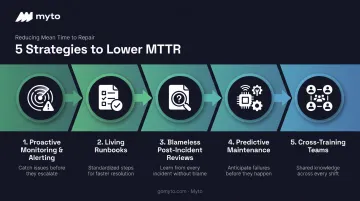
- Implement proactive monitoring and alerting. Catch issues the moment they occur, tied to actionable symptoms rather than speculative causes. Alert noise buries real problems just as effectively as no alerts at all.
- Build living runbooks, not static PDFs. Documentation that reflects how work actually happens today lets any technician follow a proven fix path, not just the most experienced one on the team.
- Run blameless post-incident reviews. Document what broke, why, and how it was fixed, without pointing fingers. The goal is preventing the same failure from driving up MTTR again next quarter.
- Invest in predictive maintenance. Sensors, IoT, and machine learning can catch failing components before they cause unplanned downtime. McKinsey's research on chemical plant maintenance found condition monitoring cut MTTR from 6.5 hours to 3 hours at one facility, and predictive maintenance broadly reduces downtime by 30% to 50%.
- Cross-train your team. Recovery shouldn't bottleneck on a single expert being reachable. Regular training and drills spread fix-it knowledge across the whole shift, not just the tenured few.
Where Myto Fits: Capturing the Human Side of MTTR
Most of the strategies above assume the knowledge to fix something already exists somewhere, documented and accessible. In practice, it usually doesn't. It's in someone's head.
Myto's platform addresses that gap directly. Operators wear AI glasses that continuously capture footage and audio while they work, with no forms and no stopping to type notes. That captured expertise automatically syncs to Myto's platform, where agentic AI structures it into SOPs, troubleshooting flows, and shift-handover documentation.
Here's what that looks like during an actual incident: a technician asks Myto's AI agent, "We replaced the bearings six months ago, could they already be worn out?"
The agent pulls context from that specific machine's maintenance history and flags likely causes, such as inadequate lubrication intervals or coolant contamination. It then surfaces the relevant SOP, complete with a step-by-step checklist and visual reference.
The technician never leaves the floor or waits for a callback. It's the closest thing to having your most experienced tech on-site at 2 a.m. on a Saturday, standing right next to whoever's actually there.
Because this knowledge compounds over time, feeding in data from every operator and every shift, each incident makes the next one faster to diagnose and repair.
Frequently Asked Questions
What is MTTR in software?
In software and DevOps, MTTR usually means mean time to restore service after an incident. It's tracked as one of the original DORA metrics, alongside deployment frequency, lead time for changes, and change failure rate.
What is MTTR, MTTF, and MTBF?
MTTR measures how fast you repair or recover from a failure. MTTF, by contrast, is the average lifespan of a non-repairable component before it fails for good. MTBF tracks the average time between failures for a system that gets repaired and returned to service.
What is MTTR and SLA?
Service level agreements often set MTTR targets as a performance guarantee, specifying maximum response or resolution times. Missing those targets can trigger service credits or other contractual penalties, so MTTR is tracked closely to stay compliant.
What is MTTR in Jira?
Jira Service Management reports this as "time to resolution," averaging the resolution times of items closed each day. It helps IT and support teams benchmark recovery speed across incidents.
What is considered a good MTTR?
It depends on the industry. IT and security teams often aim for under an hour, following DORA's elite-performer benchmark. Manufacturing systems more commonly target under 5 hours, depending on severity and equipment criticality.
What's the difference between MTTR and MTTA?
MTTA measures the time between an alert firing and someone starting work on it. MTTR measures the full repair or recovery time after that. Together, they show whether delays come from slow response or slow fixes.