
Introduction
A stamping press goes quiet for three hours. No alarm, no warning, just a fault code and a line full of parts that can't move. By the time technicians diagnose it, source a part, and restart the line, the plant has lost a full shift of output.
Many maintenance teams struggle to separate three terms that get used interchangeably: "downtime," "maintenance downtime," and "maintenance window." That confusion leads to poor tracking, misdirected improvement projects, and budgets built on the wrong assumptions.
Unplanned downtime costs the world's 500 largest companies an estimated $1.4 trillion annually, roughly 11% of revenue, according to Siemens' 2024 True Cost of Downtime study.
This guide breaks down what downtime maintenance actually means, planned versus unplanned types, its true cost, common causes, and the strategies that reduce it.
Key Takeaways
- Downtime maintenance covers any equipment offline period, whether scheduled or triggered by failure
- Unplanned events cost far more than planned ones due to reactive troubleshooting and parts sourcing
- Every hour of downtime maintenance chips away at the Availability component of OEE
- A small group of chronic-failure assets drives most unplanned stoppages
- Predictive maintenance, parts readiness, and frontline expertise capture deliver the biggest reduction gains
What Is Downtime Maintenance?
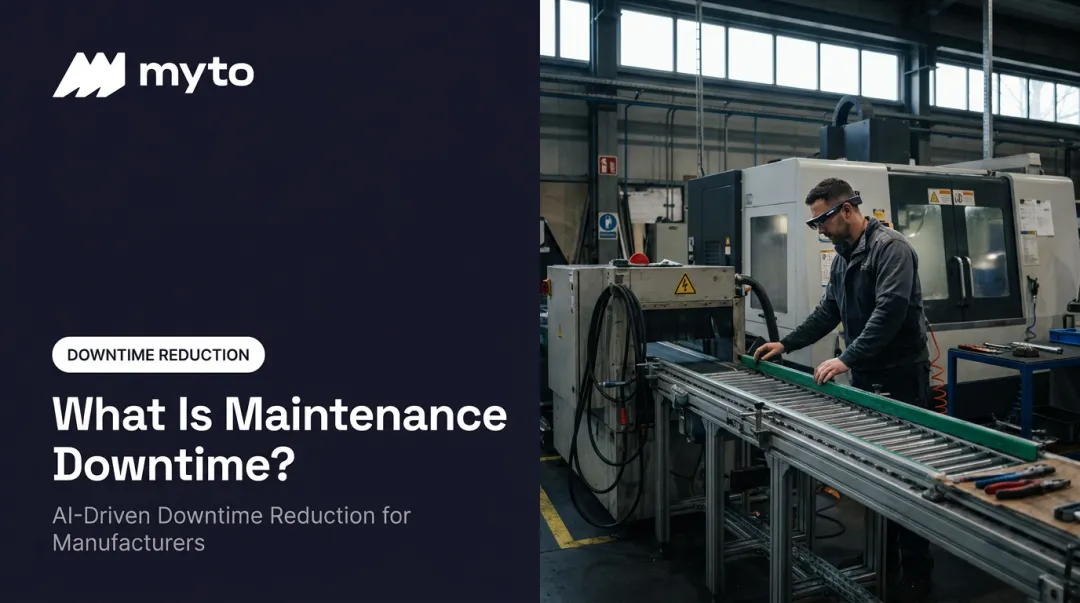
Downtime maintenance is the period a piece of equipment is taken offline, either by schedule or by necessity, to perform preventive servicing, corrective repairs, or emergency intervention. It's a subset of the broader term "downtime," which includes any stoppage regardless of cause, such as material shortages, changeovers, or soft demand.
That distinction matters. General downtime gets blamed on operations, supply chains, or scheduling, while downtime maintenance is tied specifically to asset condition and measured against total planned production time.
It's also the one category maintenance teams can actually control through better strategy. That controllability is why it deserves its own tracking line rather than getting lumped into a generic "stoppage" bucket.
Planned Downtime Maintenance
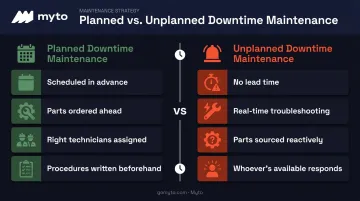
Planned downtime is a deliberate, pre-scheduled stoppage: preventive maintenance, overhauls, and inspections. Because the team knows the date in advance, they can prepare:
- Order and kit parts ahead of time
- Assign the right technicians and skill sets
- Write detailed work procedures before the shutdown starts
Duration can be compressed by staging materials in advance and running tasks in parallel instead of sequentially. Coordinating the work with production's own scheduled stops, like a changeover or shift break, lets the maintenance window ride inside existing downtime rather than adding to it.
Unplanned Downtime Maintenance
Unplanned downtime is what happens when equipment fails without warning. There's no lead time. Technicians troubleshoot in real time, hunt for parts they didn't know they'd need, and mobilize whoever's available, not necessarily the person who knows the machine best.
This reactive scramble is expensive. Reliability experts have long estimated that unplanned downtime in process industries costs several times more per hour than planned maintenance. No single independent study confirms a universal ratio, so that multiplier is best read as directional rather than a fixed benchmark.
What's consistent across sources is the mechanism: every extra minute spent diagnosing or waiting on parts is a minute the line stays dark.
The Real Cost of Downtime Maintenance
The repair bill, labor plus parts, is usually the smallest piece of the puzzle. Lost production revenue almost always dominates the total cost, and it's the part most plants underestimate.
A simplified cost formula looks like this:
(Downtime Hours × Production Rate × Unit Margin) + Labor Cost + Parts Cost + Indirect Costs
Here's a worked example for a mid-size CNC line:
| Cost Component | Detail | Subtotal |
|---|---|---|
| Lost production | 4 hours × 60 units/hr × $45 margin | $10,800 |
| Labor | 2 technicians × 4 hrs × $65/hr | $520 |
| Parts | Replacement bearing assembly | $850 |
| Indirect costs | Expedited shipping, overtime, scrap | $1,200 |
| Total | $13,370 |
Notice that lost production accounts for 81% of the total. This is why maintenance leaders who only track labor and parts costs are missing most of the picture.
This same lost time directly erodes OEE Availability, calculated as Run Time divided by Planned Production Time, where Run Time equals Planned Production Time minus Stop Time. Every hour of downtime maintenance is a direct hit to that ratio, and it compounds into Performance and Quality losses further down the OEE calculation.
The scale varies enormously by industry. A global survey of 3,215 plant-maintenance decision-makers across oil and gas, chemicals, food and beverage, metals, and energy found that more than two-thirds of industrial businesses experience an unplanned outage at least monthly.
The typical reported cost: nearly $125,000 per hour. Your own number will depend heavily on your process rate and margin, but the direction is the same everywhere: small stoppages add up fast.
Common Causes of Unplanned Downtime
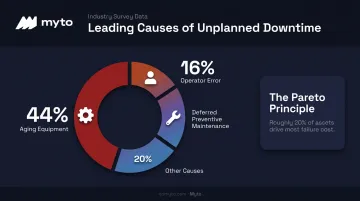
Most unplanned downtime traces back to a handful of familiar culprits. According to Plant Engineering's 2018 maintenance survey, aging equipment accounted for 44% of unscheduled downtime causes, while operator error accounted for 16%. Deferred preventive maintenance compounds both problems, since worn components that should have been caught in a PM cycle instead fail in production.
There's a fourth cause that rarely shows up in surveys but shapes how long every failure takes to fix: the loss of tribal knowledge.
- A senior technician who can hear a bearing about to fail before it shows up on any sensor
- A specific torque sequence or alignment trick that was never written into an SOP
- Undocumented troubleshooting logic that lives only in one person's head
When that person is on vacation, or retires, less experienced technicians take considerably longer to diagnose the same recurring fault. Industry data on this pattern is limited, but the mechanism is well documented. Plants that rely on a single expert for a given machine routinely lose extra hours per incident, simply waiting for that person to become available.
Chronic-failure assets make this worse. Reliability programs commonly apply the Pareto principle, prioritizing the roughly 20% of assets that generate the majority of failure cost and downtime. This is a practical heuristic for where to focus root-cause work first, not a fixed law that holds true at every plant.
How to Reduce Downtime Maintenance: Best Practices
Reducing downtime maintenance means eliminating the conditions that create breakdowns and shortening the diagnostic path when they still happen.
Catch Faults Before They Become Failures
Predictive maintenance and condition monitoring (vibration analysis, thermal imaging, oil analysis) are built to catch degrading equipment during the P-F interval, the window between when a fault becomes detectable and when the asset actually fails. Combining multiple techniques rather than relying on one sensor type catches a wider range of failure modes earlier.
Pair this with Reliability-Centered Maintenance (RCM) principles: use historical failure data to set PM frequencies based on actual failure modes, not blanket calendar intervals. This eliminates both over-maintenance (wasted labor on healthy assets) and under-maintenance (surprises on neglected ones).
Fix the Parts Sourcing Delay
Unavailable parts extend every repair. Linking critical spares to asset records and automating reorder points removes the scramble that turns a 45-minute repair into a 4-hour one. This typically works best as a layer connected to your existing CMMS or EAM system, since that's where parts inventory data usually already lives.
Close the Knowledge Gap
That knowledge gap is where Myto's wearable AI glasses come in, capturing how experienced technicians actually troubleshoot, hands-free, with no extra steps or paperwork. Real examples include:
- A senior tech performing a spindle vibration diagnostic sequence, verified with a dial indicator
- Root-cause identification for premature bearing wear, tracing it to inadequate lubrication, coolant contamination, or over-speed operation
- A full downtime recovery sequence, from first alarm to restart
Myto's agentic AI structures the captured session into a standardized SOP with a diagnostic checklist, then surfaces it automatically the next time a less experienced technician hits the same fault, at 2 a.m. or otherwise. The platform sits on top of existing CMMS, MES, and SCADA systems rather than replacing them, pulling in machine history and past tickets to enrich each workflow.

Coordinate With Production Planning
Finally, embed planned maintenance inside production's own scheduled stoppages, like a changeover or shift transition, whenever possible. Done well, this creates zero net additional downtime, since the line was stopping anyway.
Downtime Maintenance vs. Related Concepts
Downtime maintenance vs. production downtime. The root causes differ, and so does ownership:
| Factor | Downtime Maintenance | Production Downtime |
|---|---|---|
| Root cause | Asset condition, worn parts, failed components, deferred servicing | Material shortages, demand shifts, process bottlenecks |
| Owned by | Maintenance team | Operations team |
Downtime maintenance vs. maintenance window. A maintenance window is the scheduled period during which downtime maintenance is executed, the calendar slot, not the event itself. You can have a four-hour maintenance window and still finish the actual repair work in ninety minutes.
Manufacturing vs. IT contexts. The concept shifts meaning outside the factory floor. In IT, a "maintenance window" for patching a hosted service is often measured in a few hours, while an unplanned outage can run considerably longer depending on root cause.
Physical equipment downtime follows different logic: shutdown length depends on isolation, inspection, repair, and restart requirements specific to that asset. Borrowing IT benchmarks for a factory floor rarely holds up.
Frequently Asked Questions
What is the meaning of downtime in maintenance?
Downtime maintenance means equipment is taken offline for planned servicing or unplanned repair. It's distinct from general production downtime, which can be caused by material shortages, demand issues, or scheduling gaps unrelated to equipment condition.
How long does downtime maintenance typically last?
It depends on whether the event is planned or unplanned. Planned maintenance windows usually run a few hours, while unplanned repairs can take anywhere from minutes to many hours depending on the root cause and parts availability.
What is the difference between planned and unplanned downtime maintenance?
Planned downtime is scheduled in advance, letting teams prepare parts, staff, and procedures ahead of time. Unplanned downtime is reactive: technicians troubleshoot in real time with no lead time, which typically drives up both cost and duration.
How is downtime maintenance different from production downtime?
Downtime maintenance falls under the maintenance team and centers on asset condition, like worn or failed components. Production downtime falls under operations and covers plant-level issues, such as supply shortages or demand shifts, that have nothing to do with equipment health.
What causes most unplanned downtime in manufacturing?
Aging equipment and operator error are the top documented causes, with 44% and 16% respectively in one major industry survey. Deferred preventive maintenance and lost tribal knowledge among less experienced technicians compound both issues.
How can manufacturers reduce downtime maintenance costs?
The highest-impact levers are predictive maintenance and condition monitoring, spare parts readiness tied to asset records, and capturing frontline troubleshooting knowledge so any technician can diagnose faults quickly, not just the one senior expert.