Introduction
Manufacturing generates more than $2.4 trillion of U.S. economic output, or roughly 10.2% of GDP. Yet walk onto plenty of plant floors today and you'll still find three-ring binders, disconnected spreadsheets, and critical process knowledge locked in the head of a technician who's been there for twenty years.
That gap between economic scale and documentation maturity is exactly where document automation comes in. It goes beyond scanning paperwork into PDFs, capturing and routing the SOPs, work orders, compliance records, and frontline expertise that keep production lines running.
This article breaks down the trends reshaping manufacturing documentation, what's driving them, how they're changing operations, and where the technology is headed next.
Key Takeaways
- AI-driven automation is replacing static digitization, cutting errors and speeding approvals
- ERP, MES, and QMS integration turns documents into real-time operational intelligence
- Wearable AI and agentic automation capture tribal knowledge that legacy tools missed
- Early adopters gain measurable advantages in uptime, compliance, and workforce output
Key Trends Reshaping Manufacturing Documentation
Five shifts define the move from manual paper chasing to self-documenting operations. Each builds on the last, from centralizing what already exists to capturing knowledge that was never written down at all.
From Paper Chasing to Centralized Digital Repositories
Automation tools now generate and store SOPs, work orders, and maintenance checklists in one searchable location, tagged with metadata for instant retrieval.
Picture a quality manager who needs the current inspection checklist during an audit. Instead of digging through filing cabinets or guessing which SharePoint folder holds the latest version, they pull it up in seconds.
Why this matters: version confusion and lost documents are a direct cause of production errors, rework, and delayed shipments.
One regulated biotech manufacturer found SOP change lead times ranging from 10 to 100 days before redesigning its process, later cutting that timeline by 50% to 90% after streamlining document control. That's the cost of disconnected systems made visible.
Workflow Automation Accelerating Approvals and Handoffs
Engineering change orders, non-conformance reports, and procurement approvals now route automatically to the right person, with built-in reminders instead of manual follow-up emails.
An ECO that once took days to wind through four departments can move in minutes once routing is automated and reviewers are notified the moment it's their turn.
Manual approval chains remain one of the biggest sources of production bottlenecks. When a form sits in someone's inbox for three days because nobody flagged it, the whole line waits.
Deeper Integration with ERP, MES, and QMS Systems
Rather than someone typing temperature readings into a form after the fact, automated batch records now pull data directly from shop-floor systems.
Example: a batch production record auto-populates with temperature, weight, and time data straight from the MES, removing the transcription step entirely.
This integration is a top priority industry-wide. 46% of manufacturers rank process automation among their top two-year investment priorities, with MES cited by 33% and QMS by 28% in Deloitte's 2025 smart manufacturing survey. This is a mainstream, industry-wide investment priority, not a fringe experiment.
Real-Time, Anywhere Access to Documentation
Cloud-based platforms let line supervisors, technicians, and inspectors pull up current documents on a tablet or phone, whether they're on the floor or checking in from home.
Multi-site manufacturers benefit most here. A plant in Ohio and a sister facility in Texas can now work from identical, synchronized SOPs instead of two versions that drifted apart over time.
Distributed teams and hybrid schedules have made single-source-of-truth access essential, not optional.
The Rise of AI Agents and Wearable Capture for Undocumented Knowledge
Here's where things get genuinely different. Every trend above still assumes someone wrote the knowledge down somewhere. The newest frontier assumes they didn't, and captures it anyway.
Wearable AI, like smart glasses, lets operators keep both hands on the job while the system passively records:
- Troubleshooting steps a senior tech performs on a spindle vibration issue
- The specific sound a technician recognizes as a bearing about to fail
- Shift-handoff conversations covering what broke, what got fixed, and what's still open
Agentic AI then structures that footage into SOPs, troubleshooting flows, and training material. It also builds agents that can act on it: opening tickets, scheduling follow-ups, and surfacing the right procedure the moment someone needs it.
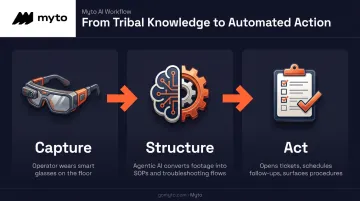
Myto is one company building specifically in this category. Its founding team draws from Mercedes-Benz, BCG, and Stanford, and the company is backed by Y Combinator and General Catalyst.
That combination of manufacturing floor experience, operational strategy, and applied AI research shapes a product built around one idea: capture expertise before it disappears.
This trend matters more than the previous four combined. Legacy document tools can only store what someone consciously typed.
They were never built to catch the knowledge that lives in a technician's hands and ears, the knowledge that walks out the door the day that person retires.
What's Driving These Document Automation Trends
Several forces are pushing adoption faster than most plants expected even two years ago.
- Technology advances: AI, industrial IoT, agentic automation, and wearable capture are making previously "undocumentable" knowledge actionable for the first time
- Workforce pressure: U.S. manufacturers may need as many as 3.8 million new workers between 2024 and 2033, with 1.9 million potentially going unfilled if the skills gap persists
- Cost pressure: unplanned downtime costs the world's largest companies an estimated $1.4 trillion annually, or 11% of revenue, according to Siemens research
- Regulatory demands: ISO 9001, FDA 21 CFR Part 11, drug CGMP rules, and OSHA recordkeeping requirements all push manufacturers toward auditable, automated records instead of paper trails
- Competitive dynamics: Industry 4.0 adoption and digital-twin initiatives are increasing the pressure to move quickly while proving compliance
These pressures reinforce each other: a retiring workforce makes tribal knowledge capture urgent, and rising downtime costs make that urgency too expensive to ignore.
How These Trends Are Impacting Manufacturing Operations
These shifts aren't theoretical. They show up in day-to-day operations, business strategy, and the composition of the workforce itself.
Operational Impact
Approval cycles are shrinking, production stoppages tied to missing or outdated documents are dropping, and rework from data-entry errors is becoming less common.
For example, a missing certificate of conformance used to halt the line until someone tracked it down. Automated systems now flag the gap before production stops, keeping schedules intact.
Documentation is also shifting from an after-the-fact chore to something generated in real time. That change directly improves traceability during audits, since inspectors can see records built as work happened rather than reconstructed afterward.
Business Impact
Manufacturers are moving away from point solutions and toward integrated automation platforms that touch ERP, MES, and QMS together. The payoff shows up in compliance and audit readiness.
There's a strategic angle too: institutional knowledge that compounds inside a platform becomes a competitive asset. A plant that has captured its best operators' troubleshooting expertise depends less on any single employee walking through the door each morning.
Platforms like Myto's capture that expertise directly from the floor, so it survives operator turnover instead of walking out the door with them.
Workforce Impact
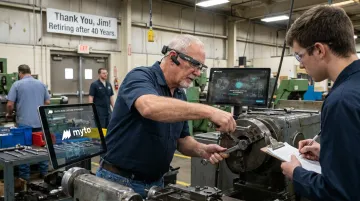
Automation frees skilled workers from paperwork so they can focus on troubleshooting, process improvement, and training newer hires. Training itself changes too: new hires can review captured troubleshooting steps instead of shadowing a senior technician for weeks.
The required skill set is shifting too:
- Fill out fewer manual forms as automated workflows handle routine documentation
- Oversee automated systems rather than execute every step by hand
- Validate AI-generated documentation before it becomes the standard reference
Future Signals for Document Automation in Manufacturing
Watch for these shifts over the next one to three years:
- Agentic AI expands beyond storage. Systems will move beyond storing documents to actively troubleshoot, remediate, and coordinate handoffs across maintenance, quality, and operations teams.
- Wearables become standard floor equipment. Hands-free capture devices feeding continuously into AI systems that learn from top-performing operators will move from pilot programs to routine deployment.
- Manufacturing intelligence compounds. Every documented interaction, every captured troubleshooting step, makes the system better at preventing downtime and standardizing best practices across an entire plant network.
None of this requires manufacturers to rip out existing MES or CMMS systems. The pattern emerging across the industry is layering intelligence on top of what's already running, not replacing it.
Conclusion
Document automation has outgrown its original job of digitizing paperwork. It's becoming a real-time operational intelligence layer that shapes how plants run, comply, and train their people.
Manufacturers that adopt deeper system integration, mobile access, and knowledge-capture technology are building an advantage that compounds. The plants that wait are the ones most exposed when a senior operator retires and takes twenty years of undocumented expertise with them.
Treating documentation as a living knowledge system, not a filing cabinet, separates plants that adapt from those that fall behind. Myto is built to make that shift, turning frontline expertise into intelligence that keeps production running long after an operator retires.
Frequently Asked Questions
What is an example of document automation?
A batch production record that auto-populates with temperature, weight, and time data pulled directly from an MES system is a common example. Another is an engineering change order that routes automatically to the right approvers without manual paperwork.
What is document automation in manufacturing?
It's software and AI-driven systems that create, route, store, and increasingly capture the knowledge behind SOPs, work orders, and compliance records. Modern versions go beyond storage to actively generate documentation from real operational data.
How does document automation improve compliance in manufacturing?
Automated version control and audit trails track and time-stamp every document change, aligning with ISO 9001, FDA 21 CFR Part 11, and OSHA recordkeeping requirements. Standardized templates also reduce missing-field risks during audits.
What's the difference between document automation and document management?
Document management focuses on storing and retrieving files that already exist. Document automation actively creates and routes documentation, and newer approaches even generate it directly from real-world work, like wearable capture of operator expertise.
Can document automation capture tacit or undocumented knowledge?
Legacy document management tools can't, since they only store what someone consciously writes down. Newer wearable and agentic AI approaches, like Myto's AI glasses, passively capture troubleshooting steps and tribal knowledge as operators work, then structure it automatically.
What ROI can manufacturers expect from document automation?
Jabil reported more than 10% higher production yield and 60% fewer defects within four weeks of adopting digital work instructions. Expect similar gains in approval speed and lower administrative overhead, though results vary by plant.