Introduction
It's 2 a.m. on a Saturday, and a stamping press throws an error code nobody on shift has seen before. The line stops. Orders back up.
By the time someone tracks down the one technician who's dealt with this exact fault before, three hours of production are gone.
This scenario plays out in plants every day, and the financial damage adds up fast. Siemens estimates the world's 500 largest industrial companies lose a combined $1.4 trillion annually to unplanned downtime, equal to 11% of their revenue.
This guide breaks down what actually causes downtime, the warning signs that precede a full stoppage, and prevention strategies that work. It also covers how capturing frontline knowledge can stop the same problems from repeating shift after shift.
Key Takeaways
- Downtime splits into two types: planned (maintenance) and unplanned (breakdowns, errors)
- Equipment failure, knowledge gaps, and poor communication drive most unplanned stops
- Ignored downtime causes compound into lost hours, missed deadlines, and safety risks
- Data tracking, preventive maintenance, and standardized troubleshooting cut downtime frequency and duration
- AI-driven knowledge capture sustains these gains long after the initial fix
Common Causes of Manufacturing Downtime
Manufacturing downtime is any stretch when a machine, line, or facility isn't producing. Planned downtime covers scheduled maintenance and changeovers. Unplanned downtime is the unscripted stuff: a breakdown, a jam, a part that just won't behave.
Unplanned downtime rarely comes from a mystery cause. It tends to trace back to a small set of recurring issues that get worse the longer they go unaddressed.
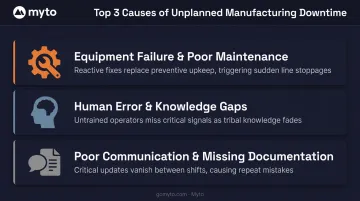
Cause 1: Equipment Failure and Poor Maintenance
Aging components, skipped inspections, and a maintenance culture that only reacts after something breaks are a recipe for surprise failures. A bearing that's been wearing down for weeks gives no formal warning until it seizes mid-shift, because nobody was tracking its condition in the first place.
That single failure can shut down a line for hours while a replacement part gets sourced.
Cause 2: Human Error and Knowledge Gaps
When the fix for a recurring problem lives only in one veteran's head, everyone else is stuck guessing. A 2017 survey of 100 global manufacturers found user error accounts for 23% of unplanned downtime - and a lot of that traces back to missing knowledge, not carelessness.
Picture this: your most experienced technician retires. Two months later, the exact issue they used to fix in ten minutes takes the new hire three hours, because the fix was never written down anywhere. That gap isn't limited to retirements. It shows up whenever a specialist is out sick or a new shift starts without the right context.
Cause 3: Poor Communication and Missing Documentation
A night-shift issue gets a quick verbal mention on the way out the door. Day shift arrives, gets a vague summary, and spends the next two hours re-diagnosing a problem someone already solved. Unclear escalation paths make this worse, letting small issues sit unreported until they become big ones.
The same gap shows up in documentation. When SOPs live in a binder nobody opens, or worse, only in someone's memory, every operator handles the same fault differently. Best practices don't spread because there's no single source of truth for what "good" looks like.
What Happens If Downtime Causes Are Ignored
Ignore these root causes long enough, and the costs stack on top of each other:
- Lost production hours that never get recovered, even if the line restarts quickly
- Missed delivery deadlines, straining customer relationships and triggering penalty clauses
- Off-quality product during rushed restarts, when settings and calibrations get skipped
- Increased safety risk, since chaotic, rushed troubleshooting is when shortcuts and mistakes happen
The scale of this is bigger than most plant managers assume. A NIST analysis of maintenance strategies found plants relying heavily on reactive maintenance averaged 10.38% unplanned downtime as a share of planned production time. Plants leaning on preventive and predictive strategies cut that number to under 5%. That's roughly double the lost capacity, just from letting root causes go unmanaged.
Warning Signs You're About to Experience Downtime
Early indicators almost always show up before a full stoppage. Most plants just don't act on them until it's too late.
- Recurring minor stops or error codes on the same piece of equipment, treated as routine annoyances instead of red flags
- Growing reliance on one or two "go-to" people to fix the same recurring issue, which is really a sign that knowledge isn't documented anywhere else
- A rising maintenance backlog or a pattern of missed preventive maintenance tasks that keeps getting pushed to "next week"
How to Reduce Manufacturing Downtime
Cutting downtime comes down to three things: data visibility, proactive maintenance, and capturing the expertise that actually keeps lines running.
Track and Analyze Downtime Data
Log the duration, cause, shift, and product for every downtime event, no exceptions. Over time, this data reveals whether you're dealing with recurring patterns or one-off flukes.
This is where Pareto analysis earns its keep: since roughly 80% of downtime typically traces back to 20% of causes, ranking issues by frequency and cost tells you exactly where to focus first. Start this tracking from day one of any improvement effort. It only gets more valuable the longer you run it.
Shift from Reactive to Preventive and Predictive Maintenance
Scheduling inspections, lubrication, and part swaps before failure occurs beats waiting for a breakdown every time. Sensor-based condition monitoring adds another layer, flagging vibration or temperature anomalies early enough to fix things during a planned window instead of an emergency one.
Build this into a recurring maintenance calendar and review it regularly. Skipping reviews is how backlogs quietly build back up.
Capture and Standardize Frontline Troubleshooting Knowledge
Most unplanned downtime drags on longer than it should for one reason: the fix lives in someone's head, not in a system anyone else can access. When that person is on vacation, out sick, or gone for good, the team is stuck reinventing the wheel.
This is the gap Myto was built to close. Instead of asking operators to stop and document what they know, Myto's wearable AI glasses capture troubleshooting steps hands-free, while the work is actually happening. No forms and no interruption to the job.
Here's what that looks like in practice:
- The glasses record footage and audio as an experienced technician diagnoses an issue, like a spindle vibration fault
- That content syncs automatically to the Myto platform, no manual upload required
- Agentic AI structures it into SOPs, troubleshooting flows, and training content
- The knowledge feeds into a unified base alongside MES, CMMS, SCADA, and ERP data

The next time a similar fault shows up, Myto's AI agents surface the relevant SOP and prior failure modes automatically. Any operator on shift can then troubleshoot without waiting for one specific person to be available. This should run alongside normal operations continuously, not just after a crisis forces the issue.
Improve Real-Time Communication and Escalation
Set up visual alerts and a tiered escalation path, operator to supervisor to manager, so problems get addressed while they're still small. Automated documentation and handoff summaries prevent the context loss that happens when a night-shift issue shrinks to a two-sentence mumble on the way out the door.
Build this into daily shift-change routines rather than treating it as optional. A handoff summary that captures what was running, what broke, what got fixed, and what still needs watching turns a guessing game into a five-minute read.
Tips for Long-Term Downtime Control
Fixing today's fire is one thing. Keeping downtime low for good takes a different approach:
- Run routine equipment audits, not just post-failure inspections, to catch wear before it turns into a stoppage
- Standardize operator training so troubleshooting steps don't change depending on who's working that day
- Maintain living documentation using AI platforms like Myto that update automatically as frontline expertise evolves, so knowledge doesn't retire when your best people do
- Lean on monitoring and AI systems that compound in value, learning from every downtime event to make the next response faster than the last
Conclusion
Manufacturing downtime isn't random. It has identifiable, fixable root causes:
- Aging equipment lacking maintenance
- Undocumented expertise trapped in operators' heads
- Weak communication at shift handoffs
- Inconsistent processes across similar machines
Consistent tracking, preventive maintenance, and capturing frontline knowledge together build a real defense against recurring stoppages.
Turning tribal knowledge into standardized intelligence costs far less than the firefighting it replaces. Myto captures that expertise before it walks out the door. The plants staying ahead of downtime built systems, not just newer machines, to hold onto what their best operators know.
Frequently Asked Questions
How do I reduce downtime?
Track downtime causes by duration and root cause, prioritize preventive maintenance over reactive fixes, standardize troubleshooting knowledge so it isn't locked in one person's head, and tighten communication between shifts.
How do you calculate downtime in manufacturing?
The basic formula is Downtime % = (Time Down / Total Scheduled Time) x 100. For cost impact, factor in hourly wage, number of affected employees, and lost output per hour.
What is downtime in a manufacturing process?
Downtime is any period production stops, whether planned (maintenance, changeovers) or unplanned (breakdowns, errors, shortages). Reduction efforts typically target unplanned downtime specifically.
What's the difference between planned and unplanned downtime?
Planned downtime is scheduled, like maintenance or changeovers. Unplanned downtime results from unexpected failures, errors, or supply shortages, and it's the primary driver of lost productivity.
What's a good downtime percentage in manufacturing?
Top-performing plants typically keep unplanned downtime in the low single digits, while average performers often run closer to 10% or higher, depending on industry and equipment age.
How does AI help reduce manufacturing downtime?
Platforms like Myto capture operator expertise and machine history in real time through wearable AI glasses, then surface relevant troubleshooting context the moment a similar issue recurs. This cuts diagnosis time compared to relying on memory or paper records.