Introduction
Manufacturing plants generate more data than almost any other industry, yet most still can't answer a simple question: why did that line go down at 2 a.m.?
Unplanned downtime, labor shortages, and knowledge that lives only in a senior operator's head are still the norm on most factory floors.
AI agents change that. Unlike the rule-based automation running on most factory floors today, agents perceive conditions, reason through decisions, and act, without someone approving every step.
That shift toward autonomous action is already showing up in the numbers. The AI-in-manufacturing market is projected to grow from $34.18 billion in 2025 to $155.04 billion by 2030, a 35.3% compound annual growth rate, according to MarketsandMarkets.
This guide covers what AI agents actually are, the types deployed on factory floors today, real use cases, benefits, common implementation pitfalls, and how to pick the right starting point for your plant.
Key Takeaways
- AI agents adapt in real time, unlike older automation running on fixed if-then rules
- Predictive maintenance, quality control, supply chain, and documentation cover most factory use cases today
- Market projections show AI in manufacturing hitting $155 billion by 2030, growing roughly 35% annually
- Most platforms miss frontline tribal knowledge that operators know but never write down
What Are AI Agents in Manufacturing?
An AI agent is autonomous software that perceives data, analyzes it, decides what to do, and acts, largely without a human clicking "approve" at every step. That's the core distinction between agents and the automation most plants have run for decades.
Traditional automation follows fixed rules: if temperature exceeds X, shut down the line. It can't adjust when conditions shift outside its programmed range. AI agents work differently across three capabilities:
- Perception – ingesting sensor and IoT data, machine logs, and system records in real time
- Reasoning – using machine learning models to weigh options and predict outcomes
- Action – triggering workflows, adjusting parameters, or opening tickets without waiting for a human
Agent vs. agentic AI: an AI agent typically handles one task, while agentic AI coordinates multiple agents toward a persistent goal across an entire workflow.
In manufacturing, that might mean five specialized agents jointly managing a production line, from quality flag to root-cause documentation to shift handoff, without a human orchestrating each handoff manually.
Can Manufacturers Actually Deploy This Today?
Yes, increasingly without a dedicated data science team. Cloud computing, edge AI, and no-code/low-code platforms have removed most of the infrastructure barrier that made this feel out of reach five years ago.
The cost of waiting shows up fast in the numbers. Myto's own data across manufacturing deployments shows plants without any knowledge-capture system in place lose 15+ hours of production a week, waiting on the one senior technician who actually knows how to fix a specific machine. Deploy an agent against that exact problem, and the payback window shrinks to months, not years.
That's the pattern worth remembering: agents pay off fastest against a narrow, well-scoped problem, not an entire factory rebuilt at once.
Types of AI Agents Used in Manufacturing
AI agents in manufacturing generally cluster into a handful of categories, each built to solve one operational pain point. Here's how the four most common types actually work on the floor.
Predictive Maintenance Agents
These agents monitor vibration, temperature, and acoustic sensor data continuously, flagging failures weeks before a breakdown happens. Instead of reacting to a machine that's already down, teams get a window to schedule repairs on their own timeline.
Deloitte estimates predictive maintenance can reduce maintenance costs by 5%-10% and increase equipment uptime by 10%-20% using sensor data, machine learning, and edge computing. On plants running thin margins, that swing is often the difference between a good quarter and a bad one.
Quality Control & Inspection Agents
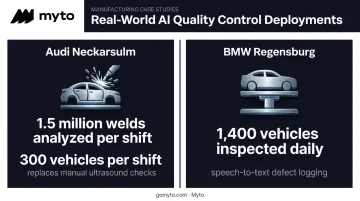
Computer vision agents inspect products at full production speed, catching defects invisible to a human eye scanning parts on a moving line. Two production examples show the scale: Audi's spot-weld inspection system analyzes roughly 1.5 million welds across 300 vehicles per shift at its Neckarsulm plant, replacing random manual ultrasound checks, while BMW's Regensburg plant generates vehicle-specific inspection recommendations for about 1,400 vehicles produced daily, with speech-to-text logging of findings.
Beyond catching defects, these agents run root-cause analysis, correlating a defect pattern with the specific process parameters that likely caused it, so the same flaw doesn't show up again next shift.
Supply Chain & Production Planning Agents
These agents forecast demand, optimize inventory levels, and reschedule production automatically when a supplier misses a shipment or a line goes down unexpectedly. They process demand signals and supply constraints far faster than a planner working in a spreadsheet, which shows up directly in lower stockout rates and tighter carrying costs.
That speed matters most during disruptions: instead of waiting for a planner to spot a missed delivery the next morning, an agent re-sequences the line the moment the gap appears.
Documentation & Knowledge Agents
Compliance records, change logs, and audit trails eat enormous amounts of manual time on any plant floor. These agents automate that paperwork, pulling from ERP and MES systems to generate audit-ready documentation without someone manually re-entering data.
Here's the catch: documentation agents can only document what's already in a structured system. The deepest operational expertise, how an experienced operator knows a bearing is about to fail by sound alone, never enters ERP, MES, or any digital system in the first place. That gap is where most AI agent platforms hit a wall. Platforms like Myto address this directly, using wearable AI glasses to capture that hands-on expertise as operators work and feed it back into the system instead of leaving it undocumented.
Closing the Knowledge Gap: Where Most AI Agents Fall Short
Most AI agent platforms are built to analyze structured data: sensor feeds, ERP records, MES logs. That's necessary, but it misses the most valuable knowledge on any factory floor: how your best operator actually troubleshoots a jam, adjusts a process, or catches a problem before it becomes a shutdown.
Manufacturing contributes $2.3 trillion to U.S. GDP, yet frontline teams still rely on binders, tribal knowledge, and disconnected systems to keep production running. Every retirement or resignation walks that expertise straight out the door.
This is the gap Myto is built to close.
How the Capture Actually Works
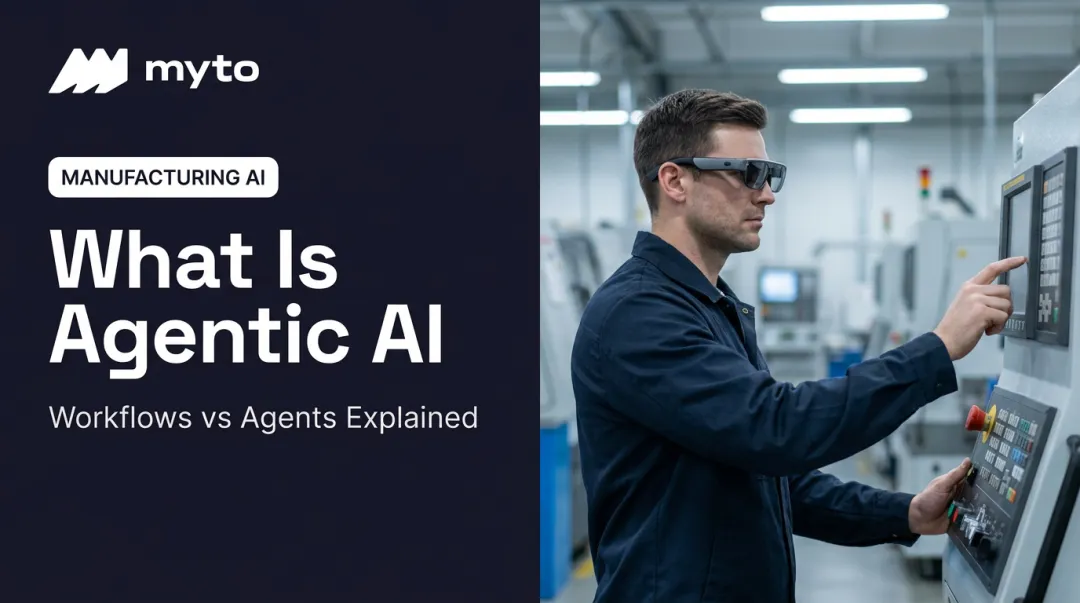
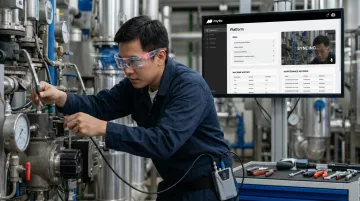
Myto pairs wearable AI glasses with agentic AI automation to passively record how experienced operators actually work: no button presses, no forms, no interruption to their shift. The glasses capture video and audio simultaneously: a technician's hands on a spindle, and what they say out loud while diagnosing it.
That footage syncs automatically to Myto's platform, where an Operational Data Integration layer connects it to existing SOPs, machine history, maintenance tickets, and MES/CMMS records already sitting in your plant's systems. Rather than replacing those systems, Myto sits alongside them, mapping logs to machines and tickets to the SOPs that should already exist.
What the AI Agents Do With It
Once knowledge is captured and structured, Myto's agents put it to work:
- Troubleshooting – pulling equipment history and the right SOP the moment a technician hits a problem, so any operator, not just the one senior tech, can diagnose it
- Documentation – generating SOPs, troubleshooting flows, and training content from how work actually happens today, not from a PDF written by an engineer who left years ago
- Handoffs – drafting shift-handover notes automatically and connecting one shift's incident to the next shift's troubleshooting flow
The practical upside: hands-free operation, fast setup with minimal IT lift, and a platform that gets smarter with every shift it observes. As the labor picture tightens, that combination matters even more.
Myto's team brings Mercedes-Benz, BCG, and Stanford experience, backed by funding from Y Combinator and General Catalyst. If you're curious how this maps to your own plant, Myto offers a 30-minute discovery call.
Benefits and ROI of AI Agents in Manufacturing
Cost savings get the attention, but they're often not the biggest number on the sheet.
Direct gains show up fast:
- Reduced unplanned downtime from predictive maintenance agents catching failures early
- Fewer defects reaching customers thanks to computer vision inspection
- Lower carrying costs from tighter, AI-driven inventory planning
Indirect gains often matter more over time:
- Faster onboarding, new operators ramp up on real, captured expertise instead of shadowing someone for three weeks
- Better decision quality, technicians get the right SOP and root-cause data the moment they need it
- Preserved institutional knowledge, so a retirement doesn't cost the plant everything one person knew
- Smoother shift handovers, outgoing techs leave real context instead of a rushed verbal recap
That last point carries real weight given the labor picture. U.S. manufacturing may need up to 3.8 million net new employees between 2024 and 2033, according to Deloitte and The Manufacturing Institute, and if the workforce gap isn't addressed, an estimated 1.9 million of those roles could go unfilled.
Knowledge capture and worker augmentation aren't a nice-to-have against that number. They're how a plant keeps running when it can't hire its way out of the shortage.
Choosing the Right AI Agents and Overcoming Implementation Challenges
Two things kill more AI projects than bad technology: messy data and unclear ownership.
Data and Legacy System Barriers
Manufacturing data typically lives scattered across ERP, MES, and QMS systems that were never designed to talk to each other. Older plants often compound this problem since the sensors and connected equipment needed to generate usable data aren't there yet.
In McKinsey's research on manufacturing COOs, 46% cited data or IT/OT limitations as a major impediment to scaling AI, close behind the 50% who cited culture as the bigger obstacle.
Workforce Adoption
That culture number isn't small. Cultural resistance and unclear roles derail AI projects faster than any technical gap. Operators who suspect an agent is there to replace them won't feed it good data, and a platform without operator buy-in never gets the inputs it needs to improve.
A Practical Selection Framework
With those barriers in mind, choose your first use case deliberately:
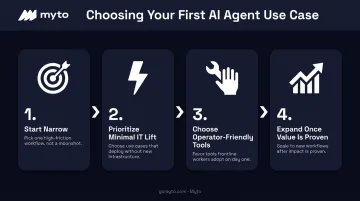
- Start narrow. Pick one high-impact, low-complexity use case, such as one line's predictive maintenance or a single inspection station, not a factory-wide rollout.
- Prioritize minimal IT lift. Platforms requiring months of infrastructure work before showing value rarely survive budget reviews. Myto follows this model, offering fast setup with no heavy infrastructure changes required.
- Choose operator-friendly tools. If the frontline workforce can't use it without heavy training, adoption stalls regardless of the technology underneath.
- Expand once value is proven. Let one working use case fund and justify the next.
Governance matters just as much as selection. Define clearly, before deployment, what agents can act on autonomously versus what needs human sign-off. Skipping that step is how a useful agent becomes a liability.
Frequently Asked Questions
Can you use AI agents in manufacturing?
Yes. Cloud computing, edge AI, and no-code platforms have made deployment realistic even for plants without a dedicated data science team. Most facilities start with one narrow use case and expand from there.
Which AI agents are best for manufacturing?
It depends on your biggest pain point. Predictive maintenance and quality control agents typically deliver the fastest ROI, while knowledge-capture agents solve the workforce and documentation gap that pure automation misses.
What types of AI agents are used in manufacturing?
The main categories are predictive maintenance, quality control and inspection, supply chain and production planning, and documentation and knowledge agents. Most plants deploy more than one type as they scale.
How is agentic AI different from traditional automation?
Traditional automation executes single, fixed-rule tasks and can't adapt when conditions change. Agentic AI coordinates multiple autonomous agents toward a persistent goal across an entire workflow, adjusting as new information comes in.
How much does it cost to implement AI agents in manufacturing?
Costs vary widely by use case, scale, and how much data preparation your systems need beforehand. That last part is often underestimated. Starting with a focused pilot keeps costs controlled while you validate the approach.
How long does it take to see ROI from AI agents in manufacturing?
Narrow use cases like predictive maintenance can show wins within months. Full-scale value across multiple workflows typically takes longer, closer to 12-18 months, as agents integrate deeper into daily operations.