Introduction
A veteran maintenance technician walks past a stamping press and slows down. Something in the rhythm sounds off, a half-second delay no sensor has flagged yet. He adjusts a tension setting, and the line keeps running. Nobody wrote that fix down. It exists only in his head.
Manufacturing generated $2.4 trillion in U.S. value added in 2023, yet most plants still run on three-ring binders and hallway conversations, propped up by the memory of a handful of experienced workers. When that technician retires, so does the fix.
This guide covers what tribal knowledge is, why capturing it is urgent, and a step-by-step framework for doing it well. It also covers the factors that determine whether an initiative succeeds, common mistakes to avoid, and the tools available today, from paper SOPs to AI-powered wearable capture.
Key Takeaways
- Tribal knowledge is undocumented expertise that leaves the moment an employee does
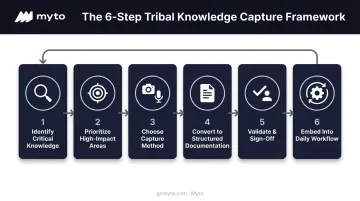
- Capturing it well means a repeatable process: identify, prioritize, capture, document, validate, embed
- Trust, ease of capture, and workflow integration matter more than which tool you choose
- One in four manufacturing workers are 55 or older, risking decades of lost expertise
- AI-powered wearable capture is replacing binders and one-time interviews as the new standard
What Is Tribal Knowledge? (And Why Capturing It Can't Wait)
Defining Tribal Knowledge and Its Examples
Tribal knowledge is the unwritten expertise, shortcuts, and troubleshooting instinct that gets passed informally from one worker to another, usually through conversation and hands-on trial and error on the floor. Nobody sits down to teach it. It just accumulates.
Common examples:
- An operator who recognizes a machine's early warning sounds, a slightly different hum before a belt slips
- A technician's undocumented workaround for a recurring sensor fault that never made it into the CMMS
- A quality inspector who knows which suppliers' materials run "tight" and need an extra check
- A shift lead who knows exactly which valve to bump when a line jams, despite no SOP mentioning it
Tribal knowledge sits between two related concepts worth distinguishing:
- Explicit knowledge is what's written down: SOPs, manuals, work instructions
- Tacit knowledge is an individual's broader personal know-how, some of which they may never share with anyone
- Tribal knowledge is the collective, shared version of tacit knowledge circulating within a team or shift, even when it never gets documented
Why the Clock Is Ticking
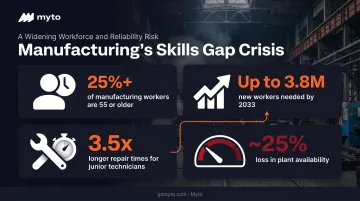
The workforce holding this knowledge is aging out faster than plants can replace it. Workers aged 55 and older now make up roughly a quarter of manufacturing employment. Deloitte and the Manufacturing Institute project manufacturers could need up to 3.8 million new workers between 2024 and 2033, with as many as 1.9 million positions going unfilled if the gap persists.
The financial exposure is just as real. At one materials-processing facility studied by BCG, junior technicians took up to 3.5 times longer than experienced peers on routine maintenance, a gap that contributed to roughly a 25% loss in plant availability. Multiply that gap across every retiring expert on the floor, and availability losses compound quickly across the plant.
This exact pattern, decades of frontline expertise walking out the door faster than it can be replaced, is what drove Myto's founders to act. Their team, which includes veterans of Mercedes-Benz, BCG, and Stanford, built tools that capture that expertise before it's lost.
How to Capture Your Organization's Tribal Knowledge: A Step-by-Step Framework
Capturing tribal knowledge is a repeatable process, not a one-time project with a finish line. Here's the framework that works on the floor, not just on paper.
Step 1: Identify Where Critical Knowledge Lives
Start by mapping the roles, machines, and processes with the highest risk of knowledge loss:
- Sole operators nearing retirement or already eligible to leave
- Machines with complex, non-intuitive troubleshooting steps
- Processes where only one or two people know the "real" procedure
Then audit existing documentation. Compare what the SOP says against what actually happens on the floor. The gap between the two is usually where the tribal knowledge lives.
Step 2: Prioritize High-Impact Knowledge First
Don't try to document everything at once. Focus on knowledge tied to:
- Safety-critical steps
- Quality escapes and rework
- Recurring downtime issues
Downtime and error logs help here. They reveal which undocumented fixes get used most often, showing you where to start.
Step 3: Choose a Capture Method That Fits Real Workflows
Interviews, shadowing, video recording, and hands-free wearable capture all work in theory. In practice, methods that require an operator to stop and write something down tend to fail, because they disrupt production and get skipped the moment things get busy.
Hands-free capture, like AI glasses that record naturally as someone works, sidesteps that problem entirely. There's nothing extra to remember.
Step 4: Convert Raw Knowledge into Structured Documentation
Raw footage, interview notes, or shadowing observations need to become something usable: an SOP, a one-point lesson, or a digital work instruction with visuals.
The part teams often skip is capturing why a step matters, not just what it is. "Tighten to 40 Nm" is a step. "Tighten to 40 Nm because over-torquing here cracks the housing" is knowledge someone can actually use when conditions change.
Step 5: Validate, Standardize, and Get Sign-Off
Ask two or three experienced workers to review the same captured procedure. Versions rarely match perfectly, and that's the point. Reconciling those differences is how you land on the version that reflects actual best practice.
Assign a named owner to approve future updates. Without that, documentation drifts and nobody trusts it.
Step 6: Embed Knowledge Into Daily Workflow and Keep It Current
Documentation stored in a separate repository rarely gets opened. Knowledge needs to show up at the point of work, through QR codes on the machine, a connected worker app, or an AI assistant that surfaces the right SOP the moment a fault code appears.
Build a review cadence too. Materials, equipment, and processes change, and outdated documentation loses its value fast.
Key Factors That Determine Whether Your Tribal Knowledge Capture Succeeds
Most capture initiatives don't fail from lack of effort. They fail because one of these variables gets ignored.
Employee Trust and Psychological Safety
Why it matters: Workers who fear job insecurity, or suspect the initiative is really about performance monitoring, will withhold exactly what you're trying to capture.
The fix: Address the concern directly, explain that the goal is preserving expertise rather than replacing the person who has it, and reward contribution instead of treating capture as surveillance.
Ease of Capture for the Operator
Why it matters: Any method that adds extra steps to an operator's day gets abandoned within weeks.
The fix: Hands-free, in-the-flow-of-work capture, such as Myto's AI glasses that log expertise as operators work, sustains participation far longer than manual logging, because there's nothing new to remember to do.
Workflow Integration vs. Standalone Repositories
Why it matters: Knowledge stored separately from where work happens rarely gets used, even when it's good.
The fix: Embedding knowledge into systems people already open, such as MES, ERP, or digital work instructions, drives adoption far better than a new portal ever will.
Leadership Sponsorship and Incentives
Why it matters: Without visible support from plant leadership, knowledge-sharing initiatives tend to stall right after the initial enthusiasm wears off.
The fix: Recognizing and rewarding contributors, even informally, keeps participation going long after the kickoff meeting.
Continuous Validation and Updates
Why it matters: Processes evolve. Static documentation becomes outdated, and outdated documentation becomes untrustworthy fast.
The fix: Assign a designated owner and a review cadence so captured knowledge stays accurate as equipment, materials, and methods change.
Common Mistakes to Avoid When Capturing Tribal Knowledge
Even well-intentioned programs run into the same handful of problems:
- Waiting for the exit interview. Starting capture only after a veteran employee announces retirement or resignation leaves weeks, not years, to transfer what they know.
- Treating it as a one-time project. Tribal knowledge capture that ends after the first documentation push goes stale the moment a process changes.
- Forcing nuance into rigid templates. Cramming a technician's judgment call into a checkbox strips out the context that made it valuable.
- Building a repository nobody opens. A knowledge base sitting outside daily workflow, disconnected from MES, ERP, or work instructions, gets ignored no matter how well it's organized.
Tools and Methods for Capturing Tribal Knowledge: From Binders to AI
Traditional and Digital Documentation Methods
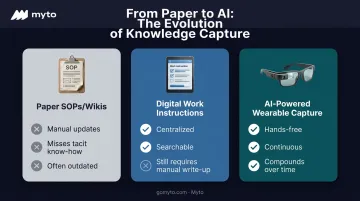
Paper SOPs, wikis, and static manuals capture explicit steps well enough. What they miss is everything else: the sound a bearing makes before it fails, the feel of a properly seated part, the context behind why a step exists. They're also hard to keep current, often sitting untouched until something breaks.
Digital work instructions and connected worker apps close some of these gaps by centralizing knowledge, supporting search, and making updates easier to distribute. That's a real improvement, but most still depend on someone finding time to sit down and manually write the knowledge into the system, meaning the bottleneck hasn't actually moved.
AI-Powered Wearable Capture: The Emerging Approach
A newer approach skips the writing step entirely. AI glasses and other wearable capture technology record physical-world expertise as operators naturally work, hands-free, with no extra steps and no burden on the person doing the job.
That raw activity, video, audio, and machine context, feeds into an agentic AI system capable of:
- Structuring footage into audit-ready SOPs and troubleshooting flows
- Surfacing the right context (machine history, applicable SOP, likely root cause) the moment a problem occurs
- Drafting shift-handover documentation automatically instead of relying on a handwritten note the next shift ignores
- Opening maintenance tickets and scheduling follow-ups without the operator leaving the floor
This is the approach Myto has built, drawing on a team with backgrounds from Mercedes-Benz, BCG, and Stanford. The key difference from a one-time interview or shadowing exercise is that it compounds. Every shift adds more context, and the system learns from how the best operators actually work rather than freezing a single conversation in time.
Choosing the Right Mix for Your Organization
No single method covers every role. A reasonable starting mix:
- Use digital work instructions for stable, low-risk processes that rarely change
- Reserve interviews and shadowing for roles being phased out or too small in number to justify new tooling
- Prioritize hands-free wearable capture for high-risk, high-complexity roles: sole experts, safety-critical troubleshooting, recurring downtime causes
Weigh facility size, IT readiness, and how critical hands-free capture is for specific roles before committing to one method across the board.
Frequently Asked Questions
How do you capture tribal knowledge?
Start by identifying the roles and machines at highest risk of knowledge loss, then pick a low-friction capture method. Document with context (not just steps), validate with multiple experienced workers, and embed the result into daily workflow rather than a standalone repository.
Is it still acceptable to say "tribal knowledge"?
Some prefer neutral alternatives like "institutional knowledge" or "collective knowledge" because of the term's cultural connotations. "Tribal knowledge" remains widely used in manufacturing and business contexts, and both terms refer to the same underlying concept.
What is an example of tribal knowledge?
A classic example is a maintenance technician who recognizes a failing bearing by its sound or vibration well before any sensor flags it, then applies a fix nobody ever wrote down.
What's the difference between tribal knowledge and tacit knowledge?
Tribal knowledge is the collective, shared expertise circulating within a group or shift. Tacit knowledge is broader: it's the personal know-how any individual holds, some of which may never get shared with anyone else.
How long does it take to capture an organization's tribal knowledge?
It's an ongoing process, not a single project with an end date. That said, prioritizing high-risk roles first can produce initial documentation within weeks rather than months.
What happens if tribal knowledge is never captured?
Expect knowledge loss every time someone leaves, inconsistent processes across shifts, slower onboarding for new hires, and the same costly troubleshooting getting repeated from scratch each time.