Confusing these terms isn't just a semantic problem. It shapes real decisions: how much control your team keeps, how auditable your processes stay, and how fast your operators can respond when a machine starts acting up at 2 a.m.
Manufacturing runs on compliance documentation, shift handoffs, and troubleshooting that can't wait for a committee meeting. Picking the wrong architecture for the job, an unbounded agent where you needed governed steps, or a rigid workflow where you needed split-second reasoning, creates friction you'll feel on the line.
This article breaks down what agentic workflows and AI agents actually are, compares them side-by-side, and helps you figure out which one (or which combination) fits your production environment.
Key Takeaways
- Agentic workflows orchestrate multiple agents, tools, and human checkpoints toward a structured goal.
- AI agents reason and act independently within a bounded task, with far less scripting.
- Workflows provide stronger governance and auditability, while agents offer greater speed and adaptability.
- Most mature deployments combine both — agents handle real-time judgment, workflows keep it auditable.
Agentic Workflows vs AI Agents: Quick Comparison
Before covering definitions, here's the side-by-side breakdown manufacturing leaders actually need when scoping a project.
| Dimension | Agentic Workflow | AI Agent |
|---|---|---|
| Autonomy level | Bounded: decisions happen at predefined nodes in a larger control graph | High: it reasons and acts in an open-ended loop without fixed steps |
| Control & traceability | Modular, step-wise visibility with logs, retries, and audit trails | Often harder to debug or certify; reasoning can feel like a black box |
| Architecture | Orchestrates multiple agents, APIs, databases, and human checkpoints | Single entity built from an LLM core, tool wrappers, and memory |
| Best fit for | Multi-step, high-reliability, compliance-heavy processes | Bounded, fast-moving, self-contained tasks |
Neither approach is inherently better. IBM frames the distinction between agentic workflows and AI agents as one of scope: a workflow is the coordinated process, while an agent is the acting component inside it. That framing matters once you start mapping these tools to actual plant-floor problems.
What Is an Agentic Workflow?
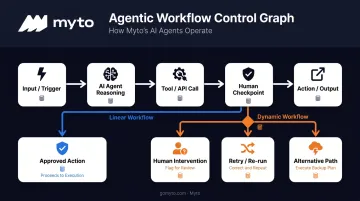
An agentic workflow is a multi-step, orchestrated process that coordinates AI agents, tool calls, and human checkpoints toward a complex goal. Think of it as the control graph that sits on top of the intelligence, coordinating how agents, tools, and people work together.
In manufacturing, that structure matters because handoffs rarely stay within one system. A quality deviation might touch a machine sensor, a CMMS ticket, a compliance database, and a supervisor's sign-off, all before the shift ends.
Two core benefits stand out:
- Governance and observability. Every step gets logged, turning audits into a quick records pull — critical on regulated lines where a missed signature carries real consequences.
- Consistency at scale. A structured workflow standardizes best-practice troubleshooting across shifts and plants, rather than leaving it to whoever's on duty.
Workflows come in two flavors:
- Linear workflows — a fixed sequence, useful when the process rarely changes (a batch-release checklist, for example).
- Dynamic workflows — branching logic where an AI evaluation at each decision node determines the next step, useful when conditions vary but still need to stay governed.
Where Agentic Workflows Prove Their Value
Workflows dominate wherever multiple systems and high stakes intersect:
- Predictive maintenance scheduling that pulls sensor data, checks parts inventory, and routes a work order
- Multi-step quality control pipelines in automotive assembly, where every inspection point needs a paper trail
- Compliance and documentation reporting, especially in pharmaceutical batch records and aerospace inspection sequences
A 2025 Alvarez & Marsal case study on a German pharmaceutical manufacturer illustrates the payoff. The company deployed an AI-powered document-review workflow to digitize and cross-check batch-release documentation.
Batch-release time dropped from weeks to days, clearing roughly €2 million in delayed revenue that had been stuck behind manual review. The workflow replaced work previously handled by a six-person team, without cutting corners on compliance.
What Is an AI Agent?
An AI agent is an autonomous software entity that perceives its environment, reasons about a goal, and takes action without a fixed script. Unlike a workflow, there's no predetermined sequence; the agent figures out its own path.
On the shop floor, this makes agents ideal frontline problem-solvers. They don't wait for a supervisor to escalate a decision; they act inside the bounds they've been given.
Two core benefits define their value:
- Speed. An agent can start diagnosing a fault the moment it's detected, cutting first-response time without a human bottleneck in the loop.
- Adaptability. When a fault doesn't match any existing SOP, an agent can still reason through the problem using historical context, rather than stalling out.
Agents split into two general categories:
- Reactive agents respond to sensor triggers or reported anomalies after the fact
- Proactive agents attempt to predict failures before they surface as downtime
Where Standalone AI Agents Prove Their Value
Agents shine in fast, bounded, single-point tasks:
- Single-machine diagnostics: pulling equipment history and surfacing likely root causes in seconds
- Real-time anomaly detection: flagging unusual vibration, temperature, or output patterns as they happen
- On-demand documentation: generating troubleshooting notes directly from operator activity, no manual write-up required
This is the exact gap Myto's AI agents were built to close. They're trained on a plant's own operational data, including SOPs, machine history, and ticket logs, plus footage captured by Myto's wearable AI glasses.
When a technician runs into spindle vibration on a CNC machine, the agent surfaces the relevant history (last bearing replacement, prior failure modes) and likely causes, then documents the resolution automatically for the next shift.
The stakes here are significant. Siemens' 2024 downtime report puts the cost of unplanned downtime at a large automotive plant at $2.3 million per hour, while broader industrial surveys put the median closer to $125,000. Either way, the math on faster diagnosis adds up fast.
Agentic Workflows vs AI Agents: Which Should You Choose?
There's no universal answer here, only a set of factors worth weighing before you commit budget and IT time to one architecture.
Ask yourself:
- How complex is the task? A single diagnostic step favors an agent; a process spanning multiple systems favors a workflow.
- Do you need auditability? Regulated processes, batch records, and safety inspections need the traceability a workflow provides.
- Is speed or control the priority? Agents move faster; workflows move more predictably.
- How many sites are you scaling across? Workflows standardize behavior across plants; agents adapt to local conditions but can drift without oversight.
Situational guidance:
- Choose agentic workflows when governance, compliance, or multi-system coordination is non-negotiable.
- Choose standalone agents for fast, bounded, high-frequency tasks where waiting for orchestration costs you more than it saves.
- Choose a hybrid model when you need both: agents handle fast decisions inside each step, workflows track the sequence and outcome.
In practice, most mature deployments follow this hybrid path. Myto's platform reflects the same model: its agents troubleshoot, document, and follow up inside each workflow step, while the broader process keeps the audit trail intact.
This mirrors how agentic system research frames the pattern — specialized agents operating inside feedback-driven processes with human oversight built in.
Real-World Example: Agentic AI on the Manufacturing Floor
Myto's founding team, with backgrounds from Mercedes-Benz, BCG, and Stanford, saw the tribal-knowledge problem firsthand before building a platform to solve it.
Senior operators were retiring faster than plants could replace them. Most of what they knew, how a bearing sounds right before it fails, how to handle a downtime event start to finish, never made it into a system.
It lived in binders nobody read or in the head of the one technician everyone waited for.
Myto's team has seen the pattern repeat across plants: on average, they lose more than 15 hours of production per week to unplanned downtime, and 60% of that downtime stems from failures the right operator could have caught or diagnosed faster.
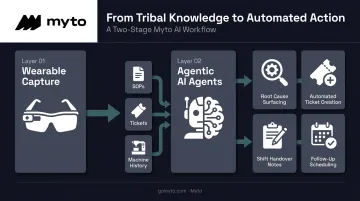
The fix combined two layers:
- Wearable capture: AI glasses record troubleshooting steps and expert maneuvers hands-free, with zero extra effort from the operator
- Agentic AI agents: trained on that captured footage plus existing SOPs, tickets, and machine history, capable of surfacing root causes, opening tickets, drafting shift-handover notes, and scheduling follow-ups autonomously
Instead of static SOPs written years ago by engineers who've since left, the system builds troubleshooting flows from how work actually happens today, and keeps them current as new footage comes in.
The takeaway: pairing workflow-level structure with autonomous agents turns one expert's hands-on knowledge into institutional knowledge. The line keeps running long after that expert has moved on.
Ready to see how it works on your floor? Book a discovery call with Myto to explore how wearable capture and agentic AI can turn frontline expertise into automated troubleshooting, documentation, and shift coordination.
Frequently Asked Questions
What is an agentic AI workflow?
An agentic AI workflow is a multi-step, orchestrated process where AI agents, tools, and sometimes humans collaborate through defined decision points to reach a goal. It provides structure and traceability around otherwise autonomous decision-making.
What are the stages of an agentic AI workflow?
Most workflows follow four stages: gathering input, reasoning through next steps, executing tasks via tools or sub-agents, then evaluating results and looping until the goal is met. Each stage can include a human checkpoint if needed.
What is an example of an agentic AI workflow?
A predictive maintenance workflow is a common example: it flags a sensor anomaly, diagnoses the likely cause, and routes a fix to the right technician. Myto's agents run this same type of workflow to cut unplanned downtime on the shop floor.
What's the difference between an AI agent and an agentic workflow?
An AI agent is a single autonomous entity making decisions internally, within a bounded task. An agentic workflow orchestrates multiple agents, tools, and steps with externalized, auditable control.
Can AI agents and agentic workflows be used together?
Yes, and most production systems do exactly that. Workflows govern and sequence the process, while agents handle the reasoning and execution within individual steps.
Is agentic AI the same as generative AI?
No. Generative AI creates content or predictions on request. Agentic AI adds autonomy and planning on top of that, letting it pursue a goal instead of just responding to a prompt.