

Many plants still fight this battle with one hand tied behind their back. Repair knowledge lives in a veteran technician's head, in a three-ring binder in the maintenance office, or scattered across a CMMS nobody fully trusts. When a machine fails at 2 a.m., the newest tech on shift has to reconstruct what the senior guy already knows by heart.
This guide breaks down what MTTR reduction actually means, how it connects to MTBF and MTTF, and the practical steps — including capturing frontline expertise before it disappears — that actually move the number.
Key Takeaways
- MTTR reduction systematically shortens the average time to restore failed equipment
- Most delay hides in diagnosis, not the physical fix itself
- It works alongside MTBF and MTTF to paint the full reliability picture
- Turning tribal knowledge into accessible guidance is the fastest lever for cutting repair time
- Tracking MTTR by machine and failure type shows exactly where to invest first
What Is MTTR (Mean Time to Repair)?
MTTR stands for Mean Time to Repair — the average time from when a failure is identified to when the equipment is back to full operational status. It's a maintainability metric: it measures how well your team responds to failures, not how often those failures happen in the first place.
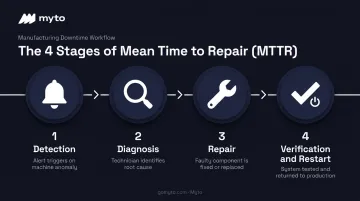
A typical repair on the plant floor moves through four stages:
- Detection — the failure is noticed, either by an operator, a sensor alert, or a quality issue downstream
- Diagnosis — the technician figures out what's actually wrong
- Repair — the physical fix happens: part replacement, adjustment, recalibration
- Verification and restart — the machine is tested and handed back to production
The formula is straightforward:
MTTR = Total repair time ÷ Number of repair events
Say a stamping press goes down three times in a month: a 45-minute fix, a 2-hour fix, and a 3-hour fix. Total repair time is 5 hours 45 minutes across 3 events, so MTTR comes out to just under 2 hours per breakdown.
A few clarifications matter: In manufacturing, MTTR usually refers to unplanned corrective repairs, not scheduled preventive maintenance. Some teams use MTTR to mean Mean Time to Restore or Mean Time to Resolve instead of Repair — the label matters less than applying one consistent definition across every shift and every technician.
The financial stakes are real. ABB's 2023 global survey of over 3,200 plant-maintenance decision-makers found that unplanned outages cost the typical industrial business a median of $125,000 per hour. That number alone explains why shaving even 20 minutes off average repair time matters at scale.
MTTR vs. MTBF vs. MTTF: Understanding Related Reliability Metrics
MTTR doesn't operate alone. Two related metrics, MTBF and MTTF, round out the reliability picture.
MTBF (Mean Time Between Failures) measures the average operating time a repairable asset runs before it fails again. Formula: total uptime ÷ number of failures. Maintenance planners use it to set inspection intervals and forecast when a machine is statistically due for trouble.
MTTF (Mean Time to Failure) applies to non-repairable components: bearings, filters, sensors, anything you replace rather than fix. Formula: total operating hours ÷ number of units observed. It tells you when to schedule a replacement before failure happens.
Here's how the three stack up:
| Metric | What It Measures | Formula | Best Use Case |
|---|---|---|---|
| MTTR | Speed of repair | Total repair time ÷ number of repairs | Diagnosing and fixing corrective maintenance issues |
| MTBF | Frequency of failure (repairable assets) | Total uptime ÷ number of failures | Scheduling inspections and preventive maintenance |
| MTTF | Lifespan (non-repairable parts) | Total operating hours ÷ units observed | Planning parts replacement before failure |
MTTR measures how fast you fix a problem. MTBF and MTTF measure how often problems occur or how long parts last. Together, the three metrics show how often failures happen, how long components survive, and how quickly your team recovers when something breaks.
There's a direct mathematical link between MTTR and uptime, too:
Availability = MTBF ÷ (MTBF + MTTR)
If MTBF stays flat but you cut MTTR in half, availability climbs, even though not a single failure was prevented. Reducing repair time is one of the fastest ways to improve uptime, even before you touch failure frequency at all.
Why MTTR Reduction Matters for Manufacturing
MTTR feeds directly into Overall Equipment Effectiveness (OEE) through the Availability component. OEE = Availability × Performance × Quality, so every hour trimmed off repair time raises Availability and, with it, the plant's overall OEE score.
Fluke's OEE benchmarking example illustrates the math well:
| Metric | Value |
|---|---|
| Expected hours | 720 |
| Downtime hours | 32 |
| Availability | 95.55% |
| Performance | 86% |
| Quality | ~87% |
| OEE | 71.48% |
Cut those 32 downtime hours in half, and both Availability and OEE climb accordingly.
But the impact reaches further than the spreadsheet:
- Missed throughput targets cascade into late shipments and strained customer relationships
- Rushed repairs performed without full context create real safety risk on the floor
- Repeat failures from incomplete fixes eat into the very MTTR gains you were chasing
Speed matters, but only when it doesn't come at the expense of doing the repair right the first time.
What Causes High MTTR in Manufacturing?
Most high-MTTR plants share a common root cause: the diagnosis phase eats far more time than the actual fix. Three patterns drive that delay:
Tribal knowledge trapped in one person's head. When the veteran technician who's fixed a specific spindle vibration issue a dozen times isn't on shift, others troubleshoot slower or escalate unnecessarily. That expertise exists as muscle memory, not documentation. Myto closes this gap by capturing it hands-free as it happens.
Fragmented systems. Work orders live in the CMMS, manuals sit in a tool-room binder, and repair history scatters across spreadsheets nobody updates. Technicians burn minutes hunting for context before they even start diagnosing, time that never counts as "repair time" yet still inflates MTTR.
Poor shift handoffs. When incoming technicians can't see what the previous shift already tried, they repeat diagnostic steps that already came up empty. A note reading "checked the spindle" says nothing about what was ruled out, so that gap gets rediscovered the hard way, every time.
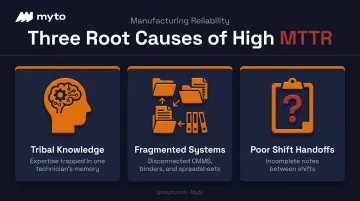
Left unaddressed, these three gaps compound into hours of wasted diagnostic time on every work order.
Proven Strategies to Reduce MTTR (and Increase MTBF)
Cutting MTTR starts before the wrench even comes out. The real fix is removing the friction that slows diagnosis and repair, not just working faster under pressure.
Build standardized troubleshooting playbooks. For common failure modes, give technicians a proven sequence to follow instead of starting from scratch every time. A good playbook includes asset identification, step-by-step instructions, required tools, torque values, and normal operating parameters.
Centralize the knowledge base. Combine machine history, past fixes, and expert know-how in one searchable place instead of relying on individual memory or scattered notes across five different tools.
Adopt predictive and condition-based maintenance. Vibration, temperature, and sensor monitoring catch developing issues before full failure. Siemens' 2024 True Cost of Downtime report documented client deployments seeing 85% better downtime-forecasting accuracy and 50% less unplanned machine downtime. These gains tie directly to raising MTBF while giving technicians earlier diagnostic context.
Standardize shift handoffs and run brief post-repair debriefs. Feed lessons from every fix back into the playbook so the same problem doesn't cost 40 minutes of rediscovery next week.
Capture expertise as it happens, not after the fact. Myto's wearable AI glasses record troubleshooting hands-free, right in the natural flow of work, with no forms, tablets, or interruptions to the technician's process. Agentic AI then structures that footage into troubleshooting flows any operator can pull up instantly, cutting the diagnosis time that traditionally eats the largest chunk of MTTR.

In practice, a technician can ask an AI agent to pull up the relevant SOP and get back more than a document: ranked likely root causes based on the machine's actual history.
Track MTTR by machine, line, and failure type. Averages hide the truth. A plant-wide MTTR of 90 minutes might mask one machine averaging 4 hours because nobody's documented its quirks. Segmenting the data shows exactly where knowledge gaps or manual processes are inflating repair time, and where to fix it first.
Frequently Asked Questions
How do you reduce MTTR and increase MTBF?
Reducing MTTR relies on standardized playbooks, centralized knowledge, and faster diagnosis. Increasing MTBF relies on predictive maintenance and fixing root causes instead of applying quick patches that fail again later.
Is lower MTTR better?
Generally, yes: lower MTTR means less downtime cost and less production impact. The caveat: speed shouldn't come at the expense of finding the true root cause, or you'll just see the same failure again soon.
What are MTTR, MTTF, and MTBF?
MTTR measures how fast you repair a failed asset. MTBF measures how often a repairable asset fails. MTTF measures the expected lifespan of a non-repairable part before replacement.
What is a good MTTR benchmark for manufacturing equipment?
There's no universal number — it varies by equipment criticality, complexity, and industry. Set internal targets per machine type using your own historical data rather than chasing an outside benchmark.
How is MTTR actually calculated on the shop floor?
Total repair time divided by number of repair events. Track it consistently by shift, machine, or failure type. A single plant-wide average hides too much useful detail to act on.
Does MTTR include time waiting for spare parts?
Most manufacturing definitions separate active repair time from logistics delays like part procurement. Track both separately: lumping them together hides whether your bottleneck is diagnosis, repair skill, or your supply chain.