Introduction
Walk into most manufacturing plants and you'll find two things: a binder full of SOPs nobody updates, and a senior operator who's the only person who knows how to fix the machine when it jams at 2 a.m.
The real issue is knowledge management, not training.
55% of organizations name silos as a top barrier to effective knowledge management, according to Deloitte's research on knowledge management strategy. The same study found 75% of leaders consider preserving institutional knowledge critical over the next year, yet only 9% felt ready to act on it.
Most companies have SOPs for tasks. Few have an SOP for how knowledge itself gets captured, stored, and kept current as experienced employees retire or move on.
This guide covers what a knowledge management SOP is, its core components, a step-by-step build process, common pitfalls, and how AI and wearable technology are changing how frontline expertise gets captured.
Key Takeaways
- Knowledge management SOPs govern how knowledge moves, not just how tasks get done
- Tacit knowledge (the stuff in people's heads) needs a different capture method than written documentation
- SOPs built without frontline input consistently see lower adoption
- AI-powered wearable capture closes documentation gaps traditional methods miss
What Is a Knowledge Management SOP?
A knowledge management SOP is a documented set of steps governing how an organization creates, stores, retrieves, shares, and eventually retires knowledge assets. It's different from a task-based SOP.
A regular SOP tells someone how to calibrate a machine. A knowledge management SOP tells the organization how that calibration knowledge gets written down, where it lives, who reviews it, and how it gets updated once the process changes.
There's a critical distinction most companies miss:
- Explicit knowledge - written documentation, manuals, checklists, anything already captured in a system
- Tacit knowledge - experience-based expertise that lives in someone's head, like knowing a bearing is failing by the sound it makes
Most SOP programs only address explicit knowledge. That's the problem. The most valuable expertise on a factory floor rarely gets written down at all.
Why It Matters
Undocumented knowledge is a liability with a countdown clock. In manufacturing specifically, a Deloitte survey of 100 manufacturing C-suite leaders found 85% rated the coming knowledge exodus a moderate-to-mission-critical threat - yet 92% admitted their organizations don't consistently capture knowledge from employees nearing retirement.
That gap has a real cost. According to industry benchmarks, the average plant loses 15+ hours of unplanned downtime a week, at roughly $260,000 per hour - close to 800 hours of lost production annually. Much of that downtime traces back to a fix that only one person on the floor actually knows how to do.
Beyond the operational risk, regulated industries face a compliance layer too:
- Pharmaceutical manufacturers must follow written procedures under CGMP (21 CFR 211.100(b))
- High-hazard facilities covered by OSHA's Process Safety Management standard must maintain written operating procedures and certify them annually
In these environments, a knowledge management SOP becomes the backup plan for when your best people walk out the door.
The Core Components of a Knowledge Management SOP
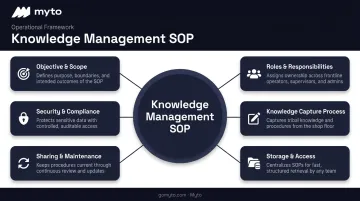
Every effective knowledge management SOP covers six areas. Skip one, and you end up with a system that captures information nobody can find or trust.
- Objective and scope - defines exactly what the SOP covers (capture, storage, retrieval, sharing) and which teams or departments it applies to
- Roles and responsibilities - assigns knowledge creators, curators, reviewers, and approvers, often using a RACI framework (Responsible, Accountable, Consulted, Informed) to clarify who signs off on what
- Knowledge capture process - outlines how both explicit and tacit knowledge get documented, including interviews, lessons-learned templates, and structured checklists
- Storage, organization, and access - covers naming conventions, tagging, metadata, and permission levels so people find what they need without digging through folders
- Sharing, distribution, and maintenance - defines communication channels, update cadence, and a review schedule so knowledge doesn't go stale
- Security and compliance - establishes access controls and data protection protocols, especially critical for regulated industries like healthcare, finance, or manufacturing
Under ISO 9001 guidance, documented information needs clear identification (title, date, author, reference number), a defined format, and a formal review-and-approval step before it's considered valid. Skipping that last step is how outdated SOPs end up circulating for years.
Myto's agentic AI platform can handle much of this automatically - its AI glasses capture tacit knowledge as operators work, then auto-generate structured SOP documentation and flag it for review before compliance windows close.
How to Develop a Knowledge Management SOP: A Step-by-Step Framework
Building a knowledge management SOP isn't a one-afternoon project. Here's the sequence that actually holds up in practice.
- Run a knowledge audit. Map what knowledge already exists, where the gaps sit, and who currently has access to what. You can't manage knowledge you haven't located first.
- Define the SOP structure. Outline the six core components (capture, storage, sharing, security, and so on) in a logical flow before you draft a single line.
- Bring in frontline employees early. Change initiatives succeed more often when the people doing the work help shape them. Floor-level input catches gaps a manager writing from an office will always miss.
- Draft using specific, active-voice language. Add flowcharts or visual aids anywhere a process branches into multiple decision points. Ambiguity is the enemy here. Platforms like Myto can auto-generate a first draft from captured operator workflows, giving your team a working start instead of a blank page.
- Roll it out in stages. Pair each phase with structured training so employees understand the new procedure before it becomes mandatory.
- Monitor, gather feedback, and schedule reviews. High-risk or heavily used procedures need more frequent check-ins than lower-risk ones. OSHA's Process Safety Management standard, for example, requires annual certification that operating procedures remain current.
Best Practices for Writing SOPs Teams Will Actually Follow
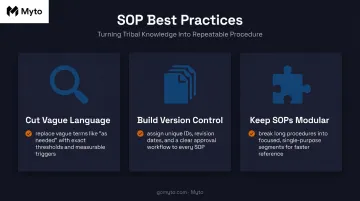
Most SOPs fail not because the content is wrong, but because nobody can follow them. Three fixes make the biggest difference:
- Cut vague language entirely: Swap "as needed" or "soon" for exact thresholds, such as a defined time window, a set quantity, or a clear trigger condition, to prevent inconsistent execution across shifts.
- Build in version control: Give every SOP a unique document ID, effective date, revision history, and approval workflow so teams don't end up following an outdated printout months after it's been revised.
- Keep SOPs modular: Break long procedures into focused segments so a frontline worker hunting for one troubleshooting step isn't stuck scrolling through forty pages to find it.
Common Challenges in Knowledge Management SOP Implementation
Even well-designed SOPs run into the same three obstacles repeatedly.
Resistance to Change
Employees ignore SOPs they feel were imposed on them rather than built with them. The fix is involving teams during drafting, not just during rollout, and being explicit about what's in it for their daily work: less rework, fewer repeated questions, faster problem-solving.
Capturing Tacit Knowledge
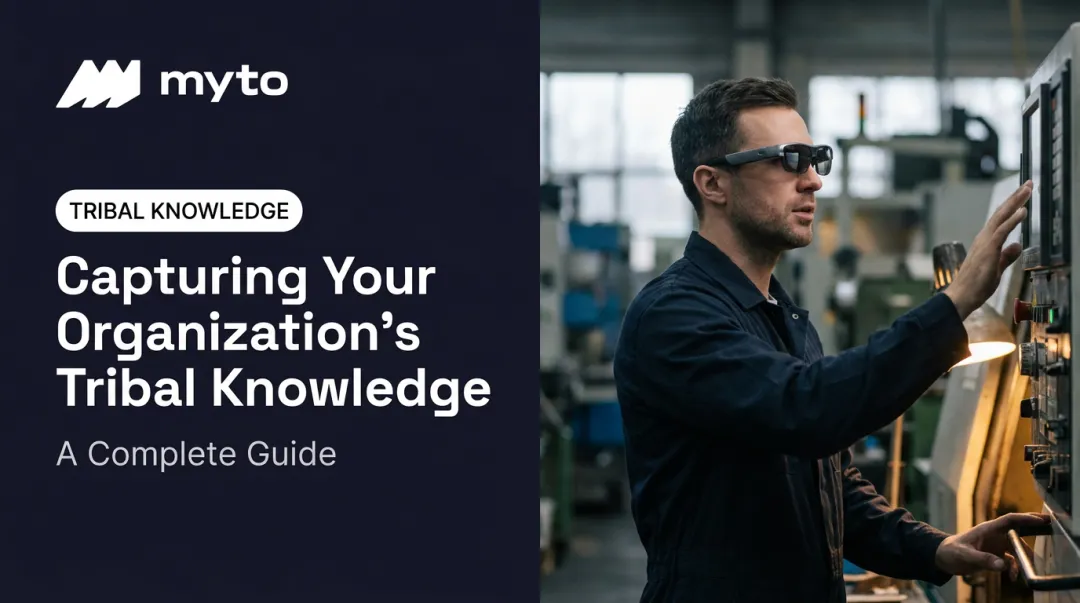
Traditional SOP methods rely on someone sitting down to write out what an expert does. That process misses the instinctive troubleshooting moves and workarounds that live only in an experienced worker's hands and head, the exact knowledge most at risk when they leave. Wearable capture tools like Myto's AI glasses solve this by recording that expertise hands-free, as the work happens.
Keeping Knowledge Current
Static documents decay fast. A process changes, a machine gets replaced, and the SOP no longer matches reality. Assigning clear ownership and a set review cadence is the only reliable defense against this.
How AI and Wearable Tech Are Changing Knowledge Capture for Manufacturing SOPs
Manufacturing contributed $3.0 trillion at an annual rate to U.S. GDP in early 2026, according to NAM's analysis of Bureau of Economic Analysis data. Despite that scale, frontline teams still lean on binders, tribal knowledge, and disconnected systems to run their SOPs day to day.
The reason is simple: traditional SOP creation depends on someone manually writing down what an expert operator does. That process is slow, incomplete, and the first thing skipped during a busy production run.
This is the gap Myto was built to close. Instead of asking operators to stop and document their work, Myto's wearable AI glasses capture real workflows hands-free, as they happen, with zero extra steps:
- Troubleshooting steps a senior technician takes when diagnosing an equipment issue
- Expert equipment maneuvers that have never made it into a written procedure
- Shift handoffs: what ran, what broke, what got fixed, and what the next shift needs to watch
- Expert behavior patterns, like recognizing a bearing failure by sound alone
From there, Myto's agentic AI turns that captured footage into structured, audit-ready outputs:
| Output | Built From |
|---|---|
| Shift-handover documents | Glasses capture + operational data |
| Troubleshooting flows | Machine history + captured expertise |
| Updated, version-controlled SOPs | Glasses capture + logs + tickets |
| Maintenance tickets & follow-ups | Machine events + agent workflows |
| Training content | Senior operator expertise capture |
The platform also ingests data your plant already generates, including SOPs, machine logs, MES and SCADA records, CMMS tickets, and quality data. It stitches all of this into one knowledge layer without replacing the systems already in place.
That shift redefines what a knowledge management SOP can be. Rather than a static document that goes stale the moment a process changes, the system compounds intelligence over time by continuously learning from how your best operators actually work.
Frequently Asked Questions
What is SOP in knowledge management?
A knowledge management SOP is a documented procedure defining how an organization captures, stores, shares, and retires knowledge assets. It's distinct from a general SOP, which governs how one specific task gets performed.
What are the four pillars of knowledge management?
Effective knowledge management depends on the interaction of people, processes, technology, and content. ISO 30401 frames these as interdependent elements rather than a fixed checklist.
What are the five parts of an SOP?
Most SOPs cover five sections: purpose and scope, roles and responsibilities, step-by-step procedure, required resources, and a review/approval step. This isn't a formal standard, just the practical baseline most teams use.
How often should a knowledge management SOP be reviewed?
High-risk or heavily used procedures typically warrant quarterly reviews, while lower-risk SOPs can follow an annual cycle. Regulated processes may have specific mandated intervals, so check applicable standards first.
What's the difference between a knowledge management SOP and a general SOP?
A general SOP governs a single task, like calibrating a machine or completing a quality checklist. A knowledge management SOP operates above that: it governs how knowledge from every process gets captured, organized, and kept current.
Who is responsible for maintaining a knowledge management SOP?
Responsibility usually sits jointly between a designated knowledge owner and the subject matter experts closest to the work. One authors and reviews updates; the other validates that the content still matches reality on the floor.