
Introduction
Every hour a machine sits idle for repairs has a dollar figure attached to it. For some plants, that number is in the thousands. For automotive lines, it can hit $2.3 million per hour, according to Siemens' 2024 True Cost of Downtime report.
Not all downtime is created equal. A scheduled oil change is a controlled cost, while a bearing failure at 2 a.m. is a different problem entirely.
Unplanned downtime remains one of the costliest, most preventable losses in manufacturing. A large share of it traces back to knowledge gaps, not just worn-out parts.
This guide breaks down what maintenance downtime means, how planned and unplanned events differ, how downtime hits your OEE score, and what actually works to reduce it.
Key Takeaways
- Maintenance downtime is any offline period for servicing, whether planned or emergency
- Unplanned downtime costs more per hour from reactive troubleshooting, rush parts, and idle labor
- Downtime directly reduces the Availability component of OEE, a key measurable performance lever
- Capturing frontline troubleshooting knowledge is an overlooked way to shrink repair duration
What Is Maintenance Downtime?
Maintenance downtime is the period an asset is taken offline, either by schedule or by necessity, to perform preventive servicing, corrective repairs, or emergency interventions. It's a subset of the broader term "downtime," which also includes stoppages from material shortages, changeovers, or demand shifts that have nothing to do with equipment condition.
Common activities that count as maintenance downtime include:
- Changing oil and fluids
- Replacing bearings or components
- Performing routine inspections and calibration
- Following lubrication schedules
- Conducting emergency repairs after a breakdown
The cost varies dramatically by industry and event type. Siemens' 2024 research found unplanned downtime running $36,000 per hour in FMCG manufacturing, compared to $2.3 million in automotive plants, twice the level reported in 2019.
Machines still need service, so downtime can't be eliminated entirely. The objective is to shift as much of it as possible into short, planned windows rather than reactive fixes that can wipe out a full shift's output.
Planned vs. Unplanned Maintenance Downtime
Planned maintenance downtime is a pre-scheduled stoppage. Parts are ordered, technicians are assigned, and procedures are documented before the machine ever powers down.
Unplanned maintenance downtime happens when equipment fails without warning. Teams scramble to diagnose the issue, locate parts, and mobilize whoever's available, often under production pressure.
How the Two Compare
| Factor | Planned Downtime | Unplanned Downtime |
|---|---|---|
| Trigger | Calendar or usage schedule | Sudden failure or defect |
| Advance notice | Days to weeks | None to minutes |
| Labor approach | Scheduled shift, familiar tech | Reactive callout, overtime, or contractor |
| Cost impact | Predictable, budgeted | Higher due to rush parts and idle production |
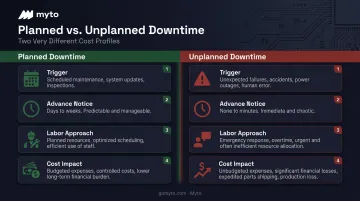
The financial gap is real. ABB's 2023 survey of 3,215 plant-maintenance leaders found unplanned downtime costs the typical industrial business $125,000 per hour. That figure includes idle labor, missed output, and the premium paid for emergency parts sourcing.
Most reliability-focused plants track a metric called Planned Maintenance Percentage (PMP), calculated as planned maintenance hours divided by total maintenance hours. Industry benchmarks put top-tier PMP at 85% or higher. Below that threshold, teams are likely spending more time firefighting than preventing.
How Maintenance Downtime Affects OEE and Production Costs
Overall Equipment Effectiveness (OEE) is calculated as:
OEE = Availability × Performance × Quality
Maintenance downtime strikes directly at the Availability component, calculated as Run Time divided by Planned Production Time. Every hour lost to repairs shrinks that number.
A Simple Example
Picture an 8-hour shift with 2 hours of unplanned downtime:
- Availability drops to 75% (6 run hours ÷ 8 planned hours)
- Assume Performance holds at 95% and Quality at 98%
- OEE lands around 69.8%, well below the widely cited 85% world-class target
That's before accounting for the full cost picture. Beyond the repair bill itself, unplanned downtime drags in:
- Lost production revenue during the stoppage
- Idle labor still on the clock
- Emergency parts at premium pricing
- Scrap, rework, and missed delivery penalties
Two metrics tell the real story here: Mean Time Between Failures (MTBF), which measures how often things break, and Mean Time to Repair (MTTR), which measures how fast you get back online. Rising unplanned downtime almost always means one or both of these is trending in the wrong direction.
Shrinking MTTR means giving technicians the right fix fast, which is exactly where AI-assisted troubleshooting, like Myto's, earns its keep.
Common Causes and Proven Strategies to Reduce Maintenance Downtime
Common Root Causes
Most unplanned downtime traces back to a short list of repeat offenders:
- Aging assets, which Plant Engineering's research ranks as the leading cause of unscheduled stoppages
- Poor spare parts availability, worsened by ongoing supply-chain disruption
- Inexperienced technicians filling gaps left by retiring veterans
- Over-maintenance from rigid, calendar-based PM schedules that service equipment that didn't need it
- Undocumented tribal knowledge that slows troubleshooting the moment the "machine expert" isn't on shift
That last point deserves attention. Myto's internal analysis of manufacturing downtime patterns found that roughly 60% of unplanned downtime ties back to failures the right operator could have caught or diagnosed faster.
When that one technician who "just knows the machine" is out, MTTR climbs sharply. Plants regularly lose 15+ hours of production waiting for that person to arrive.
Highest-Impact Reduction Strategies
Three levers consistently move the needle:
Condition monitoring and predictive maintenance. McKinsey's research shows predictive maintenance typically reduces machine downtime by 30% to 50% and extends machine life by 20% to 40%. It converts unplanned failures into scheduled events.
Optimizing PM schedules with failure data. Instead of servicing on a fixed calendar, use actual failure history to trim unnecessary work orders, cutting over-maintenance without increasing risk.
Capturing frontline expertise before it walks out the door. This is where a lot of plants leave the biggest gains on the table.
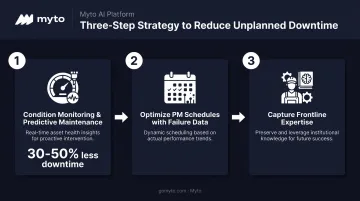
Myto approaches this through wearable AI glasses that record an operator's troubleshooting steps hands-free, no forms, no pausing to write notes. The footage syncs automatically to Myto's platform, where agentic AI structures it into searchable SOPs and diagnostic flows.
The next time a different technician hits the same failure, even at 2 a.m. on a weekend, the system surfaces the equipment history and likely root cause. It also pulls a step-by-step checklist from how the plant's best technician solved it before, so no one reinvents the wheel and MTTR keeps shrinking.
Maintenance Downtime vs. Production Downtime
These two terms get used interchangeably, but they're owned by different teams and driven by different problems.
Maintenance downtime is about asset condition, and it belongs to the maintenance department. Production downtime stems from supply, demand, or process issues, and it sits with operations.
Side-by-side, the distinction is clear:
| Aspect | Maintenance Downtime | Production Downtime |
|---|---|---|
| Owner | Maintenance department | Operations |
| Example | Bearing failure mid-shift, or a scheduled PM window for lubrication | Material stockout, changeover between product runs, or demand-driven line pause |
Here's where it gets strategic: planned maintenance windows can be embedded inside planned production stoppages, like a changeover that's already happening anyway. Servicing a machine during a changeover adds zero net downtime, because the line was stopping regardless. Smart scheduling teams look for these overlaps deliberately rather than treating every stoppage type as a separate calendar event.
Frequently Asked Questions
What is downtime in maintenance?
Downtime in maintenance is any period equipment sits unavailable for production while crews service it, whether through a scheduled inspection or an unexpected failure requiring emergency repair.
How long does a maintenance window typically last?
Maintenance windows vary widely by industry and equipment type. Planned windows for manufacturing equipment range from a few minutes for routine checks to several days for major overhauls, depending on scope.
What is TBM and CBM in TPM?
TBM (Time-Based Maintenance) services equipment on fixed calendar or usage intervals regardless of condition. CBM (Condition-Based Maintenance) triggers work based on real-time asset condition data. Both operate within the Planned Maintenance pillar of Total Productive Maintenance.
What is the difference between planned and unplanned maintenance downtime?
Planned downtime is scheduled in advance with parts and labor prepared. Unplanned downtime results from unexpected failure, and it typically costs far more per hour due to reactive troubleshooting and rush parts sourcing.
How is maintenance downtime calculated?
Calculate it as total unavailable hours due to maintenance within a set period, then express that as a percentage of planned production time: (Maintenance Stop Time ÷ Planned Production Time) × 100.
What causes unplanned maintenance downtime?
Top causes include aging equipment, missing spare parts, inexperienced technicians, and a lack of documented troubleshooting knowledge among frontline teams. That last gap is often the fastest one to close.