Workflow management often gets reduced to flowcharts and software feature lists. But its real value shows up somewhere much less abstract: fewer errors on the floor, faster handoffs between shifts, and less time spent firefighting problems that a documented process would have prevented.
This article breaks down what workflow management actually delivers in day-to-day operations, not just how it's defined on a whiteboard.
Key Takeaways
- Structured workflows cut coordination overhead and free up time for production work
- Standardized processes catch errors before they become costly rework
- Faster context-sharing closes the gap between a problem and its resolution
- Skipping workflow management causes inconsistent output and turnover-driven knowledge loss
- The biggest gains come from continuous review, not a one-time setup
What Is Workflow Management?
Workflow management is the practice of mapping, executing, and optimizing the sequence of tasks, decisions, and handoffs required to complete recurring work. It's the discipline of controlling and monitoring how work actually moves, not just documenting it once and forgetting it.
You'll see it in action across:
- Approval chains in finance and procurement
- Production and quality-check sequences in manufacturing
- Service requests and ticket routing
- Employee onboarding and training paths
- Cross-team handoffs in automotive, aerospace, and other regulated industries
The value lies in the outcome: consistent, fast execution regardless of who's handling the work that day.
Key Advantages of Workflow Management
The advantages below aren't process theory. They tie directly to numbers businesses already track: cost per transaction, cycle time, error rate, and how fast decisions get made. And they get more pronounced as headcount, task volume, and process complexity grow.
Advantage 1: Improved Efficiency and Productivity
Structured workflows eliminate the dead time between steps. When ownership and timing are clear, work doesn't sit in someone's inbox waiting to be noticed.
In practice, this looks like automated handoffs replacing manual status-check emails, and approvals moving forward without someone chasing a signature. That's not a small thing.
In a survey of 9,615 global knowledge workers, Asana found that 58% of time went to "work about work", meaning coordination, status updates, and searching for information, rather than skilled, strategic tasks.
Removing that coordination overhead doesn't just make people feel less busy. It frees hours that convert directly into faster cycle times and a lower cost per completed task.
KPIs impacted:
- Cycle time
- Throughput
- Cost per transaction
- Employee utilization
This advantage matters most in high-volume, repetitive processes with multiple handoffs across departments — order processing, invoice approvals, or any workflow where five people touch the same task before it's done.
Advantage 2: Greater Visibility, Consistency, and Reduced Errors
Workflow management creates a single, traceable record of every step, decision, and owner in a process. Instead of five employees improvising five slightly different methods, everyone follows the same defined path.
That standardization matters because it catches errors early, before they compound downstream. The American Society for Quality reports that quality-related costs can run 15% to 20% of sales revenue, and as high as 40% in some organizations, a mix of scrap, rework, warranty claims, and returns that trace back to inconsistent execution.
Visibility also pays off outside the day-to-day. When every step is documented, audits move faster and compliance reporting stops being a scramble.
KPIs impacted:
- Error rate
- Rework cost
- Audit readiness
- Compliance adherence
This benefit is sharpest in regulated industries, multi-step approvals, or any environment with high staff turnover, where undocumented knowledge becomes a liability the moment someone walks out the door.
Advantage 3: Faster Decision-Making and Reduced Downtime
Well-managed workflows put the right context, meaning data, history, and next steps, in front of the person who needs it, right when they need it. That shortens the gap between "something's wrong" and "problem resolved," especially in production environments where every idle minute has a price tag.
That price tag is significant. Siemens estimates unplanned downtime costs the world's 500 largest companies about $1.4 trillion a year, equal to 11% of revenue. For a large automotive plant, that translates to roughly $2.3 million per idle hour.
How this plays out on the factory floor
This is where the gap between theory and execution shows up most. A machine acts up, and the only person who truly knows the fix is a senior technician who isn't on shift. Everyone else waits.
This is the exact problem Myto's platform was built to close. Instead of tribal knowledge living only in one operator's head, Myto's wearable AI glasses capture troubleshooting steps, expert maneuvers, and verbal commentary hands-free, as the work happens. No forms, no stopping to document.
That captured footage feeds Myto's agentic AI, which structures it into SOPs, troubleshooting flows, and shift-handover notes. The system then surfaces that knowledge to the next operator who hits the same issue.
The platform's Operational Data Integration layer also pulls in machine logs, maintenance tickets, and MES, SCADA, and CMMS records. When a problem occurs, the system can pull up the likely root cause and repair history instantly, instead of leaving someone to guess.

KPIs impacted:
- Downtime
- Mean time to resolution
- Decision lag
- Production throughput
This advantage matters most in high-stakes environments where delays carry direct financial or safety consequences, which is most manufacturing floors.
What Happens When Workflow Management Is Missing or Ignored
Skip structured workflows, and the gaps show up fast:
- Inconsistent results — each employee follows their own informal process, so output quality swings depending on who's working
- Higher error rates and rework: undocumented steps and tribal knowledge that never gets captured lead to the same mistakes repeating
- Reactive firefighting — teams solve the same problem repeatedly instead of preventing it once
- Rising costs over time: small inefficiencies compound until they show up as a real line item
- Scaling and onboarding friction — without documented processes, delegating work or training new hires takes far longer than it should
None of this is dramatic on any single day. It's the accumulation that hurts.
How to Get the Most Value from Workflow Management
Workflow management pays off most when it's applied consistently across a process, not patched into one department while the rest keeps improvising.
Review with real data, not assumptions. Track cycle time, error rate, and cost per transaction on a regular cadence. These numbers show exactly where a workflow breaks down, rather than where someone assumes it does.
Act on what you capture. The biggest gains come from actually using the insights gathered, not just collecting them. This is where AI-driven platforms change the equation.
Myto's four-phase approach, Learn, Capture, Structure, Execute, is built around this exact idea. Tribal knowledge often stays locked in a senior operator's head until they retire.
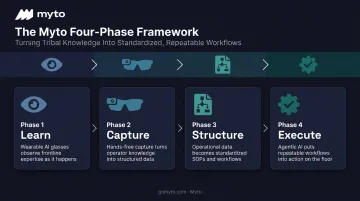
That gap can cost a plant an estimated 800 hours of unplanned downtime a year, according to Myto's internal data. The platform closes it by automatically turning captured expertise into standardized, repeatable workflows that anyone on the floor can follow.
That's the difference between a workflow that exists on paper and one that actually gets used.
Conclusion
The real value of workflow management lies beyond the diagram: it delivers the control and consistency needed to get work done reliably, day after day.
Efficiency gains, better visibility, fewer errors, faster decisions: these advantages don't max out once and stay flat. They compound as workflows get reviewed and refined over time.
That's why workflow management works best as an ongoing practice, not a one-time project. Knowledge capture and AI-driven automation now help teams sustain those gains, instead of losing them every time someone leaves. Platforms like Myto turn that frontline knowledge into action, so teams keep improving instead of starting over.
Frequently Asked Questions
What are the advantages of a workflow management system?
The core advantages are efficiency, visibility, error reduction, and accountability. Structured systems remove coordination overhead, standardize how work gets done, and create a clear record of who owns each step.
What is the primary goal of workflow management?
The goal is to organize and standardize task sequences so work moves predictably from start to finish, then optimize them as conditions change. Workflow management means keeping ongoing control over the process, well beyond a single round of documentation.
What is the difference between workflow management and workflow automation?
Workflow management is the broader discipline of designing, controlling, and monitoring processes. Automation is one tool used within it, applied to execute repetitive steps without manual effort.
What are the benefits of automating workflows specifically?
Automation cuts manual errors and speeds up turnaround on repetitive tasks, freeing employee time for higher-value work. It's most effective on steps that don't require human judgment.
How do businesses measure the success of workflow management?
Common metrics include cycle time, error rate, throughput, and cost per transaction. Tracking these over time shows exactly where a workflow is improving or breaking down.
What industries benefit most from workflow management?
Manufacturing, healthcare, and financial services see the biggest gains, since they run high volumes of repeatable, regulated tasks where consistency and speed directly affect cost and safety.