This guide is for production managers, quality engineers, and operations leaders who own the outcome when an SOP fails: a defect that slips through, a safety incident during a shift change, an audit finding that names a procedure nobody actually follows. Getting SOP production right affects quality, safety, compliance, and how fast new hires get up to speed.
Most teams treat "writing an SOP" as a documentation chore handed to whoever has time. In reality, it's an operational process with defined inputs, steps, and controls — and most plants handle it poorly.
This article breaks down what SOP production actually is, how it works step-by-step, where it applies, what factors determine whether it succeeds, and when it isn't the right tool at all.
TL;DR
- SOP production converts real operational knowledge into a controlled, standardized document, not a best-practice guess
- Manufacturers use it to eliminate variation across operators, shifts, and sites
- Core workflow: define scope, capture SME input, draft steps, validate on-floor, train, then review
- Poor SOPs usually fail from vague instructions, missing tolerances, or outdated versions
- Not every task needs a full SOP; a checklist often works better without slowing operators down
What Is the SOP Production Process?
SOP production is the end-to-end process of identifying a critical task, capturing the correct method for performing it, and formalizing that method into a controlled, reviewed document. It has inputs (operator knowledge, specs, equipment manuals) and an output: an approved procedure. It's not a one-off writing exercise.
The goal is one approved "correct way" to perform a task that produces the same result no matter who executes it. First shift or third. Veteran or new hire.
SOP Production vs. Work Instructions vs. Process Maps
These three get confused constantly, and mixing them up is one of the fastest ways to end up with a document nobody uses.
- Work instruction: A single, granular action, like "torque bolt to 45 Nm." One step, no context.
- Process map: Shows workflow across multiple operations, such as how a part moves from station to station. No execution detail.
- SOP: The complete procedure for a task, with enough sequence and detail to execute it correctly, start to finish.
What separates an SOP from an informal training note or a supervisor's verbal explanation is control. An SOP requires formal review and approval before it goes live, and before any later change goes live too. Tribal knowledge, no matter how accurate, isn't an SOP until it's been through that review.
What Every SOP Production Process Must Output
Regardless of format, the process needs to produce these components:
- Purpose and scope: what task, and what it doesn't cover
- Responsibilities: who executes, who verifies, who approves
- Materials and equipment: parts, tools, machine setup
- Step-by-step procedure: the sequence, with tolerances
- Safety guidance: PPE, lockout/tagout, hazard notes
- Documentation and verification requirements: what gets recorded and checked
Why and Where SOPs Are Used in Manufacturing
Manufacturing runs on repeatability. When a task isn't standardized, variation creeps in — different operators do it differently, and that variation shows up downstream as defects, rework, safety incidents, and audit findings.
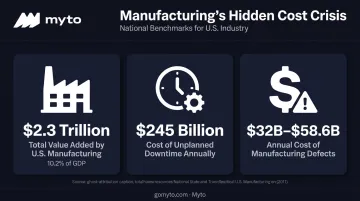
The scale here is enormous. U.S. manufacturing generated $2.3 trillion in value added in 2023, or 10.2% of GDP, according to NIST's Annual Report on the U.S. Manufacturing Economy.
The same report estimates unplanned downtime costs U.S. discrete manufacturers roughly $245 billion annually, with defect costs adding another $32 billion to $58.6 billion. Standardization isn't the only fix, but at this scale, unmanaged variation gets expensive fast.
Beyond the cost impact, SOP production carries legal weight in regulated environments. Auditors and inspectors expect documented proof that processes run as planned:
- ISO 9001:2015 (Clause 4.4) requires documented information showing processes occurred as planned
- FDA drug manufacturing (21 CFR 211.100) requires written production and process-control procedures, reviewed and approved by the quality unit
- Automotive (IATF 16949) requires documented processes for supplier evaluation, problem-solving, and training competence
Where SOP Production Fits in the Operational Lifecycle
SOP production typically happens at specific trigger points, not on a fixed writing schedule:
- New equipment commissioning
- Process changes (materials, tolerances, methods)
- Recurring high-risk tasks tied to safety or quality
- Corrective actions following a quality issue
- Shift or site standardization efforts
How the SOP Production Process Works (Conceptual Flow)
At a high level, SOP production takes a task's real-world execution as input, structures it through subject-matter-expert input and drafting, validates it against actual floor conditions, and outputs a controlled, trainable standard.
What goes into the process:
- Operator know-how, including the workarounds nobody wrote down
- Equipment manuals and machine specs
- Quality specs and tolerances
- Past incident and deviation data
The core transformation is turning inconsistent, undocumented methods into one explicit, testable sequence of steps with defined tolerances and checkpoints. That doesn't happen in a vacuum : the process stays controlled through cross-functional review across quality, safety, and production, plus formal sign-off before rollout.
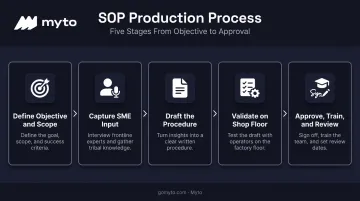
Here's how that plays out in five steps.
Step 1: Define Objective and Scope
Before anyone writes a word, clarify which specific task is covered, who it affects, and what business goal it supports (quality, safety, throughput, or compliance). Skip this and you end up with an SOP trying to cover three tasks at once, or one too narrow to be useful.
Step 2: Capture Input from the People Who Do the Work
This is where real execution knowledge comes from: operators, engineers, quality leads. It's also traditionally the hardest step, because the best operators rarely write down what they do. They just do it, and the reasoning behind a specific hand movement or machine adjustment stays in their head.
Pulling that knowledge out usually means interviews, which means pulling an experienced operator off the line — something plants are understandably reluctant to do. This is the gap tools like Myto's wearable AI glasses are built for.
The glasses passively capture video and audio as a top performer runs a task. That footage feeds into Myto's Operational Data Integration layer alongside existing SOPs, machine logs, and maintenance tickets. The result: a more accurate starting draft, captured without an interview and without touching production time.
Step 3: Draft the Procedure
Convert what you captured into a sequential, actionable format: checklist, flowchart, or narrative, depending on the task. Use measurable instructions, not vague verbs. "Tighten securely" isn't a standard. "Torque to 45 Nm ± 2" is.
Step 4: Validate on the Shop Floor
Test the draft with an actual operator, ideally someone new to the task, at normal line speed. If they hesitate, get confused, or need to ask questions the SOP should have answered, the draft isn't finished yet.
Step 5: Approve, Train, and Review
Secure sign-off from quality, safety, and production. Roll out through hands-on training, not a document drop in a shared folder. Then schedule recurring reviews on a fixed cadence, and immediately after any process or equipment change.
Key Factors That Affect SOP Production in Manufacturing
A handful of variables determine whether an SOP actually holds up on the floor, or just becomes another skipped document:
- Inputs and materials — part specs, revision levels, and approved substitutions need to be captured accurately. An SOP that references the wrong revision is worse than no SOP at all.
- Operating conditions — line speed and shift patterns shape how effective a written procedure is in practice, and environmental factors like heat or humidity can throw it off further. A procedure written for day shift doesn't always survive third shift.
- Equipment and system dependencies — whether the SOP ties to a specific machine setup or calibration status, and whether it feeds into MES integration. Change the machine, and the SOP needs a look too.
- Scale and frequency — high-repetition, high-risk tasks justify rigorous SOP production. A task performed twice a year doesn't need the same investment.
- Safety and regulatory constraints — lockout/tagout, PPE requirements, and audit expectations specific to your industry.
Lockout/tagout shows how specific these constraints get. OSHA's standard, 29 CFR 1910.147, requires energy-control procedures to be inspected at least annually, with a signed certification identifying the equipment, the inspection date, and the inspector. This is a recurring, documented obligation built into the procedure itself.
Common Issues and When SOP Production Isn't the Right Approach
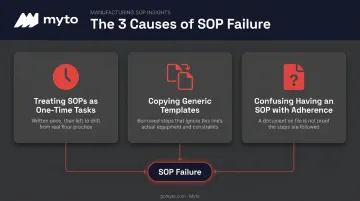
Most SOP failures trace back to a handful of predictable mistakes.
Treating it as a one-time task. Writing an SOP isn't "done" at publication. It's an ongoing process that needs validation and updates as conditions change.
Copying generic templates. Teams grab a template, fill in the blanks, and skip testing against real floor conditions. The result reads fine but is full of vague verbs and missing tolerances — an SOP that doesn't guide anyone.
Confusing having an SOP with SOP adherence. A document sitting on a shared drive doesn't mean operators follow it. FDA's warning letter to Top Health Manufacturing makes the point: the company had a written SOP for supplier approval, but its own quality-control unit wasn't following it. The document existed on paper, but operators weren't following it in practice.
That gap, between the SOP on file and what actually happens on the floor, is where undocumented workarounds and lost institutional knowledge tend to persist for years. It often surfaces only when a key employee retires or leaves, taking the real method with them. Platforms built to capture frontline activity, like Myto, help close this gap by feeding real floor practice back into the SOP itself, not just periodic manual reviews.
Not every task needs a full SOP, though. It makes sense for high-risk, high-repetition, or regulated tasks. It's overkill for:
- Low-risk tasks performed rarely
- Situations better served by a simple checklist
- Cases where verbal guidance from a supervisor is genuinely sufficient
If procedures are getting written "by default" for every task regardless of risk, that's a signal the process is over-documenting rather than documenting by need.
Frequently Asked Questions
What is SOP in production?
SOP production is the process of converting how a task is actually performed into a documented, standardized, and approved procedure. Manufacturers apply it consistently across the entire operation, regardless of shift or operator.
What are the 5 key parts of a manufacturing SOP?
The core components are title, purpose, scope, procedure, and responsibilities. Many manufacturers add materials/equipment and safety guidance depending on the task's complexity, and platforms like Myto can auto-populate these fields directly from captured operator workflows.
How detailed should a manufacturing SOP be?
Detailed enough to prevent variation at critical steps, but not so detailed it slows down an experienced operator at normal line speed. If a trained operator has to stop and re-read a step, it's too vague or too cluttered.
How often should manufacturing SOPs be reviewed and updated?
Most manufacturers set a fixed annual review cadence, then update immediately after process, equipment, or safety-related changes. Some regulated procedures, like lockout/tagout, carry a mandatory annual review under OSHA.
Who should be involved in creating an SOP for manufacturing?
Operators, process engineers, and quality or compliance leads should all contribute, with supervisors weighing in on floor realities. A designated process owner approves and maintains the final document.
What's the difference between an SOP and a work instruction?
An SOP covers a complete procedure end-to-end, including scope, responsibilities, and safety requirements. A work instruction details one granular step within that broader SOP, like a single torque spec or setting.