Agentic AI represents a different approach. Instead of waiting for a condition to be met, these systems receive a goal, plan the steps needed to reach it, and act across tools and systems — largely without human approval at each stage.
This guide covers what agentic AI actually is, how it differs from traditional automation, how it works mechanically, and where it's already delivering results in manufacturing and knowledge-intensive workflows.
Key Takeaways
- Agentic AI perceives context, plans multi-step actions, and executes tasks autonomously without waiting for human triggers
- Unlike RPA, it adapts when conditions change and handles exceptions without halting
- Its value compounds as agents learn from real workflows and refine decision-making over time
- Deployment requires data quality, governance, and change management — not just technology selection
- Manufacturing, IT, and HR teams are already using it to cut response times and reduce manual workload
What Is Agentic AI?
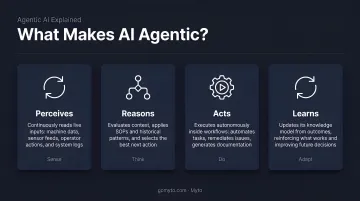
Agentic AI refers to AI systems that operate with meaningful autonomy: they perceive their environment, receive or set goals, plan sequences of actions, and execute those actions across tools and systems — with minimal human intervention at each step.
This is distinct from generative AI like chatbots. A chatbot generates content in response to a prompt. Agentic AI acts on the world — completing tasks, advancing processes, and driving outcomes. One responds; the other executes.
A 2025 NBER paper from researchers at MIT, Harvard, and Boston University defines AI agents as "autonomous systems that perceive, reason, and act on behalf of human principals." These systems work for people, within boundaries people define, but they determine how to get there.
The Core Characteristics That Make AI "Agentic"
Four properties distinguish genuinely agentic systems from smarter automation:
- Autonomy — the system executes tasks and makes decisions without requiring approval at every step, unlike rule-based automation that waits for a specific condition
- Goal-directed behavior — rather than following a fixed sequence, the agent receives an objective ("resolve this issue") and determines the required steps itself
- Reasoning and planning — the system can break a complex problem into sub-goals, sequence its actions, and adjust the plan when earlier steps produce unexpected results
- Contextual memory — agents maintain state across a workflow run and improve over time by incorporating feedback, making them more reliable the more they're deployed
In manufacturing, Myto applies this model directly to factory operations. Agents are trained on each plant's own SOPs, machine history, ticket logs, and captured operator knowledge. They can open tickets, draft shift-handover notes, schedule maintenance follow-ups, and surface troubleshooting context — without the operator leaving the floor or switching applications.
Agentic AI vs. Traditional Automation: What's the Real Difference?
Enterprise automation has evolved in roughly three phases:
- RPA — rule-based task execution; reliable for repetitive, structured processes
- Siloed AI — department-specific pattern recognition (fraud detection, demand forecasting)
- Agentic AI — goal-driven, cross-system orchestration that handles multi-step workflows end-to-end
Each phase emerged because the prior one hit a ceiling. RPA's limits are well-documented: it executes predefined sequences reliably, but halts when a process hits an exception or requires a judgment call. It also breaks down when tasks span systems it wasn't explicitly programmed to handle. Deloitte's 2022 intelligent automation survey found process fragmentation was the top barrier to scaling automation — the exact gap RPA alone can't bridge.
Agentic AI vs. RPA: A Direct Comparison
| Dimension | RPA | Agentic AI |
|---|---|---|
| How it works | Executes predefined, scripted sequences | Plans and adapts actions to reach a goal |
| Inputs it handles | Structured, predictable data | Structured and unstructured; adapts to variation |
| Exception handling | Stops or fails; requires human intervention | Evaluates situation; resolves or escalates with context |
| Best suited for | High-volume, stable, repetitive tasks | Multi-step workflows with variation and decision points |
| Mental model | "What do I do when X happens?" | "What should happen next to complete this correctly?" |
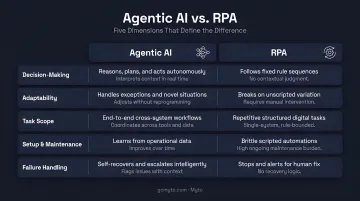
Agentic AI doesn't replace RPA — it can orchestrate it. An agent can direct RPA bots to handle specific tasks within a larger, agent-managed workflow. Existing automation investments don't get discarded. They become components inside a smarter system.
How Agentic AI Works: The Core Mechanics
Agentic AI operates through a continuous loop: perceive → reason → plan → execute → review. This loop runs without human intervention until the task is complete or a genuine exception requires escalation.
Data Ingestion and Perception
The agent collects inputs from its environment (documents, messages, system records, sensor data, metadata, real-time signals) and uses natural language understanding and entity recognition to extract relevant meaning.
Myto's platform ingests operational data factories already produce:
- SOPs, machine logs, and maintenance tickets
- Machine history and quality data
- MES/SCADA/CMMS/EAM records and ERP work orders
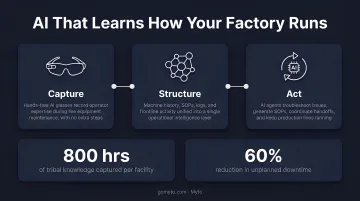
The platform also captures physical-world knowledge through AI glasses worn by frontline operators, recording footage and audio in the natural flow of work with no extra steps required. That unstructured expertise flows into the same knowledge layer as the structured system data.
Context and Memory Reasoning
Before acting, the agent evaluates what has already happened, what state the process is in, and which data points matter most for the next step. Short-term memory covers the current run; long-term memory retains patterns from prior decisions.
Myto's system builds this knowledge layer by reading operational data "through a manufacturing lens" — connecting logs to machines, tickets to SOPs, and shift-handoff notes to troubleshooting flows. Each new data point strengthens the system's ability to resolve the next issue faster.
Autonomous Task Planning and Execution
Unlike fixed-rule automation, the agent maps the most appropriate sequence of actions to reach the intended outcome — deciding which tools to call, whether steps should run in parallel, and how to adapt based on what it actually encounters.
When something unexpected occurs during execution, the agent evaluates the situation and either resolves it using available information and business rules, or escalates to a human with full context about what happened and what's needed — rather than simply stopping.
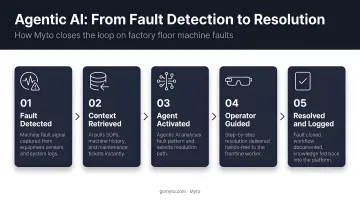
Take a machine fault on the factory floor. Myto's agents immediately pull equipment history (bearing replacement dates, prior failure modes), load the relevant SOP, surface likely root causes, and walk the operator through a diagnostic checklist.
At the same time, agents open a maintenance ticket, document the troubleshooting path, and queue a shift-handover note — all without the operator leaving the floor or routing anything manually.
Key Benefits of Agentic AI for Workplace Automation
Gartner projects that by 2028, at least 15% of day-to-day work decisions will be made autonomously through agentic AI — up from essentially 0% in 2024 — and that 33% of enterprise software applications will include agentic AI capabilities.
That same report notes more than 40% of agentic AI projects will be canceled by end-2027 due to unclear value or inadequate risk controls. That figure underscores why governance matters as much as technology selection.
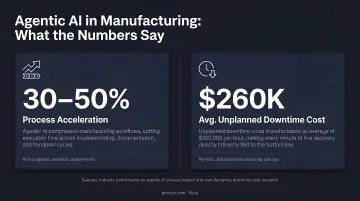
For organizations that deploy it well, BCG research points to agentic AI accelerating business processes by 30–50% and reducing low-value employee work time by 25–40%.
These gains show up across several areas:
- Reduced coordination overhead — agents handle the routing, documentation, and follow-up that currently requires human handoffs
- Fewer exception delays — instead of stopping for human input, agents evaluate and resolve most exceptions in-flow
- Consistency — information is interpreted and acted on the same way every time, across shifts and teams
- Scalability — unlike RPA, agentic systems handle volume increases and new conditions without proportional re-engineering effort
In manufacturing, the stakes are clear. The world's 500 largest companies lose nearly $1.4 trillion annually to unplanned downtime — roughly 11% of revenues. That's the problem agentic AI is directly positioned to reduce.
Agentic AI in the Workplace: Key Use Cases
Knowledge Work, IT, and HR Workflows
In knowledge-intensive processes, agentic AI's value is handling multi-step tasks that previously required human judgment at every handoff.
Examples already in production:
- IT service desk — agents triage incoming tickets, pull relevant history, suggest resolution steps, and document outcomes; Salesforce's Agentforce resolves IT and HR questions 24/7 for 76,000 employees through Slack
- Contract review — agents detect risks, flag deviations, and recommend changes without requiring a human to read the entire document first
- HR administration — agents handle benefits inquiries, onboarding tasks, and common requests conversationally, freeing HR teams for higher-complexity work
Manufacturing and Physical Operations
The physical world presents a harder problem. Capturing the unstructured, hands-on knowledge that frontline operators carry requires specific infrastructure — not just software, but a way to record what happens on the floor as it happens.
Platforms like Microsoft's Factory Operations Agent, Siemens' Industrial Copilot for maintenance, and Cognite's Atlas AI are applying industrial AI agent architecture to production environments. Each connects real-time operational data to agents that can guide troubleshooting, automate documentation, and coordinate handoffs.
Myto approaches this by combining wearable AI glasses with agentic automation. Operators capture expertise hands-free as they work; that knowledge feeds directly into agents that can remediate issues, generate SOPs, and handle shift handovers autonomously.
This directly addresses manufacturing's tribal knowledge problem. The Manufacturing Institute and Deloitte project that manufacturers may need 3.8 million additional employees by 2033, with up to 1.9 million positions going unfilled. When experienced operators leave, the knowledge they carry needs to already be in the system.
What to Consider Before Implementing Agentic AI
Three factors determine whether a deployment succeeds or becomes one of Gartner's canceled projects.
Data quality and structure
Agentic systems are only as reliable as the information they work with. Unstructured or siloed data — common in manufacturing, healthcare, and operations — requires teams to capture and structure it before or during deployment. Without clean, accessible data, agents can't reason correctly — and autonomous decisions made on bad inputs compound errors faster than any human would.
Governance, oversight, and accountability
Because agents make decisions autonomously, organizations need:
- Clear definitions of what agents are authorized to do
- Audit trails of every action taken
- Escalation pathways for edge cases
- Defined human oversight checkpoints
Without these, compliance and trust degrade quickly. NIST's AI Risk Management Framework provides a baseline governance structure (Govern, Map, Measure, Manage) applicable to most agentic deployments.
Change management and workflow redesign
Current processes assume human intervention at multiple stages. Agentic AI requires mapping which tasks are suitable for autonomous execution — then restructuring workflows to match.
Organizations that treat it as a drop-in replacement will consistently underutilize it. A maintenance workflow redesigned around an agentic system, for example, can route alerts, pull machine history, and draft a work order before a technician ever touches the problem.
Frequently Asked Questions
What is agentic AI in simple terms?
Agentic AI is AI that can receive a goal, figure out the steps needed to reach it, and take action across systems — without a human approving each move. Unlike traditional automation that only acts when a specific rule fires, agentic AI reasons through the situation and decides what to do next.
How is agentic AI different from robotic process automation (RPA)?
RPA follows fixed, predefined scripts and fails when processes vary or require decisions. Agentic AI reasons through changing conditions, handles exceptions in-flow, and completes entire workflows end-to-end. The two can work together, with agents directing RPA bots for rule-based subtasks inside a larger workflow.
What are the risks of using agentic AI in the workplace?
The main risks are unreliable decisions from poor training data, security exposure from broad system access, and accountability gaps when autonomous decisions cause harm. Governance frameworks, audit logging, and clear escalation pathways are essential before deploying at scale.
Can agentic AI be used in manufacturing environments?
Yes — agents can monitor production data, guide troubleshooting, automate documentation, and coordinate shift handoffs. The core challenge is capturing the unstructured, physical-world expertise that frontline operators carry. Platforms designed specifically for manufacturing, like Myto, address this by combining wearable capture technology with agentic automation.
How long does it take to see results from agentic AI deployment?
Well-targeted deployments in high-volume, well-defined processes typically show measurable efficiency gains within weeks to a few months. Broader ROI compounds as agents learn from real workflows — organizations with clean data and clear governance frameworks consistently see results faster.
Will agentic AI replace human workers?
Agentic AI handles repetitive coordination, documentation, and exception-resolution tasks, freeing workers for judgment-intensive work. Human oversight remains essential, particularly for high-stakes decisions. The most effective implementations define human-in-the-loop checkpoints from the start, rather than treating oversight as an afterthought.